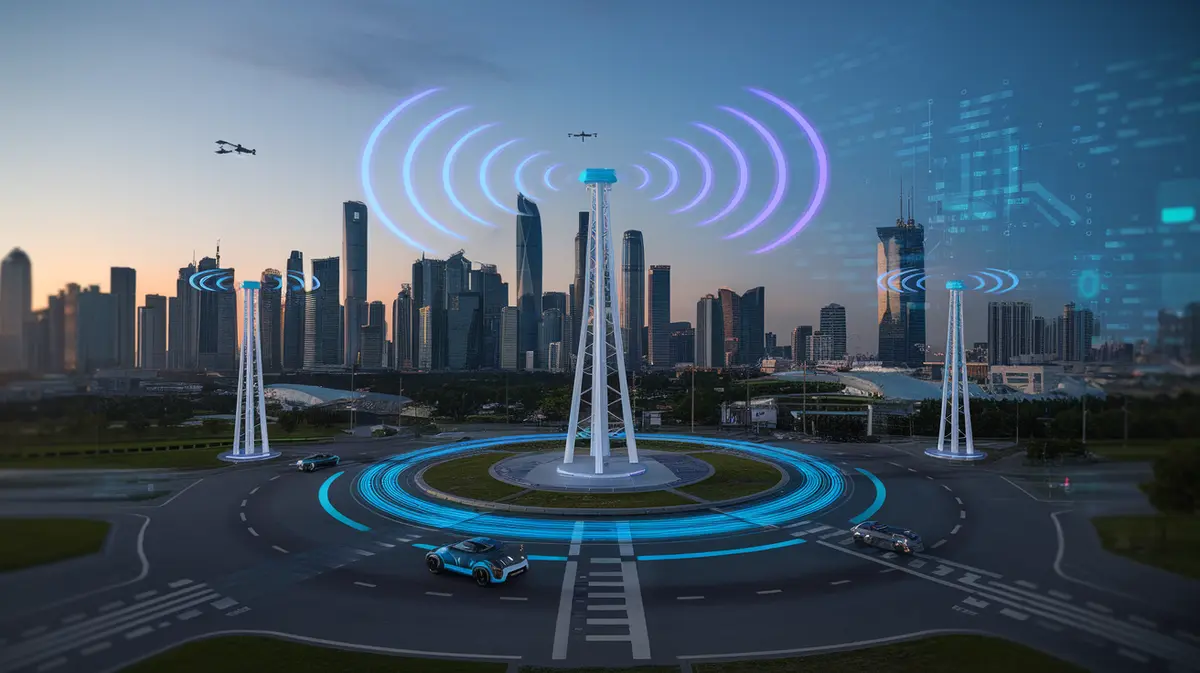
5G and 6G Networks: How Next-Generation Connectivity Is Powering the Intelligent World in 2026
- Internet Pros Team
- February 23, 2026
- Networking & Security
The world runs on wireless connectivity. From the smartphones in our pockets to the autonomous vehicles navigating city streets, from factory robots coordinating in real time to surgeons operating remotely across continents — every breakthrough in modern technology depends on networks that are faster, more reliable, and more intelligent than the generation before. In 2026, 5G has matured from a buzzword into the backbone of industrial transformation, connecting over 6 billion devices worldwide and enabling applications that were impossible just three years ago. Meanwhile, the research race toward 6G has accelerated dramatically, promising speeds one hundred times faster than 5G, sub-millisecond latency, and the fusion of communication with sensing, AI, and computing. The next generation of connectivity is not just about faster downloads — it is about building the infrastructure for an intelligent, always-connected world.
The State of 5G in 2026
When 5G first launched commercially in 2019, critics dismissed it as little more than a marketing upgrade. Seven years later, the technology has matured into three distinct service categories that are reshaping every major industry. Enhanced Mobile Broadband (eMBB) delivers peak speeds exceeding 10 Gbps for consumer and enterprise applications. Ultra-Reliable Low-Latency Communication (URLLC) provides sub-5-millisecond response times for mission-critical systems like autonomous vehicles and remote surgery. And Massive Machine-Type Communication (mMTC) supports up to one million connected devices per square kilometer, enabling the dense IoT networks that power smart cities and industrial automation.
By early 2026, 5G covers approximately 85 percent of the world's urban population, with standalone (SA) deployments — networks that operate independently of 4G infrastructure — becoming the norm rather than the exception. The shift to standalone 5G has unlocked the full potential of network slicing, allowing operators to create dedicated virtual networks tailored for specific industries and use cases.
| 5G Service Category | Peak Capability | Key Use Cases | 2026 Status |
|---|---|---|---|
| eMBB | 10+ Gbps download speeds | 8K streaming, cloud gaming, AR/VR | Widely deployed globally |
| URLLC | <5ms latency, 99.999% reliability | Remote surgery, autonomous vehicles, industrial control | Enterprise and industrial rollouts expanding |
| mMTC | 1 million devices per km² | Smart cities, agriculture sensors, logistics tracking | Large-scale IoT deployments active |
The Technologies Driving 5G Forward
Several key technologies have converged to make 5G the most transformative wireless generation in history. Understanding these building blocks reveals why 5G is fundamentally different from everything that came before.
Millimeter Wave (mmWave)
Operating between 24 and 100 GHz, mmWave frequencies deliver extraordinary bandwidth but over shorter distances. In 2026, mmWave is deployed in dense urban environments, stadiums, airports, and enterprise campuses where capacity demands are highest. Advanced beamforming techniques use antenna arrays with 64 or more elements to focus signals directly at devices, overcoming the propagation challenges that initially limited mmWave adoption.
Network Slicing
Network slicing allows a single physical 5G infrastructure to be partitioned into multiple virtual networks, each optimized for a specific application. A hospital can have a dedicated slice with guaranteed ultra-low latency for remote surgery, while a logistics company runs a separate slice optimized for massive IoT device connectivity — all on the same physical towers and spectrum. This capability is driving the private 5G revolution across manufacturing, healthcare, and logistics.
Open RAN
Open Radio Access Network (Open RAN) architecture disaggregates traditional proprietary base station hardware into modular, interoperable software and hardware components. This allows operators to mix equipment from different vendors, reduces costs by up to 40 percent, and accelerates innovation. By 2026, Open RAN deployments have expanded significantly, with major operators like Vodafone, Deutsche Telekom, and Rakuten running production networks on open, multi-vendor architectures.
5G Is Transforming Every Industry
Industries Being Reshaped by 5G in 2026
- Manufacturing: Private 5G networks connect thousands of robots, sensors, and automated guided vehicles on factory floors with sub-millisecond coordination, enabling lights-out manufacturing and real-time quality control
- Healthcare: Surgeons perform remote procedures with haptic feedback over URLLC connections, while 5G-connected ambulances stream patient vitals to emergency rooms before arrival
- Autonomous Vehicles: Vehicle-to-everything (V2X) communication over 5G enables cars, trucks, and drones to share position and intent data with infrastructure and each other in real time
- Agriculture: Dense IoT sensor networks monitor soil conditions, weather, crop health, and livestock across thousands of acres with continuous, low-power connectivity
- Entertainment: Multi-angle 8K live streaming, immersive AR overlays at sporting events, and cloud-based gaming without perceptible lag are now mainstream consumer experiences
- Energy: Smart grid management with 5G-connected sensors enables real-time load balancing, predictive maintenance on transmission infrastructure, and integration of distributed renewable energy sources
The Road to 6G: What Comes Next
While 5G continues to mature, the wireless industry is already deep into research on 6G — the sixth generation of mobile networks expected to begin commercial deployment around 2030. If 5G connected machines, 6G will connect intelligence. The vision for 6G extends far beyond faster speeds; it aims to merge communication, sensing, computing, and artificial intelligence into a single unified network fabric.
"6G will not just be a faster pipe. It will be an intelligent network that perceives the physical world, reasons about it, and acts on it in real time — blurring the boundary between the digital and physical forever."
Key 6G Technologies Under Development
- Terahertz (THz) Communication: Operating above 100 GHz and into the terahertz range, 6G will access vast swaths of unused spectrum capable of delivering speeds exceeding 1 Tbps — fast enough to transmit a holographic video stream in real time
- Integrated Sensing and Communication (ISAC): 6G base stations will simultaneously communicate and sense the environment, functioning as distributed radar systems that can map physical spaces, detect objects, and track movement without dedicated sensors
- AI-Native Networks: Unlike 5G, where AI is bolted on for optimization, 6G is being designed from the ground up with machine learning embedded in every layer — from spectrum management and beamforming to resource allocation and anomaly detection
- Reconfigurable Intelligent Surfaces (RIS): Smart surfaces embedded in buildings, vehicles, and infrastructure will dynamically reflect, refract, and focus wireless signals, effectively turning the entire physical environment into a programmable antenna
- Non-Terrestrial Networks (NTN): Low-earth orbit satellite constellations and high-altitude platform stations will integrate seamlessly with ground-based 6G infrastructure, delivering true global coverage including oceans, deserts, and polar regions
| Specification | 5G (Current) | 6G (Projected) |
|---|---|---|
| Peak Data Rate | 10-20 Gbps | 1+ Tbps |
| Latency | 1-5 ms | <0.1 ms |
| Device Density | 1 million/km² | 10+ million/km² |
| Frequency Bands | Sub-6 GHz, mmWave (24-100 GHz) | Sub-THz, THz (100 GHz - 3 THz) |
| AI Integration | AI-assisted optimization | AI-native throughout all layers |
| Coverage | Terrestrial primarily | Terrestrial + satellite + aerial |
What This Means for Businesses
How Organizations Should Prepare for the Connectivity Revolution
- Evaluate private 5G: Organizations with large campuses, factories, warehouses, or healthcare facilities should assess whether a dedicated private 5G network can replace Wi-Fi for mission-critical and IoT applications with better reliability and security
- Architect for network slicing: Design applications and services that can take advantage of guaranteed quality-of-service parameters through dedicated 5G network slices tailored to your workload
- Invest in edge computing: 5G and edge computing are synergistic — processing data closer to the network edge reduces latency and bandwidth costs while enabling real-time AI inference at the point of action
- Plan for IoT scale: With mMTC supporting millions of devices per square kilometer, now is the time to design sensor architectures, data pipelines, and analytics platforms that can handle massive device fleets
- Monitor 6G developments: Stay informed about 6G standardization progress through 3GPP and regional research initiatives — early awareness of 6G capabilities will inform long-term infrastructure and product roadmaps
The Connected Future Is Already Here
The evolution from 5G to 6G is not merely an incremental upgrade in wireless speeds — it represents a fundamental shift in how networks interact with the physical world. 5G has already proven that wireless connectivity can be reliable enough for autonomous vehicles, precise enough for remote surgery, and dense enough for city-scale IoT deployments. 6G will take this further by embedding intelligence, sensing, and computing directly into the network itself, creating an ambient layer of connectivity that is as invisible and essential as electricity.
For businesses, the message is clear: connectivity is no longer just a utility — it is a competitive advantage. Organizations that invest in next-generation network capabilities today will be positioned to lead in automation, real-time decision-making, and customer experience for the decade ahead.
At Internet Pros, we help businesses design, deploy, and optimize network infrastructure for the 5G era and beyond — from private network assessments and IoT architecture to edge computing integration and future-proofing for 6G. Contact us to discuss how next-generation connectivity can transform your operations.