The AI Energy Crisis: How Artificial Intelligence Is Reshaping Global Power Infrastructure in 2026
- Internet Pros Team
- March 9, 2026
- AI & Technology
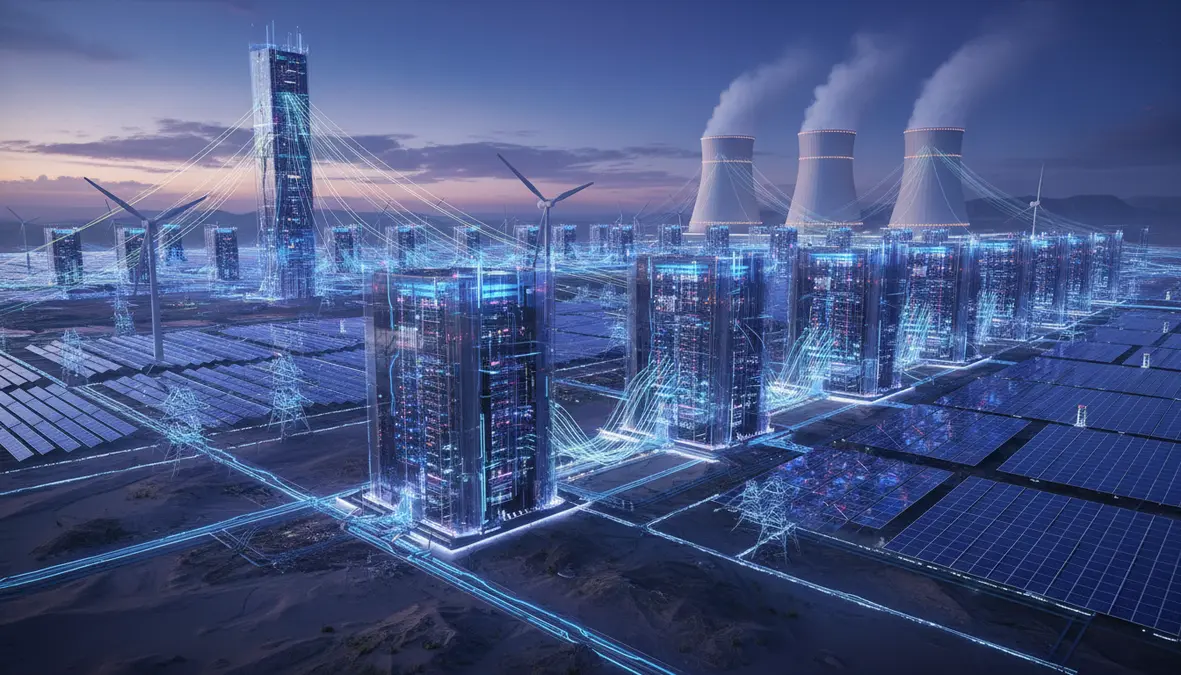
In January 2026, a utility company in Virginia — the state that hosts the densest concentration of data centers on Earth — made an extraordinary announcement: it could no longer guarantee grid capacity for new data center connections before 2030. The waiting list had grown to 37 gigawatts of requested power, roughly equivalent to the entire electricity consumption of the Netherlands. That same month, the International Energy Agency published its annual report confirming what the industry had been whispering for two years — global data center electricity consumption had doubled since 2022, reaching over 1,000 terawatt-hours annually, with AI workloads accounting for more than 40 percent of the increase. The artificial intelligence revolution is not just a software story. It is becoming the largest energy story of the decade.
The Scale of AI's Energy Appetite
To understand the AI energy crisis, you need to understand what happens inside a modern AI data center. Training a frontier AI model like GPT-5 or Claude Opus 4.6 requires thousands of high-end GPUs running continuously for months. NVIDIA's H200 GPU consumes 700 watts under load. A single training cluster of 25,000 H200s — a configuration now standard for frontier model development — draws approximately 17.5 megawatts just from the GPUs alone, before accounting for cooling, networking, storage, and facility overhead. The total facility power for such a cluster exceeds 40 megawatts, enough to power 30,000 homes.
But training is only part of the equation. Inference — the process of running trained models to answer queries, generate content, and power AI applications — is now consuming far more aggregate energy than training. Every ChatGPT query uses approximately 10 times more electricity than a traditional Google search. With billions of AI queries processed daily across OpenAI, Google, Anthropic, Meta, and dozens of other providers, inference energy demand is growing exponentially.
"We are looking at a world where AI could consume 3 to 4 percent of global electricity generation by 2030. That is not a projection — it is the trajectory we are on today. The question is not whether this will strain energy systems, but how we build fast enough to prevent AI growth from being energy-constrained."
| Metric | 2022 | 2024 | 2026 (Est.) | 2028 (Proj.) |
|---|---|---|---|---|
| Global Data Center Electricity (TWh) | 460 | 720 | 1,050 | 1,580 |
| AI Share of Data Center Power | 10% | 25% | 42% | 58% |
| US Data Center % of National Grid | 2.5% | 4.2% | 6.1% | 8.0% |
| Average GPU Cluster Power (MW) | 5 | 15 | 40 | 80+ |
The Nuclear Renaissance: Big Tech Goes Atomic
The most dramatic response to AI's energy demands has been the technology industry's embrace of nuclear power. In 2025 and 2026, a series of announcements transformed the relationship between Silicon Valley and nuclear energy from theoretical interest to concrete investment.
Microsoft led the charge by signing a 20-year power purchase agreement to restart the Three Mile Island Unit 1 reactor in Pennsylvania, delivering 835 megawatts of carbon-free baseload power exclusively for its AI data centers. The deal stunned the energy world — not because of its size, but because it signaled that the tech industry was willing to invest billions in dedicated nuclear capacity rather than compete for increasingly scarce grid power.
Google's Geothermal and SMR Strategy
Google has pursued a diversified clean energy approach, signing the first-ever corporate agreement for small modular reactor (SMR) power with Kairos Power, with the first reactor expected to come online in 2030. Simultaneously, Google partnered with Fervo Energy to deploy next-generation enhanced geothermal systems, which now provide 150 megawatts of 24/7 carbon-free power to Google's Nevada data center campus — the largest corporate geothermal deployment in history.
Amazon's Nuclear Portfolio
Amazon Web Services has become the most aggressive nuclear investor in the tech sector, acquiring a nuclear-powered data center campus in Pennsylvania, investing 500 million dollars in X-energy's SMR technology, and partnering with Dominion Energy to explore small modular reactors adjacent to existing nuclear sites in Virginia. AWS has stated publicly that nuclear power is essential to meeting its AI infrastructure goals.
Efficiency Innovations: Doing More with Less
While new power sources are critical, the AI industry is simultaneously pursuing dramatic efficiency improvements. NVIDIA's Blackwell B200 GPU delivers four times the inference performance per watt compared to its predecessor, the H100. This means that the same AI workload that consumed 1,000 watts in 2023 now requires approximately 250 watts on Blackwell — a staggering improvement that partially offsets the exponential growth in AI compute demand.
Liquid cooling has become the standard for new AI data center deployments, replacing traditional air cooling that consumed up to 40 percent of total facility energy. Direct-to-chip liquid cooling systems from companies like CoolIT, GRC, and Vertiv reduce cooling energy by 80 to 90 percent, enabling power usage effectiveness (PUE) ratios approaching 1.05 — meaning nearly all electricity goes directly to computation rather than overhead.
- Model optimization: Techniques like quantization, pruning, and distillation reduce model sizes by 50 to 80 percent with minimal accuracy loss, dramatically cutting inference energy costs
- Workload scheduling: AI clusters increasingly shift training jobs to hours when renewable energy is abundant, using carbon-aware computing frameworks developed by Google and Microsoft
- Sparse architectures: Mixture-of-experts models like those used in GPT-4 and Mixtral activate only a fraction of total parameters per query, reducing energy per inference by 60 percent or more
- Edge inference: Running smaller AI models on local devices — phones, laptops, IoT hardware — eliminates the data center energy cost entirely for many common AI tasks
The Grid Bottleneck: When Power Exists but Cannot Be Delivered
Even where sufficient generation capacity exists, the electrical grid itself has become a bottleneck. In the United States, the average time to build a new high-voltage transmission line has stretched to 10 years due to permitting, environmental review, and land acquisition challenges. Data center developers in Northern Virginia, the world's largest data center market, routinely wait three to five years for grid connections. Similar constraints exist in Dublin, Frankfurt, Singapore, and other global data center hubs.
This grid bottleneck is driving a trend toward on-site power generation. Companies are building dedicated natural gas plants, deploying large-scale battery storage, and even exploring on-site nuclear microreactors to bypass the grid entirely. While controversial from a carbon perspective, these solutions reflect the reality that AI companies cannot afford to wait a decade for grid upgrades. The US Department of Energy has responded with an expedited permitting program for AI-related energy infrastructure, and Congress is considering legislation to streamline transmission line approvals — but the gap between demand and delivery capacity continues to widen.
The Global Race for AI Power
The AI energy crisis is not limited to the United States. Nations worldwide are grappling with how to power the AI revolution while meeting climate commitments. The United Arab Emirates has positioned itself as a global AI hub partly because of abundant solar energy and natural gas. Saudi Arabia's NEOM project includes dedicated AI data center zones powered by renewable energy. Norway and Sweden are attracting hyperscale data centers with cheap hydroelectric power and natural cooling. Meanwhile, Singapore has lifted its moratorium on new data center construction after securing commitments for green energy imports from neighboring countries.
China has taken perhaps the most aggressive approach, with state-directed construction of massive data center campuses in Inner Mongolia and Guizhou — regions chosen for their combination of cheap coal and hydroelectric power, land availability, and cool climates. China's approach prioritizes compute capacity over carbon considerations, creating a geopolitical dynamic where AI energy policy becomes intertwined with AI competitiveness.
What This Means for Your Business
The AI energy crisis may seem like a problem for hyperscale cloud providers, but its effects cascade through the entire technology ecosystem. Rising energy costs are increasing cloud computing prices — AWS, Azure, and Google Cloud have all implemented energy surcharges for GPU instances in 2026. Businesses running AI workloads need to optimize their model architectures, choose efficient hardware, and consider where their compute runs. Companies in energy-constrained regions may face delays in deploying AI infrastructure, while those in regions with abundant clean energy gain a competitive advantage.
At Internet Pros, we help businesses navigate the AI infrastructure landscape — optimizing AI deployments for energy efficiency, selecting the right cloud providers and regions for cost-effective compute, implementing model optimization techniques that reduce inference costs by 50 to 80 percent, and building sustainable AI architectures that deliver powerful results without unsustainable energy bills. Contact us today to discuss how we can help your organization deploy AI responsibly and efficiently in the era of constrained energy resources.