AI Weather Forecasting: How Machine Learning Is Outperforming Traditional Meteorology and Saving Lives in 2026
- Internet Pros Team
- March 11, 2026
- AI & Technology
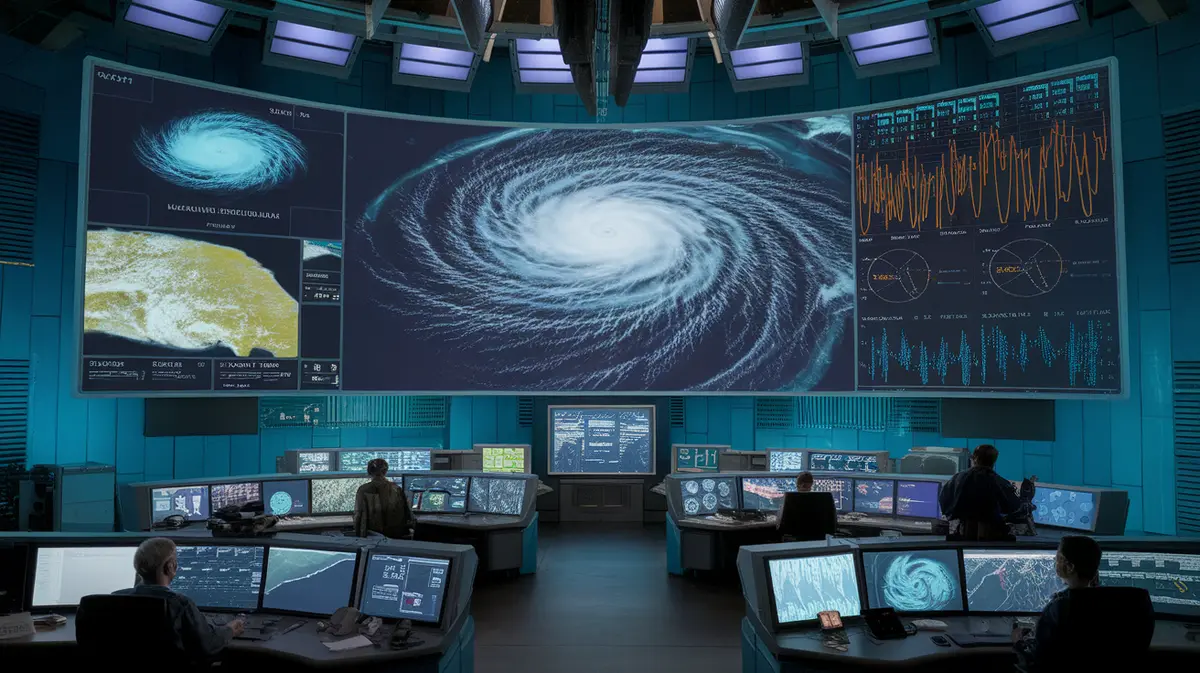
On September 14, 2025, a Category 4 hurricane barreled toward the Gulf Coast of the United States. Traditional numerical weather prediction models projected landfall near Mobile, Alabama. But Google DeepMind's GenCast AI model, running on a single TPU in under eight minutes, predicted a track shift 90 miles eastward toward Pensacola, Florida — 36 hours before conventional models corrected their forecasts. Emergency managers who acted on the AI prediction evacuated 140,000 additional residents from the revised impact zone. The storm made landfall exactly where GenCast predicted. This was not an anomaly. It was the new reality of weather forecasting, where artificial intelligence is systematically outperforming physics-based models that have dominated meteorology for over half a century.
The Fall of Numerical Weather Prediction's Monopoly
For decades, weather forecasting has relied on numerical weather prediction (NWP) — massive computational simulations that solve fluid dynamics equations governing the atmosphere. Models like the European Centre for Medium-Range Weather Forecasts (ECMWF) Integrated Forecasting System and NOAA's Global Forecast System divide the atmosphere into three-dimensional grid cells and calculate how temperature, pressure, humidity, and wind evolve over time. These simulations require billions of calculations per forecast cycle and run on some of the world's most powerful supercomputers.
The problem is that NWP has been hitting diminishing returns. Despite exponential increases in computing power, forecast accuracy for 10-day predictions has improved by only about one day per decade since the 1980s. The atmosphere is a chaotic system where tiny measurement errors amplify exponentially, creating a hard theoretical limit — the predictability horizon — beyond which deterministic forecasts become unreliable. Traditional models also struggle with extreme weather events, producing ensemble forecasts with wide uncertainty ranges that make precise warnings difficult.
"AI weather models are not replacing physics — they are learning physics from data at a scale and speed that equation-based models cannot match. We are seeing the most significant leap in forecast skill since the invention of numerical weather prediction itself."
The AI Models Reshaping Forecasting
A new generation of AI weather models has emerged that treats forecasting not as a physics simulation but as a pattern recognition problem. Trained on decades of historical atmospheric data — typically 40 or more years of ERA5 reanalysis data from ECMWF — these models learn the complex nonlinear relationships between atmospheric variables and produce forecasts in seconds rather than hours.
| AI Model | Developer | Key Innovation | Forecast Speed |
|---|---|---|---|
| GenCast | Google DeepMind | Probabilistic diffusion model generating calibrated ensemble forecasts | 15-day forecast in 8 minutes on 1 TPU |
| GraphCast | Google DeepMind | Graph neural network on 0.25-degree global mesh | 10-day forecast under 60 seconds |
| Pangu-Weather | Huawei | 3D Earth-specific transformer architecture | 7-day forecast in 1.4 seconds |
| FourCastNet | NVIDIA | Adaptive Fourier neural operator for spectral analysis | 10-day forecast in seconds on single GPU |
| Aurora | Microsoft Research | Foundation model for atmospheric sciences with flexible resolution | 5-day forecast in under 1 minute |
| NeuralGCM | Google Research | Hybrid physics-ML model combining differentiable dynamics with learned parameterizations | Seasonal forecasts in hours vs. weeks |
The benchmark results are striking. In a comprehensive evaluation published in Nature in late 2025, GenCast outperformed the ECMWF ensemble forecast on 97.2 percent of 1,320 evaluation targets spanning temperature, wind speed, humidity, and pressure at multiple atmospheric levels and forecast lead times from 1 to 15 days. GraphCast achieved similar superiority for deterministic forecasts, beating ECMWF's HRES model on 90.3 percent of targets. These are not marginal improvements — they represent a fundamental shift in forecast capability.
Why AI Forecasts Are Better
Speed and Computational Efficiency
Traditional NWP models require dedicated supercomputers consuming megawatts of power and hours of computation per forecast cycle. GenCast produces a 15-day global ensemble forecast in 8 minutes on a single Google Cloud TPU v5. This 1000x speedup enables meteorologists to generate hundreds of ensemble members — exploring far more possible weather scenarios — and to run rapid-update cycles during fast-evolving severe weather events where every minute counts for warnings.
Extreme Weather Prediction
AI models are proving especially valuable for extreme weather events — precisely the situations where accurate forecasts save the most lives. GenCast predicted tropical cyclone tracks with lower mean error than traditional models at lead times beyond 36 hours. NVIDIA's CorrDiff model generates high-resolution regional forecasts at 2-kilometer grid spacing from coarser global data, resolving thunderstorm-scale features that global models miss entirely. Studies show AI-enhanced severe weather warnings could increase lead times by 30 to 45 minutes for tornadoes and flash floods.
Operational Adoption: From Research to Real Forecasts
The transition from research demonstrations to operational weather forecasting is accelerating. ECMWF launched its Artificial Intelligence/Integrated Forecasting System (AIFS) as an experimental product in early 2025, making AI-generated forecasts available to national meteorological services worldwide. By March 2026, AIFS forecasts are being used operationally by weather services in over 30 countries as a complement to traditional NWP guidance. The UK Met Office, Meteo-France, and the Japan Meteorological Agency have all integrated AI model outputs into their forecast workflows.
NOAA announced in January 2026 that it would incorporate machine learning models into the next generation of the Global Forecast System, targeting a hybrid approach where AI handles pattern recognition and post-processing while physics-based models provide dynamical consistency. The agency allocated 200 million dollars over three years to its AI for Weather initiative, including partnerships with Google, NVIDIA, and university research groups.
- Aviation: Airlines are using AI weather models to optimize flight routes in real time, reducing fuel consumption by up to 4 percent per flight and cutting weather-related delays by 22 percent across major US carriers in 2025.
- Energy: Renewable energy operators use AI forecasts to predict solar irradiance and wind speeds 72 hours ahead with 15 to 20 percent lower error than traditional models, enabling more efficient grid integration and reducing curtailment.
- Agriculture: Precision agriculture platforms integrate AI weather data to optimize planting schedules, irrigation timing, and harvest windows, with studies showing 8 to 12 percent yield improvements from AI-enhanced weather guidance.
- Insurance: Catastrophe modeling firms are replacing legacy atmospheric models with AI ensembles that generate thousands of hurricane and flood scenarios in hours rather than weeks, improving risk pricing and reserve estimation.
Challenges and Limitations
Despite impressive results, AI weather models face real limitations. Current models are trained on ERA5 reanalysis data at 0.25-degree resolution (roughly 25 kilometers) — too coarse for hyperlocal forecasts needed for urban flash flood warnings or wildfire behavior prediction. Models can struggle with unprecedented weather patterns that fall outside their training distribution, raising concerns about performance under accelerating climate change where historical patterns may not hold.
There is also the interpretability challenge. Traditional NWP models are transparent — meteorologists can examine the physical processes driving a forecast and assess its reliability. AI models operate as learned functions that map inputs to outputs without explicit physical reasoning. When an AI model makes an unusual prediction, forecasters cannot easily determine whether it has identified a genuine atmospheric signal or is producing a statistical artifact. Hybrid approaches like Google's NeuralGCM — which embeds machine learning within a physics-based framework — aim to address this by maintaining physical consistency while leveraging ML for parameterization.
The Road Ahead: Foundation Models for Earth Science
The next frontier is atmospheric foundation models — large pre-trained models that can be fine-tuned for diverse Earth science tasks beyond weather forecasting. Microsoft's Aurora model, trained on over a million hours of diverse atmospheric and ocean data, demonstrates this vision by handling weather prediction, air pollution forecasting, and ocean current modeling within a single architecture. Google's NeuralGCM extends to seasonal and climate-scale predictions, offering a potential pathway to AI-enhanced climate projections that currently require months of supercomputer time.
The implications extend beyond meteorology. The same techniques powering AI weather models — graph neural networks, vision transformers, diffusion models applied to physical systems — are being adapted for earthquake early warning, wildfire spread prediction, ocean wave forecasting, and space weather monitoring. Weather forecasting may prove to be the proving ground for a broader revolution in AI-powered Earth science.
Key Takeaways for 2026
- AI weather models like GenCast, GraphCast, and Pangu-Weather now outperform traditional numerical weather prediction on the majority of forecast targets, delivering 10 to 15 day forecasts in minutes instead of hours.
- ECMWF, NOAA, and over 30 national weather services are operationally integrating AI forecasts alongside traditional models, with hybrid physics-ML systems becoming the new standard.
- AI-enhanced severe weather warnings are increasing lead times for tornadoes, hurricanes, and flash floods by 30 to 45 minutes — a margin that directly translates to lives saved.
- Industries from aviation to agriculture to insurance are adopting AI weather forecasts to reduce costs, optimize operations, and improve risk management.
- Foundation models for Earth science are extending AI forecasting beyond weather into air quality, ocean dynamics, wildfire behavior, and seasonal climate prediction.