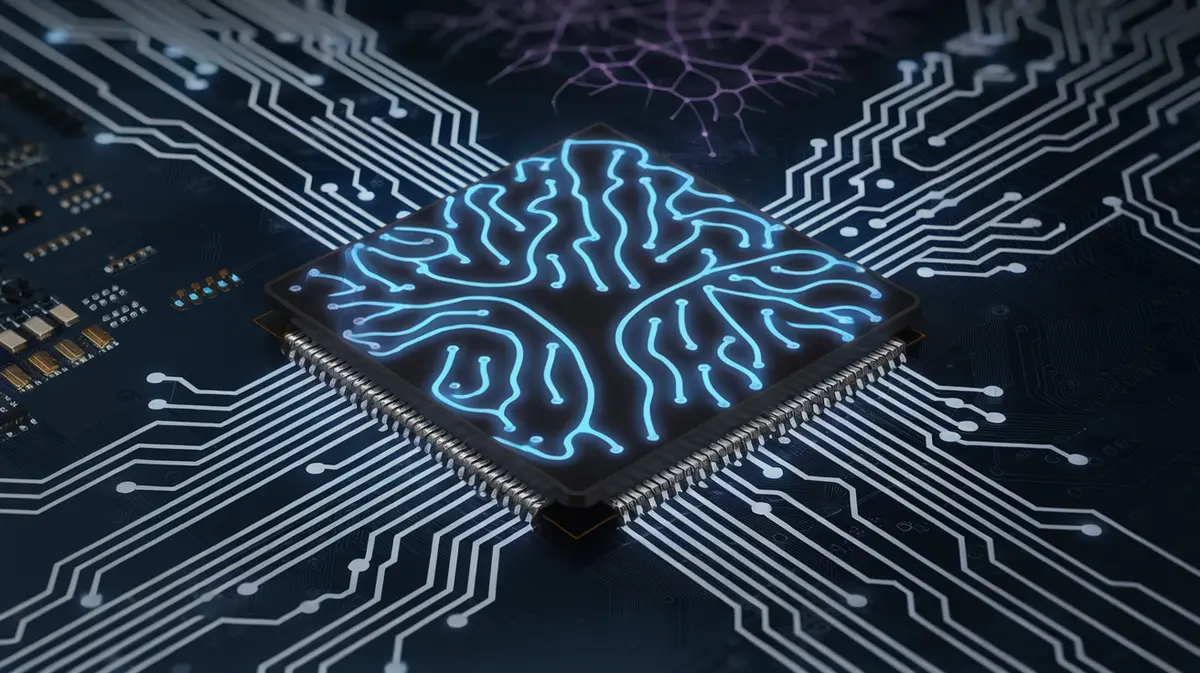
Neuromorphic Computing: How Brain-Inspired Chips Are Revolutionizing AI in 2026
- Internet Pros Team
- February 20, 2026
- AI & Technology
Modern AI is devouring electricity. Training a single large language model can consume as much energy as an entire town uses in a year, and the world's data centers are projected to draw more power than some nations by 2028. Meanwhile, the human brain — which outperforms every AI system at general reasoning, sensory perception, and continuous learning — runs on roughly 20 watts, less than a dim light bulb. Neuromorphic computing is the field dedicated to closing that gap. By designing chips that process information the way biological neurons do, neuromorphic engineers are building a new class of AI hardware that is faster, vastly more energy-efficient, and capable of learning in real time. In 2026, these brain-inspired processors are moving from research labs into products that are reshaping edge AI, robotics, and autonomous systems.
What Is Neuromorphic Computing?
Traditional processors — CPUs and GPUs — follow the von Neumann architecture, where data is stored in memory and shuttled to a separate processing unit for computation. This constant movement of data creates a bottleneck known as the von Neumann bottleneck, which wastes energy and limits speed. Neuromorphic chips take a fundamentally different approach. Inspired by the brain, they integrate memory and processing in the same location, use spikes (brief electrical pulses) instead of continuous numerical calculations, and activate only the circuits relevant to the current input — just like biological neurons that fire only when stimulated.
The result is hardware that excels at pattern recognition, sensory processing, and adaptive learning while consuming a fraction of the power required by conventional AI accelerators.
| Feature | Traditional AI Chips (GPU/TPU) | Neuromorphic Chips |
|---|---|---|
| Architecture | Von Neumann (separate memory and compute) | Brain-inspired (co-located memory and compute) |
| Processing Model | Continuous floating-point math | Event-driven spikes (fire only when needed) |
| Energy Efficiency | Hundreds of watts per chip | Milliwatts to low single-digit watts |
| Learning | Offline training, then static deployment | On-chip continuous learning in real time |
| Best For | Large-scale training, batch processing | Edge AI, robotics, sensory processing, always-on inference |
The Chips Leading the Neuromorphic Revolution
Several major technology companies and research institutions are racing to commercialize neuromorphic processors. Each chip takes a different design approach, but all share the core principle of mimicking biological neural networks in silicon.
Intel Loihi 2
Intel's second-generation neuromorphic research chip contains over one million artificial neurons and supports programmable spiking neural network models. Loihi 2 is 10 times faster and has 15 times greater resource density than its predecessor. Intel's Lava open-source software framework allows researchers and developers to build neuromorphic applications for robotics, optimization, and real-time anomaly detection without needing specialized hardware expertise.
IBM NorthPole
IBM's NorthPole chip eliminates the memory bottleneck entirely by distributing memory across 256 computing cores on the same die. The result is an inference processor that delivers 25 times better energy efficiency than leading GPUs on image recognition benchmarks. NorthPole is designed for deployment at the network edge, where power budgets are tight and latency must be minimal — making it ideal for autonomous drones, medical devices, and satellite image processing.
Samsung & SynSense
Samsung has invested heavily in neuromorphic research through its Advanced Institute of Technology, while SynSense (formerly aiCTX) is shipping commercial neuromorphic vision sensors that process visual data at microsecond latency with power consumption under 1 milliwatt. These sensors are already deployed in industrial inspection, smart agriculture, and autonomous navigation systems where conventional cameras and GPUs cannot match the speed or efficiency requirements.
Why Neuromorphic Computing Matters Now
The Energy Crisis in AI
The explosive growth of generative AI has created an unsustainable energy trajectory. Global data center electricity consumption is doubling every two to three years, and traditional scaling — building bigger GPU clusters in bigger data centers — is hitting physical and economic limits. Neuromorphic chips offer an alternative path: AI that can run on battery-powered devices at the edge, without cloud connectivity, at a thousandth of the energy cost. For applications like always-on health monitoring, environmental sensing, and embedded robotics, this efficiency is not a luxury — it is a requirement.
Real-Time Learning Without Retraining
Conventional deep learning models are trained offline on massive datasets and then deployed as static inference engines. If conditions change — a new type of defect appears on a manufacturing line, for example — the model must be retrained on new data and redeployed. Neuromorphic chips support on-chip learning through spike-timing-dependent plasticity, the same mechanism biological brains use to strengthen or weaken connections between neurons based on experience. This allows neuromorphic systems to adapt continuously to new patterns without any cloud connection or retraining cycle.
"Neuromorphic computing is not about making a faster GPU. It is about building a completely different kind of intelligence — one that learns, adapts, and perceives the way living systems do, at a fraction of the energy cost."
Real-World Applications in 2026
Where Neuromorphic Chips Are Making an Impact
- Autonomous Robotics: Neuromorphic vision and decision systems that allow robots to navigate unpredictable environments with sub-millisecond reaction times and all-day battery life
- Smart Manufacturing: Real-time defect detection on production lines using neuromorphic vision sensors that learn new defect patterns on the fly without stopping production
- Wearable Health Devices: Always-on neural processors in smartwatches and medical wearables that monitor heart rhythms, detect seizures, and analyze biosignals for weeks on a single charge
- Autonomous Vehicles: Low-latency sensor fusion chips that process LIDAR, radar, and camera data simultaneously with power budgets small enough for electric vehicle efficiency requirements
- Space and Defense: Radiation-hardened neuromorphic processors aboard satellites that perform real-time image analysis in orbit without transmitting raw data to Earth, saving bandwidth and enabling faster decision-making
- Smart Agriculture: Neuromorphic-powered drones and ground sensors that identify crop diseases, monitor soil conditions, and trigger precision irrigation using only solar power
Challenges on the Path to Mainstream Adoption
Despite remarkable progress, neuromorphic computing faces several hurdles before it can achieve widespread commercial deployment:
- Software ecosystem maturity: Most AI developers are trained on conventional frameworks like PyTorch and TensorFlow — spiking neural network tools like Intel's Lava and SynSense's Sinabs are still developing community adoption
- Standardization: No industry-wide standard exists for neuromorphic instruction sets, making cross-platform portability difficult
- Scalability: While neuromorphic chips excel at edge inference, scaling them to handle the massive parameter counts of large language models remains an open research challenge
- Talent pipeline: Neuromorphic engineering requires expertise spanning neuroscience, electrical engineering, and computer science — a rare combination that universities are only beginning to produce at scale
- Benchmarking: Comparing neuromorphic chip performance against GPUs is not straightforward because the workloads and metrics are fundamentally different, making procurement decisions harder for enterprises
What This Means for Businesses
How Organizations Should Prepare
- Edge AI deployments: Evaluate neuromorphic processors for applications that require real-time inference at ultra-low power — sensor networks, wearables, IoT devices, and embedded systems
- R&D teams: Experiment with spiking neural network frameworks and begin prototyping neuromorphic applications alongside conventional deep learning pipelines
- Sustainability goals: Factor neuromorphic hardware into your organization's energy efficiency and carbon reduction strategies for AI workloads
- Talent development: Invest in cross-disciplinary training that combines neuroscience fundamentals with hardware and software engineering skills
- Strategic partnerships: Engage with Intel, IBM, SynSense, or academic neuromorphic computing labs to gain early access to hardware, tools, and research insights
The Road Ahead
The global neuromorphic computing market is projected to reach $17.2 billion by 2030, growing at a compound annual rate of over 50 percent. As energy costs for AI continue to rise and demand for intelligent edge devices accelerates, neuromorphic hardware is positioned to become a foundational layer of the computing stack — not replacing GPUs, but complementing them in the applications where biological inspiration outperforms brute-force computation.
The brain took evolution 500 million years to design. Neuromorphic engineers are building its silicon counterpart in a single generation. The chips that think like neurons are no longer a distant academic curiosity — they are shipping, learning, and already transforming how machines perceive and interact with the world.
At Internet Pros, we help businesses navigate the rapidly evolving AI hardware landscape and architect solutions that leverage the right technology for each workload — from cloud-scale GPU clusters to energy-efficient edge deployments powered by next-generation processors. Contact us to explore how neuromorphic and edge AI technologies can give your organization a competitive advantage.