Spatial Computing in 2026: How AR, VR, and Mixed Reality Are Reshaping Business and Daily Life
- Internet Pros Team
- February 17, 2026
- AI & Technology
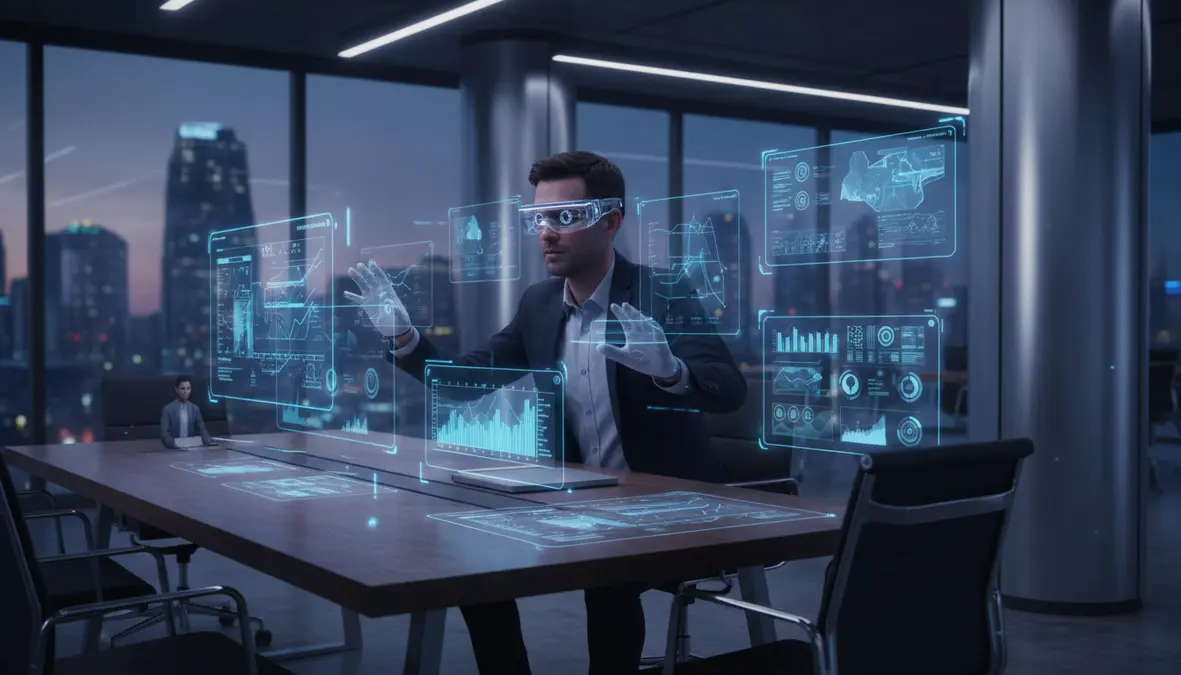
The line between the physical world and the digital one is disappearing. Spatial computing — the broad category encompassing augmented reality, virtual reality, and mixed reality — has moved from science fiction demos and gaming novelties into the mainstream of business, education, and everyday life. In 2026, people are collaborating in three-dimensional virtual workspaces, surgeons are overlaying patient data onto living tissue during operations, and factory workers are following holographic assembly instructions that float above the parts they are building. This is not a future prediction. It is happening now.
What Is Spatial Computing?
Spatial computing refers to any technology that blends digital content with the physical world or creates entirely immersive digital environments. Unlike traditional screens that confine information to flat rectangles, spatial computing places data, objects, and interfaces in three-dimensional space around the user. You interact with digital content the same way you interact with real objects — by looking at them, reaching for them, walking around them, and manipulating them with your hands.
The term covers three related but distinct technologies that sit on a spectrum from fully real to fully virtual:
The Spatial Computing Spectrum
- Augmented Reality (AR): Digital content overlaid onto the real world through transparent glasses or phone screens — you see the real environment with virtual elements added on top
- Mixed Reality (MR): Digital objects that interact with and respond to the physical environment — virtual items can sit on real tables, be occluded by real walls, and respond to real-world lighting
- Virtual Reality (VR): Fully immersive digital environments that replace the physical world entirely — users are transported to completely synthetic spaces for work, training, or entertainment
- Extended Reality (XR): The umbrella term for all spatial computing technologies, representing the full continuum from AR through MR to VR
The Hardware Driving the Revolution
What has changed between the awkward VR experiments of 2016 and the spatial computing reality of 2026 is hardware. The devices are lighter, sharper, longer-lasting, and — critically — socially acceptable to wear. Three major platforms are competing for dominance.
Apple Vision Pro
Apple's second-generation Vision Pro has dropped in both price and weight, bringing spatial computing to a broader consumer and enterprise audience. Its eye-tracking and hand-gesture controls set the standard for natural interaction, and its seamless integration with the Apple ecosystem makes it the default choice for creative professionals and corporate environments.
Meta Quest 4
Meta's Quest 4 dominates the affordable end of the market with full-color passthrough, standalone processing power, and a massive app ecosystem. Its social and collaboration features, built on years of Horizon Workrooms development, make it the go-to device for remote teams and VR training programs across industries.
Microsoft HoloLens 3
Microsoft's HoloLens 3 targets enterprise and defense applications with ruggedized hardware, Azure cloud integration, and industry-specific software for manufacturing, healthcare, and field service. Its partnership with OpenAI brings AI-powered spatial assistants that can identify objects and guide workers through complex procedures.
How Spatial Computing Is Transforming Industries
The impact of spatial computing extends far beyond gaming and entertainment. Across virtually every sector, organizations are discovering that placing information in three-dimensional context dramatically improves understanding, decision-making, and performance.
Healthcare and Surgery
Surgeons wearing AR headsets can see CT scans, MRI data, and real-time vital signs overlaid directly onto a patient during procedures. Instead of glancing away at a separate monitor, the surgeon sees a three-dimensional map of blood vessels and tissue structures exactly where they are in the body. Studies from early 2026 show a 30 percent reduction in procedure time and significantly improved precision for complex operations like spinal surgery and tumor removal.
Manufacturing and Field Service
Factory workers wearing AR glasses see step-by-step holographic instructions overlaid on the equipment they are assembling or repairing. Boeing reports that AR-guided wiring assembly has reduced error rates by 90 percent and cut training time for new technicians by half. Field service engineers can connect to remote experts who see exactly what the on-site worker sees and annotate the real-world view with arrows, highlights, and instructions.
Education and Training
Medical students dissect virtual cadavers. Architecture students walk through buildings that have not been built yet. Corporate employees practice high-stakes scenarios — emergency response, customer de-escalation, equipment operation — in safe virtual environments where mistakes have no real consequences but the learning transfers to the real world.
| Industry | Spatial Computing Application | Measured Impact |
|---|---|---|
| Healthcare | AR-guided surgery and diagnostics | 30% faster procedures, improved precision |
| Manufacturing | Holographic assembly instructions | 90% error reduction, 50% faster training |
| Retail | Virtual try-on and 3D product previews | 40% reduction in return rates |
| Real Estate | Virtual property tours and staging | 3x more properties viewed per buyer |
| Education | Immersive 3D learning environments | 75% better knowledge retention |
The Enterprise Workspace Revolution
One of the most significant shifts in 2026 is the transformation of remote work through spatial computing. The flat grid of video call faces that defined the pandemic era is giving way to three-dimensional virtual offices where remote teams sit around shared tables, sketch on infinite whiteboards, and manipulate 3D models together as if they were in the same room.
"Spatial computing is not about escaping reality — it is about enhancing it. The most powerful applications are the ones that make the real world more useful, more informative, and more connected."
Companies like Accenture, Nvidia, and Siemens have deployed spatial computing workspaces for distributed teams, reporting higher engagement, better information retention in meetings, and a stronger sense of presence compared to traditional video calls. The spatial audio and gaze-tracking in modern headsets create social cues — eye contact, spatial positioning, voice direction — that flat screens cannot replicate.
AI Meets Spatial Computing
The convergence of artificial intelligence and spatial computing is creating experiences that were impossible even two years ago. AI models now power the key capabilities that make spatial computing practical:
- Scene understanding: AI identifies real-world objects, surfaces, and room geometry in real time, allowing virtual content to interact naturally with physical spaces
- Hand and eye tracking: Machine learning models interpret hand gestures and eye movements with sub-millimeter accuracy, enabling intuitive control without physical controllers
- Spatial AI assistants: AI agents that exist in 3D space, can see what you see, understand your physical context, and provide relevant information or guidance overlaid on the real world
- Real-time translation: AR glasses that translate foreign text and speech in real time, overlaying translated words onto signs, menus, and conversation partners
- Generative 3D content: AI models that create three-dimensional objects, environments, and animations from text descriptions, dramatically reducing the cost of building spatial content
Challenges and What to Watch
Despite the rapid progress, spatial computing faces real challenges that will shape its trajectory over the next few years:
Privacy and Surveillance
AR glasses equipped with cameras and AI raise serious privacy concerns. Devices that can identify faces, read screens, and record environments continuously create new risks around consent and data collection. Regulatory frameworks are still catching up to the technology, and public acceptance varies widely by culture and context.
Content and Developer Ecosystem
Building spatial applications is more complex than building traditional software. 3D design skills, spatial UX principles, and performance optimization for head-mounted displays require new expertise. The developer ecosystem is growing rapidly, but the talent gap remains a bottleneck for enterprise adoption at scale.
What This Means for Your Business
Spatial computing is no longer a technology you can afford to watch from the sidelines. Companies that integrate AR, VR, and mixed reality into their operations are gaining measurable advantages in training speed, error reduction, customer engagement, and remote collaboration. The question is not whether spatial computing will affect your industry — it is whether you will lead the adoption or scramble to catch up.
At Internet Pros, we help businesses explore and implement spatial computing solutions that deliver real value. Whether you are looking to create immersive product demonstrations, deploy AR-guided training for your workforce, or build virtual collaboration spaces for distributed teams, the technology is ready and the results are proven. The spatial computing era is here — and the businesses that embrace it first will define the next decade of their industries.
Key Takeaways
- Spatial computing encompasses AR, VR, and mixed reality technologies that blend digital content with the physical world or create fully immersive digital environments
- Apple Vision Pro, Meta Quest 4, and Microsoft HoloLens 3 are driving mainstream adoption with lighter, more capable, and more affordable hardware in 2026
- Industries from healthcare to manufacturing are reporting dramatic improvements — 30 percent faster surgeries, 90 percent fewer assembly errors, and 75 percent better training retention
- AI integration is the catalyst making spatial computing practical, powering scene understanding, hand tracking, spatial assistants, and real-time translation
- Privacy, developer talent, and content creation remain key challenges, but the trajectory is clear — spatial computing is moving from early adoption to mainstream business infrastructure