eVTOL Air Taxis: How Joby, Archer, Lilium, and Volocopter Are Launching Commercial Urban Air Mobility in 2026
- Internet Pros Team
- April 28, 2026
- AI & Technology
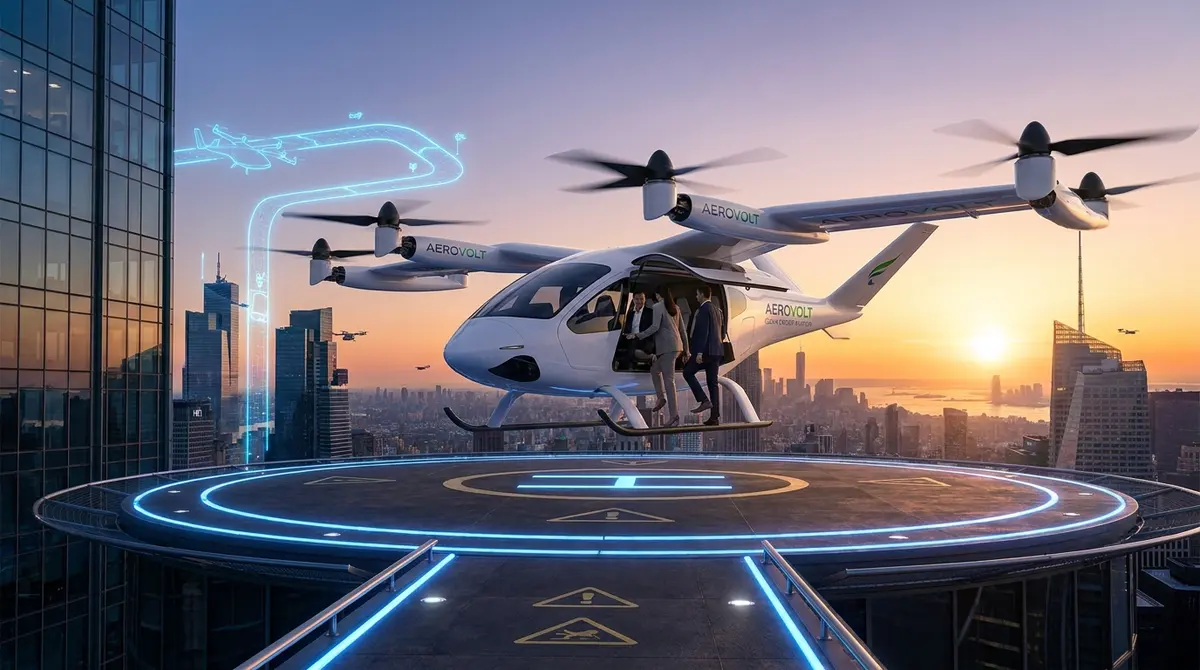
For a century, the only way to skip Manhattan traffic was a helicopter — loud, expensive, dangerous enough that one or two crashes per year were considered acceptable. In 2026, that changes. A new class of aircraft called eVTOLs — electric vertical takeoff and landing vehicles built by Joby Aviation, Archer, Lilium, Volocopter, EHang, Beta Technologies, Vertical Aerospace, and Wisk Aero — is finally crossing the line from prototype to paying passenger. Joby is flying scheduled service between JFK, LaGuardia, and Manhattan with Delta. Archer is doing the same with United at Newark. Volocopter is operating tourist hops over Singapore's Marina Bay. EHang is running pilotless sightseeing flights in Guangzhou. The question stops being "will electric air taxis happen?" and becomes "what do they actually change about how cities move?"
What Makes an eVTOL Different from a Helicopter
An eVTOL is a piloted or autonomous aircraft that takes off and lands vertically using electrically driven rotors, then transitions to wing-borne forward flight powered by batteries instead of jet fuel. The defining technology is distributed electric propulsion (DEP) — instead of a single giant rotor and a tail rotor like a helicopter, an eVTOL uses six to thirty-six smaller electric motors spread across the airframe, often on tilting nacelles or ducted fans. That distribution buys three things a helicopter cannot offer: redundancy (any single motor can fail without the aircraft falling), dramatically lower noise (small fast rotors at staggered phases sound less like a chopper and more like a hairdryer at 65 dBA), and simpler mechanics (no swash plate, no tail rotor, no transmission gearbox).
The economic case follows from the physics. A turbine helicopter burns roughly $400 per flight hour in fuel and another $600 in maintenance on rotating parts that need rebuilding every few hundred hours. An eVTOL burns about $20 of electricity per flight hour and replaces most of that rotating mass with brushless motors and battery packs that are cheaper to swap than to overhaul. The result is a per-seat-mile cost that, at scale, lands somewhere between an Uber Black and a short-haul commercial flight — not free, but no longer a once-in-a-lifetime indulgence.
Quieter Than a Truck
Joby and Archer measured around 65 dBA on takeoff at 100 meters — about the noise of a passing truck and roughly 100 times quieter than a Bell 206 helicopter at the same distance.
Zero Local Emissions
Battery-electric flight produces no CO2, NOx, or particulates at the vertiport — moving the carbon footprint upstream to the grid, where it follows whatever decarbonization the local utility is doing.
Fail-Safe Redundancy
Six to twelve independent motors mean a single failure is a non-event. There is no tail rotor to lose, no main shaft to fracture, no autorotation drill to perform under stress.
15-Minute Trips
JFK to Manhattan in seven minutes versus an hour-plus by car. LAX to Santa Monica in eight. Trips that previously meant a half-day commitment compress into a coffee break.
Battery-Limited Range
Most production eVTOLs cruise 100 to 250 miles on a charge — enough for inter-city hops but not yet for long-haul. Energy density is the binding constraint, not aerodynamics.
Fast Turnaround
Megawatt-class CCS chargers and battery-swap pads at vertiports can return an aircraft to mission-ready in 5 to 15 minutes, supporting 8 to 12 revenue flights per aircraft per day.
The 2026 eVTOL Lineup
A dozen aircraft programs cleared first flight by 2025, but only a handful have crossed the certification finish line. Here is the field that is actually carrying paying passengers in April 2026.
| Aircraft | Maker | Configuration | Status & Launch Market |
|---|---|---|---|
| Joby S4 | Joby Aviation | 6 tilt-rotors, 4 passengers + pilot | FAA Type Certificate; commercial service NYC + LA with Delta and Uber app integration |
| Midnight | Archer Aviation | 12 tilt + lift rotors, 4 passengers + pilot | FAA TC stage; UAE, NYC, and SF Bay routes with United Airlines and Stellantis manufacturing |
| Lilium Jet | Lilium | 30 ducted electric jets, 4-6 passengers + pilot | EASA Special Condition VTOL track; relaunched after 2024 restructuring; Florida and Saudi Arabia routes |
| VoloCity | Volocopter | 18 fixed rotors, 1 passenger + pilot | EASA TC stage; tourist service in Singapore Marina Bay and Paris Olympics legacy routes |
| EH216-S | EHang | 16 fixed rotors, 2 passengers, autonomous | CAAC type certificate (first in world); autonomous tourist flights in Guangzhou, Hefei, and Dubai |
| ALIA-250 | Beta Technologies | 4 lift rotors + pusher prop, 5 passengers + pilot | FAA cargo first; UPS and U.S. Air Force deliveries; passenger variant in certification |
| VX4 | Vertical Aerospace | 8 tilt + lift rotors, 4 passengers + pilot | UK CAA / EASA test flights; launch customers Virgin Atlantic, American, and Japan Airlines |
| Wisk Generation 6 | Wisk Aero (Boeing) | 12 tilt + lift rotors, 4 passengers, autonomous | FAA autonomous-aircraft pathway; first uncrewed passenger eVTOL targeting late-2020s service |
How Joby Actually Got Certified
Type certification is the bottleneck that killed every previous attempt at urban air mobility. The FAA has only two categories that fit a piloted eVTOL — Part 23 (small airplanes) and the new Part 21.17(b) special class created for "powered-lift" aircraft. Joby chose the special-class pathway with Powered-Lift Operations rules finalized in 2024, and spent five years grinding through the four-stage process: G-1 issue paper (defining the certification basis), means-of-compliance documents (proving electric propulsion meets equivalent safety), conformity inspections on production aircraft, and finally the type inspection authorization flight tests. Archer, Beta, and Vertical are following the same trail, six to eighteen months behind.
The technical bar is uncompromising. Powered-lift type certification demands proven safe behavior in single-motor failure, dual-motor failure on the same side, complete battery-bus failure, controlled-flight-into-terrain avoidance, lightning strike, bird strike, and high-energy rotor burst — all demonstrated either by flight test or by exhaustive simulation tied back to flight-test data. The FAA also requires continued operational safety data — every flight, every charge cycle, every failure mode is reported back to the regulator for the life of the fleet.
"We did not invent a new aircraft. We invented a new certification basis, and then we built an aircraft to fit it. The hard part was never the propellers — it was convincing the FAA that a clean-sheet electric powered-lift could be as safe as a Cessna built to standards from 1965."
Vertiports: The Other Half of the Network
An eVTOL without a vertiport is a science fair project. Building the ground infrastructure — pads, charging, passenger terminals, weather stations, air traffic interface — is roughly half the capital cost of standing up a working network. The FAA published its first Vertiport Engineering Brief 105A in 2023, and the 2025 update added detailed guidance on Touchdown and Liftoff Areas (TLOFs), Final Approach and Takeoff Areas (FATOs), megawatt charging, and the new Powered-Lift Designated Magnetic Heading markings that distinguish a vertiport from a heliport.
The launch networks of 2026 lean hard on existing helipads. Joby and Delta are using Manhattan Downtown Heliport, JFK's East Heliport, and a new vertiport at LaGuardia. Archer and United operate from Newark, the SF Marina Green helipad, and three Stellantis-funded vertiports in Los Angeles. Volocopter retrofitted four Singapore HDB rooftops. The truly purpose-built vertiports — Skyports' Dubai Hub at the marina, Lilium's Orlando Lake Nona terminal, Ferrovial's Spain network — are coming online quarter by quarter through 2026 and 2027.
Air Traffic Control for a Sky Full of Air Taxis
A handful of eVTOLs flying tourist loops is one thing. A thousand a day operating point-to-point in a major metro is a fundamentally different air traffic problem, and the FAA, EASA, and ICAO have spent the last five years quietly designing the answer: Urban Air Mobility (UAM) corridors, also called UAM Operating Volumes. These are pre-coordinated low-altitude tubes (typically 500 to 4,000 feet AGL) where eVTOLs self-separate using Provider of Services for UAM (PSU) data exchange, similar to how drones operate under the Remote ID and UTM frameworks but with higher reliability requirements.
The first operational UAM corridor went live between JFK and Manhattan in mid-2025, with a second pair connecting LAX to Santa Monica and downtown Los Angeles in early 2026. Each corridor publishes real-time slot availability over an ASTM F3548-compliant API; operators reserve slots minutes ahead of departure and the corridor enforces minimum separation, weather minimums, and contingency routing. By the late 2020s the FAA expects this same architecture to scale to thousands of simultaneous eVTOL operations across two dozen U.S. metros.
The Battery Problem That Nobody Solved Yet
Energy density is the binding constraint on every eVTOL program, full stop. A modern lithium-ion pouch cell delivers around 280 Wh/kg at the cell level and roughly 200 Wh/kg at the pack level. Jet-A is about twelve thousand Wh/kg. Even after accounting for the four-times-better efficiency of an electric motor versus a turbine, electric flight is still operating at a roughly fifteen-times energy-density disadvantage — which is exactly why production eVTOLs cruise 100 to 250 miles, not 1,000.
The path forward is incremental. Silicon-anode chemistries from Sila and Group14 are pushing pack-level energy density toward 350 Wh/kg in 2026. Solid-state cells from QuantumScape, Solid Power, and Toyota promise 400 to 500 Wh/kg by the late 2020s. Lithium-sulfur from Lyten and OXIS could go higher still, with weight savings critical for an aircraft. None of these unlock transcontinental electric flight on their own — but each one extends eVTOL range enough to add new city pairs, support hot-and-high operations, and tighten reserve margins. Hybrid-electric and hydrogen fuel cell architectures from Joby (post-acquisition of H2FLY), ZeroAvia, and Universal Hydrogen are the parallel track for the longer routes that pure batteries cannot reach this decade.
Autonomy: The Real Endgame
Pilot wages are the single largest operating cost for an air taxi, and removing the pilot doubles the available passenger seats. That is why every serious eVTOL program has an autonomous variant on the roadmap: Wisk is uncrewed from day one (the FAA is developing a brand-new autonomous certification basis just for them), Joby is flying remotely piloted cargo missions with the U.S. Air Force, Archer has a research partnership with Anduril on autonomy, and EHang has been operating fully autonomous passenger flights in China since 2023.
The technical pieces — sense-and-avoid radar, lidar, computer vision for vertiport approach, certified flight management software, ground-based supervisory control — are all in advanced development. The regulatory and public-acceptance pieces are decades behind. Expect the late 2020s to look like a piloted-with-augmentation regime, with a single remote pilot eventually supervising multiple aircraft, and full per-aircraft autonomy as a 2030s milestone tied to whatever the FAA does with the broader Beyond Visual Line of Sight (BVLOS) drone framework.
What This Means for Cities, Customers, and the Industry
For passengers, a ride from JFK to Manhattan in 2026 is roughly $200 to $300 — about three times an Uber, but for a journey that takes seven minutes instead of seventy. For corporate travelers and high-end leisure, the math is already compelling. The truly democratized "$50 air taxi to anywhere" pitch from the 2020 era requires another decade of cost reduction, autonomy, and battery progress; it is not gone, just not 2026.
For cities, eVTOLs raise hard zoning, noise, and equity questions. Even at 65 dBA, a thousand daily takeoffs over a residential neighborhood is a political fight. The vertiport siting decisions being made in 2026 — who gets the rooftop, who gets the noise, who pays for the upgrade to the grid — will define the public legitimacy of the entire industry for a generation. Singapore, Dubai, and Paris are leaning in; San Francisco and parts of New York are pushing back hard.
For aerospace, eVTOLs are the first new aircraft category to clear FAA type certification in fifty years, and the first to be born electric. The supply chains they spin up — battery, motor, power electronics, flight control software — will reshape sustainable aviation more broadly, including the regional electric airliners now being designed by Heart Aerospace, Eviation, and Beta. The technology developed for an air taxi over Manhattan does not stay in Manhattan.
Key Takeaways for 2026
- Commercial eVTOL service is real. Joby, Archer, Volocopter, and EHang are flying paying passengers; this is no longer a 2030 forecast.
- Distributed electric propulsion is the unlock. Six to thirty motors instead of one rotor buys redundancy, lower noise, and far simpler maintenance.
- Type certification is the moat. The FAA powered-lift special class took years to grind through; the leaders are several certification cycles ahead of the field.
- Vertiports are half the business. Without ground infrastructure, charging, and UAM corridors, the aircraft is a curiosity.
- Batteries still bound the network. Expect 100 to 250 mile ranges in 2026, with silicon-anode and solid-state chemistries unlocking longer routes through the late 2020s.
- Autonomy is the long-term cost story. Wisk, EHang, and the U.S. Air Force are pioneering uncrewed eVTOLs; the rest of the industry will follow as soon as the regulator allows.
The first commercial passenger flight on a fixed-wing aircraft was 1914. The first scheduled jet service was 1952. The first commercial type-certificated electric vertical takeoff and landing aircraft was 2025, with paying passengers in 2026. Whether eVTOLs become the next great leap in city transportation or a curiosity that mostly serves the well-off depends on what happens next: how fast battery energy density improves, how many vertiports get built, how the public reacts to a sky full of air taxis, and how quickly autonomy crosses from cargo into passenger service. None of those answers are settled yet — but for the first time in a century, the question of how we move through and above a city is genuinely being rewritten.