The Open Data Lakehouse in 2026: How Apache Iceberg, Delta Lake, Databricks, Snowflake, and Open Table Formats Are Ending Data Silos and Vendor Lock-In
- Internet Pros Team
- June 25, 2026
- Software Development
For thirty years, companies that wanted to ask hard questions of their data faced an awkward choice. A data warehouse was fast and reliable but expensive and closed - your data lived inside one vendor's system, and getting it out, or letting another tool read it, meant copying everything. A data lake was cheap and open - just files in cloud storage - but slow, messy, and missing the guarantees that serious analytics need. So most organizations built both, and then spent a fortune copying the same data back and forth between them. In 2026 that compromise is finally collapsing. A new architecture called the open data lakehouse, built on open table formats like Apache Iceberg and Delta Lake, lets every engine read and write one shared copy of the data - and the long war over whose format wins has effectively ended.
Warehouse vs. Lake: The Thirty-Year Compromise
A data warehouse stores data in a tightly managed, proprietary system optimized for fast queries and trustworthy answers - the kind of place a finance team runs its quarterly numbers. The catch is that the data is locked inside that system; using it elsewhere means exporting copies, and you pay the vendor for both storage and every query. A data lake flips the trade-off: it dumps raw files (often in the open Parquet format) into cheap cloud object storage like Amazon S3, where anything can read them. But a pile of files has no concept of a table - no safe way to update rows, no protection when two jobs write at once, no record of what changed. The result was the worst of both worlds for many teams: data copied into a lake for cheap storage, then copied again into a warehouse to actually be useful.
The Breakthrough: A Table Layer Over Plain Files
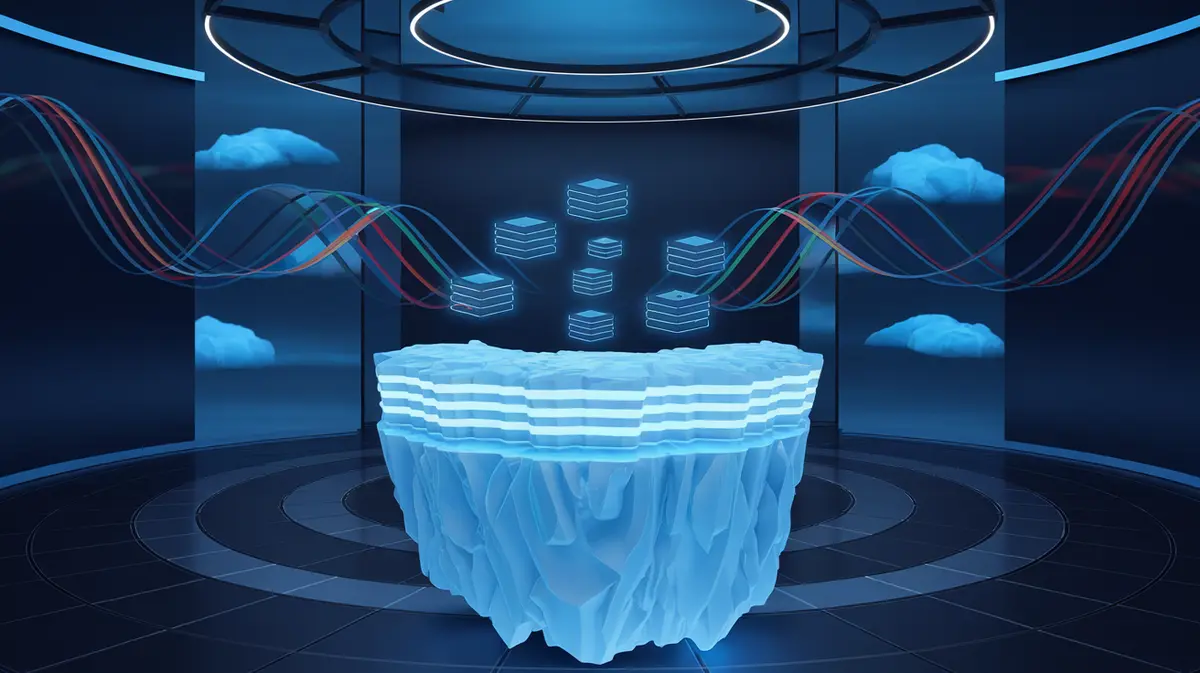
The lakehouse closes the gap with a deceptively simple idea. Keep the cheap, open files in object storage exactly as they are - but lay a thin layer of metadata over them that describes which files make up a table, what the columns are, and what changed and when. That metadata layer is the open table format, and it gives a humble folder of Parquet files the powers people expected only from a warehouse.
What the Metadata Layer Adds
ACID transactions so two jobs can write without corrupting each other, schema evolution so you can add or rename a column without rewriting petabytes, and time travel so you can query the table exactly as it looked last Tuesday - or roll back a bad load in seconds.
Why It Matters: One Copy, Many Engines
Because the format is open and the files stay in your own storage, any compatible engine - Spark, Flink, Trino, DuckDB, Snowflake, BigQuery - can read and write the same table. You stop copying data between systems and start pointing tools at a single source of truth.
This is the heart of the lakehouse: the storage of a lake, the behavior of a warehouse, and - crucially - no single vendor standing between you and your own data.
The Format War That Ended in a Truce
For years three open table formats competed: Apache Iceberg (born at Netflix), Delta Lake (born at Databricks), and Apache Hudi (born at Uber). Choosing one felt risky, because it implied betting on which ecosystem would win. The standoff broke in dramatic fashion: Databricks - Delta Lake's creator - acquired Tabular, the company founded by Iceberg's creators, signaling it would support both and bring the formats together. Around the same time, Snowflake, long a closed warehouse, embraced Iceberg as a first-class storage option and open-sourced its Polaris catalog. The message to the industry was unmistakable.
"The format stopped being the thing you fight over. When the two biggest rivals in the business both agreed your data should live in open files they don't control, the question changed from 'which vendor owns my tables?' to 'which engine do I want to point at them today?' That is a very different - and much healthier - question."
A key enabler of that truce is the REST catalog - a standard way for any engine to discover and safely commit to tables - so the catalog, not a proprietary database, becomes the neutral meeting point where many tools coordinate on one set of data.
Who Is Building the Lakehouse
What was a niche idea is now the default direction of the entire data industry:
- Databricks - which popularized the term "lakehouse," created Delta Lake, and bought Tabular to unify it with Iceberg under its Unity Catalog.
- Snowflake - the classic cloud warehouse, now reading and writing Iceberg tables in customer storage and stewarding the open Polaris catalog.
- AWS - whose S3 Tables bake Iceberg support directly into object storage, making the lakehouse a feature of the bucket itself.
- Google & Microsoft - BigQuery and Fabric increasingly query open tables in place rather than demanding data be loaded in first.
- Confluent - whose Tableflow turns streaming Kafka topics directly into Iceberg tables, collapsing the wall between real-time and analytics.
- Dremio, Starburst & the Trino community - independent engines built to query open tables fast, with no warehouse to buy.
Lakehouse vs. Classic Warehouse
| Property | Classic Cloud Warehouse | Open Lakehouse |
|---|---|---|
| Where data lives | Vendor's proprietary system | Your own object storage, open files |
| Who can read it | Mainly that vendor's engine | Any compatible engine |
| Copies of the data | Often many, kept in sync | One shared source of truth |
| Switching cost | High - export everything | Low - point a new tool at it |
| Storage and compute | Often bundled | Separate; pay for each on its own |
The Honest Trade-Offs
The lakehouse is powerful, but it is not free of friction, and the teams running it in production are clear about the rough edges:
- It is assembled, not bought. A warehouse is one polished product; a lakehouse is storage, a table format, a catalog, and one or more engines stitched together - more flexibility, more moving parts to manage.
- Maintenance is real. Open tables accumulate small files and old snapshots; without routine compaction and cleanup, performance and storage bills drift the wrong way.
- Governance is harder when everything can read the data. Open access is the point, but it means permissions and auditing must live in the catalog layer, not inside one walled-off system.
- Maturity varies by engine. Two tools may both "support Iceberg" yet differ on advanced writes, making thorough testing essential before you commit.
"The win is not a faster query. The win is that next year, when a better or cheaper engine shows up, you adopt it on Friday instead of budgeting an eighteen-month migration. Open formats turn your data platform from a marriage into a series of dates."
What This Means for Your Business
You do not need a petabyte of data to care about this shift - you need to care about not being trapped. The practical move for most organizations in 2026 is to insist that new analytics data land in an open table format from the start, so it is never locked inside a single tool. Treat your catalog as critical infrastructure, because it is now the place where access, governance, and discovery live across every engine. And when you evaluate a data platform, ask the new question the lakehouse makes possible: not "how fast is your warehouse?" but "can I read my own data with someone else's tools without copying it?" The deeper change is that data is becoming a shared, open asset you own outright, rather than a deposit held inside a vendor's vault - and the companies that design for that openness now will spend the next decade adopting better tools instead of escaping old ones.
At Internet Pros, we help businesses cut through fast-moving technology and turn it into a practical roadmap - from data and analytics strategy to the software that ties new systems together. Get in touch to talk through what an open data architecture could mean for your operation, or explore more technology insights on our blog.