Vertical Farming in 2026: What Survived the Shakeout, Why the Winners Look More Like Data Centers Than Farms, and Which Crops Actually Pay
- Internet Pros Team
- August 14, 2026
- AI & Technology
Few technologies have compressed an entire hype cycle into a decade as violently as vertical farming. Between roughly 2015 and 2022 it raised billions of dollars on a genuinely appealing promise: grow food in stacked trays inside a building, anywhere, year-round, with a fraction of the water and none of the weather. Then the flagship companies started failing - loudly, expensively, and in public, until the obituaries were written. What almost nobody noticed is that while the headline names collapsed, a quieter set of operators turned the same technology into a functioning, unglamorous, occasionally profitable business. The question in 2026 is not whether vertical farming works. It is which parts work, and why the survivors look more like well-run data centers than like farms.
What the Crash Actually Proved
The collapse is usually narrated as a technology failure. It was not. The hydroponics worked. The LEDs worked. The yields per square foot were real and frequently spectacular. What failed was arithmetic.
A vertical farm replaces two things nature provides for free - sunlight and land - with two things you must buy: electricity and real estate. That trade only makes sense if the crop is valuable enough per kilogram, and the facility efficient enough per kilowatt-hour, to cover the substitution. Many of the best-funded operators built enormous, capital-intensive facilities before proving that equation on a small one, then discovered that the price of electricity is not a rounding error in a business where lighting is the product.
The second failure was crop selection driven by ambition rather than economics. Strawberries, tomatoes, and staple grains photographed beautifully in investor decks, but demanded far more light energy per kilogram than leafy greens while competing with field produce priced by a system with a century of scale behind it. Growing wheat indoors is technically straightforward and economically absurd.
Vertical farming did not fail as a technology. It failed as a business model that assumed cheap capital and cheap electricity would both last.
The Crops That Pay, and the Ones That Never Will
The most useful thing to understand about controlled environment agriculture is that the economics are decided before construction starts, by the choice of crop. The pattern that emerged from the shakeout is remarkably consistent.
| Crop Category | Energy per kg | Price Premium | Verdict in 2026 |
|---|---|---|---|
| Leafy greens, herbs, microgreens | Low | Moderate, shelf-life driven | The core business - fast cycles, high density, short supply chains |
| Seedlings and propagation | Very low | High per unit | Quietly the best margin in the industry |
| Pharmaceutical and specialty botanicals | Irrelevant | Very high | Works because purity and consistency, not price, are the product |
| Berries and vine crops | High | Seasonal only | Viable in greenhouses, marginal in fully enclosed stacks |
| Staple grains and root vegetables | Very high | None | Not economic, and unlikely ever to be |
The seedling business deserves attention because it inverts the whole pitch. Instead of competing with field agriculture, it supplies it: uniform, disease-free young plants raised indoors in a few weeks, then transplanted outdoors to finish under free sunlight. The facility handles only the stage where precision is worth paying for. That is not a replacement for farming; it is a component upgrade, and it sells.
Why the Survivors Look Like Infrastructure Companies
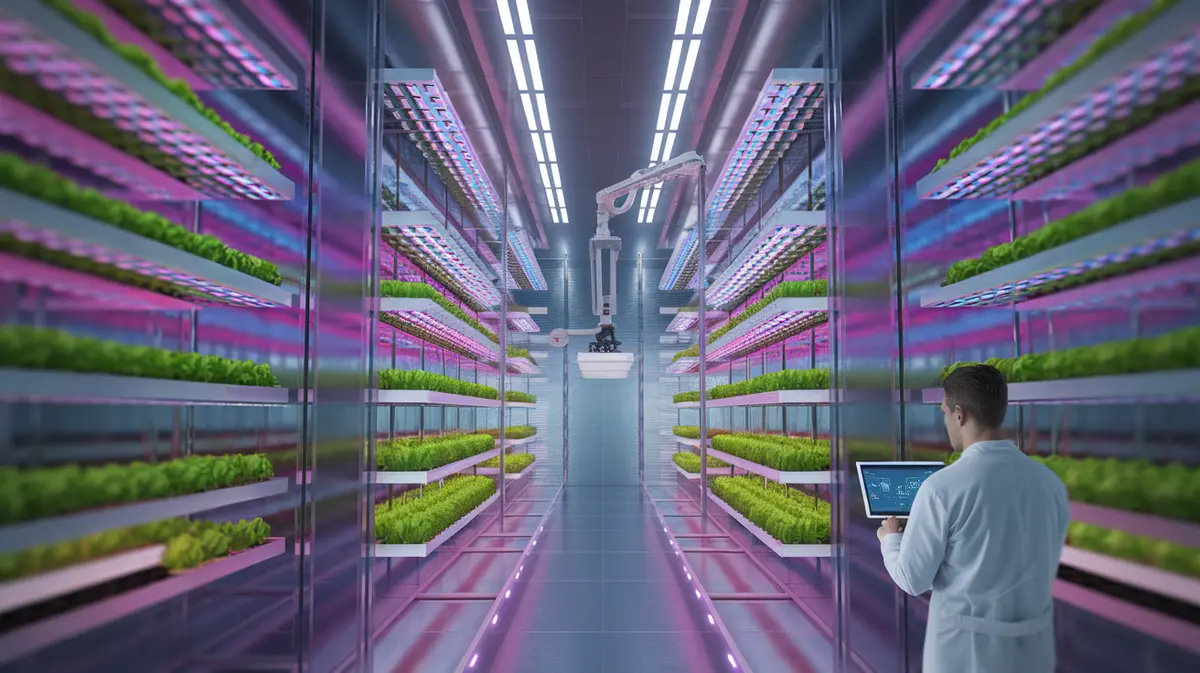
Walk into a well-run indoor farm today and the resemblance to a data center is hard to miss. Racks in rows. Hot and cold aisles. Redundant power. Sensors everywhere. A control room where a few people watch dashboards rather than plants. The operational discipline that made large-scale computing economical transfers almost directly.
Energy Is the Product
In a vertical farm, photosynthesis is a manufacturing process and light is the raw material. That reframing changes every decision. Operators buy power on time-of-use contracts and shift light cycles into cheap overnight windows, treating the canopy as a flexible load the way a compute cluster treats batch jobs - some selling that flexibility back to the grid, others co-locating with waste heat or curtailed renewable generation.
The lighting hardware improved steadily and unglamorously: more efficient horticultural LEDs, spectral tuning matched to crop and growth stage, and dimming that follows real plant response rather than a fixed schedule. None of it is a breakthrough. All of it compounds.
Automation Where It Pays, Not Everywhere
Early facilities tried to automate everything and built machines costlier than the labor they replaced. The current generation is selective: tray movement, seeding, and harvesting are automated, quality inspection is handled by computer vision that flags anomalies for a human, and everything else stays manual until the numbers say otherwise. Automate the repeated path, leave the exceptions to people.
The Data Layer Is the Real Moat
A closed environment is a rare thing in agriculture: an experiment where every variable is measurable and controllable. Temperature, humidity, carbon dioxide, nutrients, light spectrum and duration, airflow - all logged continuously against a crop cycle short enough to run dozens of iterations a year. Operators that treat this as a machine learning problem rather than a farming problem accumulate an advantage competitors cannot buy, and the resulting growing recipes are the genuinely defensible asset - more so than the building.
The Numbers That Decide a Facility
- Kilowatt-hours per kilogram of salable product. The one metric that predicts survival. Track it weekly, not annually.
- Salable fraction. Yield is vanity. What percentage left the building at full price after trimming, grading, and shrink?
- Labor minutes per tray. Automate the top three line items on this list and ignore the rest.
- Delivered cost versus the incumbent. Compare to the field-grown product landed at the same shelf, not to a national average.
- Days from harvest to shelf. Freshness is the durable advantage. If the logistics erase it, so does the customer.
The Advantages That Held Up
Strip away the hype and several claims survived contact with reality. Water use really is dramatically lower, because a recirculating system reuses what an open field loses to evaporation and runoff. Pesticide use really does approach zero in a sealed room. Yields per unit of floor area really are extraordinary once stacking is counted. And output is genuinely predictable - a grower can commit to fixed weekly volume at fixed quality twelve months out.
That last point is underrated. The strongest commercial argument for controlled environment agriculture in 2026 is not sustainability or novelty - it is supply certainty. When drought, heat, or a border disruption takes a growing region offline, contracted indoor volume keeps arriving on schedule at an agreed price. Operators selling that insurance have far healthier order books than those still selling a story about the future of food.
The Limits Worth Stating Plainly
Vertical farming will not feed the world, and honest operators stopped claiming it would. Calorie crops - grains, legumes, tubers - are produced by sunlight at a scale no electrically lit facility can approach. What indoor growing can do is take a slice of production, mostly perishable and high-value, and make it local, consistent, and clean.
There are second-order risks too. A sealed environment that excludes pests also excludes the ecology that suppresses them, so one contamination event can move through a facility fast. And the carbon case depends entirely on the local grid: a facility on coal-heavy power is not an environmental improvement over a field, whatever the water figures say.
What This Means If You Are Not Building a Farm
The lesson generalizes well beyond agriculture. A working technology and a working business are separate achievements, and the second is usually harder. Vertical farming had a repeatable, impressive technical result years before anyone had a defensible unit economic model, and the gap between the two consumed billions of dollars.
The operators still standing did three things differently. They proved the economics at small scale before spending on large scale. They chose the narrow application where their advantage was decisive instead of the broad one where it was merely present. And they instrumented everything, so that the improvements came from measured iteration rather than from conviction.
That is a description of good engineering practice in any field - and it is why the second act of vertical farming, conducted with far less noise than the first, is the one worth watching.