4D Imaging Radar in 2026: How Cheap Silicon Quietly Became the Sensor That Sees Through Everything Cameras and Lidar Cannot
- Internet Pros Team
- August 11, 2026
- AI & Technology
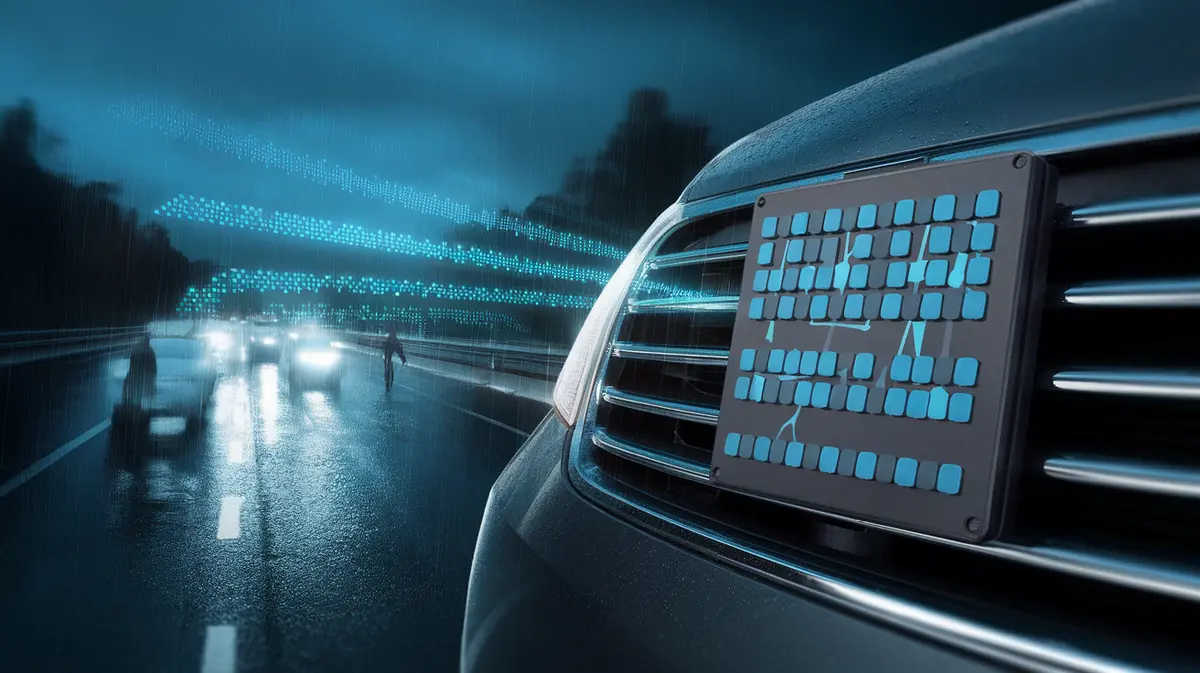
For twenty years, radar was the sensor nobody wrote about. It sat behind the front grille, it kept your adaptive cruise control from rear-ending the car ahead, and it told you almost nothing else. Cameras got the machine learning attention and lidar got the venture capital. Then radar quietly changed - not because anyone invented new physics, but because the same semiconductor economics that made phones cheap arrived in the millimeter-wave band. In 2026 a radar module the size of a deck of cards produces a point cloud, resolves how tall an object is, measures its velocity directly rather than inferring it, and does all of that through fog thick enough to blind every other sensor on the vehicle.
What the Fourth Dimension Actually Is
The name is marketing, but the underlying claim is real. Traditional automotive radar reported three things about a detection: range, azimuth (bearing left or right), and Doppler velocity. What it could not tell you was elevation - whether the return came from an overpass, a road sign gantry, a discarded muffler on the tarmac, or a stopped vehicle in your lane.
This is not a trivia-level limitation. It is the specific reason legacy radar systems were programmed to ignore stationary objects: a radar that cannot distinguish a bridge overhead from a stalled car ahead can brake for both or for neither. Engineers chose neither, and a series of well-documented crashes into stationary vehicles followed. Adding elevation is what turns radar from a device that tracks moving obstacles into one that can describe a scene.
| Dimension | What It Measures | Why It Matters |
|---|---|---|
| Range | Distance to the reflecting surface | Accurate to centimeters, unaffected by lighting |
| Azimuth | Horizontal bearing | Which lane the object occupies |
| Elevation | Vertical angle | Drive under it, drive over it, or stop for it |
| Doppler | Radial velocity, measured directly | Known in one frame, not derived from tracking across frames |
That last row deserves emphasis because it is radar's genuinely unique advantage. A camera or a lidar knows where something is; to learn how fast it is moving, it must observe the object across several frames and compute the difference. Radar measures velocity in the first frame, from the frequency shift of the return itself. A pedestrian stepping off a curb is moving in the data before any tracker has had time to decide that a pedestrian exists.
How the Resolution Got Better Without New Physics
Radar angular resolution is set by aperture - the physical size of the antenna array measured in wavelengths. At 77 GHz the wavelength is under four millimeters, which is why automotive radar can be small at all, but a handful of antennas still produces a blurry picture. The improvement came from three converging changes.
MIMO and the Virtual Array
Multiple-input multiple-output radar transmits from several antennas on orthogonal waveforms and receives on several more. The signal processing then synthesizes a virtual array whose element count is the product, not the sum, of the two. Twelve transmitters and sixteen receivers yield 192 virtual channels from 28 physical antennas. Aperture is bought with arithmetic rather than with sheet metal.
Radar-on-Chip in Standard CMOS
Millimeter-wave front ends used to require exotic semiconductor processes. Moving them to standard RF CMOS put the transceiver, the analog-to-digital converters, and increasingly the DSP core on one die that can be manufactured on the same economics as any other automotive chip. Cascading several of those chips together is now the normal way to build a high-channel-count imaging sensor.
Learned Processing Instead of Hand-Tuned Thresholds
Classical radar pipelines detect targets with constant false alarm rate thresholding, which is fast, explainable, and throws away most of the raw data. Feeding earlier-stage tensors into neural networks recovers weak returns that thresholding discarded and classifies object types from micro-Doppler signatures - the distinctive modulation produced by swinging arms and legs, or by rotating wheels.
The interesting shift is not that radar got smarter. It is that radar stopped throwing away ninety percent of what it already measured, because compute finally became cheap enough to keep it.
Where Radar Wins Outright
Sensor comparisons usually degenerate into partisanship, so it is worth being specific about the conditions where the choice is not close.
- Fog, heavy rain, snow, and dust. Millimeter waves pass through water droplets and particulates that scatter the near-infrared light lidar depends on and that erase the contrast cameras need. This is physics, not engineering effort, and it will not be closed by a better lidar.
- Direct sun and total darkness. Radar is an active sensor that supplies its own illumination and does not care about dynamic range. Low sun angle at dusk is one of the hardest camera conditions and a complete non-event for radar.
- Instant velocity. Doppler is available on the first return, which shortens the reaction path for automatic emergency braking.
- Cost and packaging. An imaging radar module costs a fraction of a comparable lidar, draws modest power, and hides behind a plastic bumper where it never needs cleaning - which quietly solves a maintenance problem that exposed optical sensors have never solved well.
Where It Still Loses
Honest limitations matter more than capability lists, and radar has real ones.
- Resolution remains an order of magnitude behind lidar. A good imaging radar resolves perhaps a degree in azimuth; lidar delivers a tenth of that. Radar will tell you something car-sized is stopped ahead. It will not read the shape of a child behind it.
- Multipath and clutter. Radio waves bounce off guardrails, tunnel walls, and the road surface, producing ghost targets that appear physically plausible. Suppressing them is the hardest part of a production radar stack.
- Poor reflectors are genuinely poor. Radar cross section depends on geometry and material. Pedestrians reflect weakly, and some obstacles are close to invisible while a small metal plate on the ground lights up like a truck.
- No semantics. Radar cannot read a stop sign, a lane marking, or a traffic light. Any complete system still needs cameras, which is why the serious debate was never radar versus cameras.
- Mutual interference. As radar density on the road rises, sensors increasingly hear each other. Mitigation schemes exist and are improving, but the problem grows with adoption rather than shrinking.
The Practical Read for 2026
The winning architecture is not one sensor. It is camera for semantics, radar for velocity and all-weather robustness, and lidar where geometric precision justifies the cost. What changed is that radar moved from the cheap backup role into a primary perception input - which reshapes cost models for driver assistance, warehouse robots, agricultural machinery, drones, and increasingly for building and industrial sensing where privacy rules make a sensor that cannot produce a recognizable image an advantage rather than a compromise.
If you are specifying autonomy or perception hardware this year, the relevant question is no longer whether to include radar, but whether the radar you are quoted actually resolves elevation and exposes a point cloud - because a great many products still labeled radar are the 2015 sensor in a new housing.
The Broader Pattern
Radar is a useful reminder that a mature technology can be transformed without any breakthrough in the technology itself. Nothing about the electromagnetic behavior of a 77 GHz chirp changed. What changed was the cost of the silicon that generates it, the cost of the compute that interprets it, and the willingness of engineers to stop discarding the parts of the signal that were inconvenient to process.
When a sensor category looks settled and boring, it is worth asking what it already measures and quietly throws away. That is where the next decade of capability tends to be hiding - not in a new device, but in the data an old one has been discarding since the day it shipped.