AI PCs and NPUs: How On-Device Neural Processing Units Are Bringing Local LLMs to Snapdragon X Elite, Apple M4, Intel Lunar Lake, and AMD Ryzen AI in 2026
- Internet Pros Team
- May 11, 2026
- AI & Technology
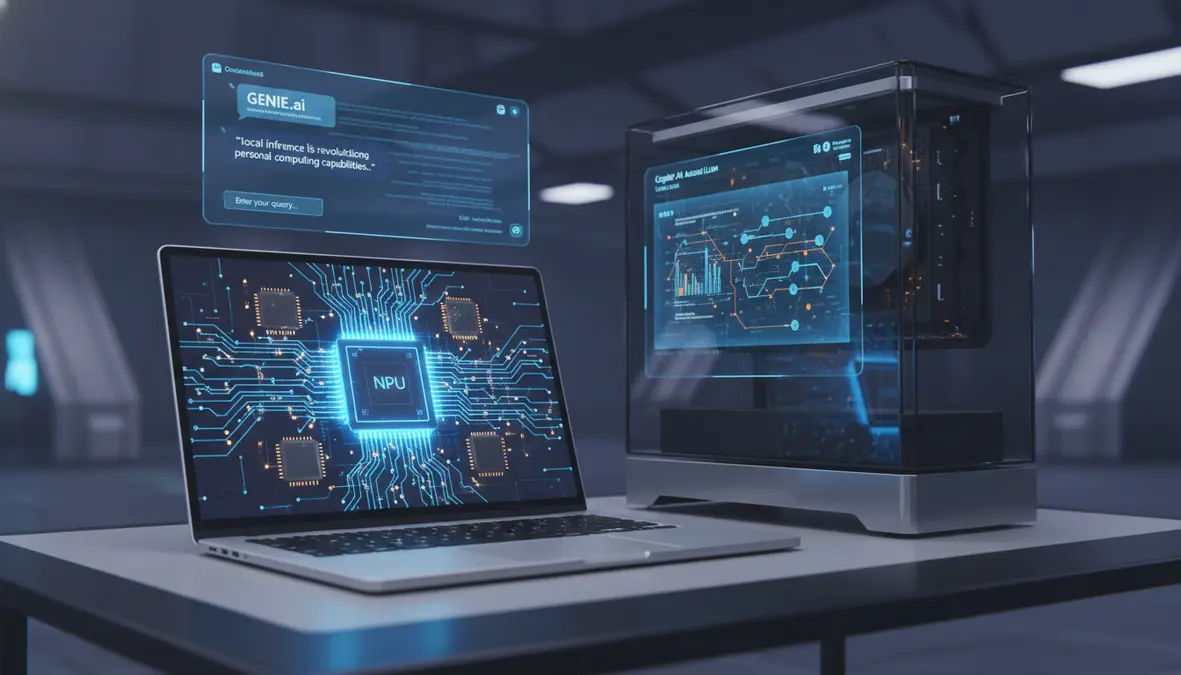
For two decades, the personal computer was a vehicle to reach somewhere else — a browser, a SaaS app, a remote API. In 2026, that geometry is quietly inverting. The Neural Processing Unit (NPU), the third silicon block now sitting alongside the CPU and GPU on every flagship laptop chip, has crossed the practical threshold for running real large language models, image generators, and speech recognizers locally — no internet, no per-token bill, no data leaving the device. Qualcomm Snapdragon X Elite, Apple M4, Intel Lunar Lake, and AMD Ryzen AI 300 all now ship with NPUs delivering 40 or more trillion operations per second (TOPS), and Microsoft, Apple, and Google have rebuilt their operating systems around that capability. The cloud is not going away — but for the first time since the smartphone era, the consumer AI experience is being measured by what your hardware can do without a network.
Why the NPU Is Not Just a Faster CPU
Modern transformer inference is dominated by dense matrix-multiply workloads at low precision — INT8, INT4, and sometimes BF16 weights. CPUs are general-purpose, GPUs are great but power-hungry, and neither was designed to run a 7-billion-parameter model for an hour on battery. The NPU is a fixed-function tensor engine optimized for exactly that: massively parallel multiply-accumulate operations at low precision, with on-chip SRAM that keeps the working set close to the math units and an instruction stream stripped of everything a transformer does not need.
The practical payoff is measured in joules per token. Running Llama 3.2 3B at INT4 on a Snapdragon X Elite Hexagon NPU consumes roughly an order of magnitude less power than running the same model on the laptop GPU, and the GPU is in turn an order of magnitude more efficient than the CPU. For all-day battery life on AI-heavy workflows, the NPU is not a luxury — it is the only path that does not melt the chassis.
"We stopped thinking of the NPU as an accessory and started designing the OS around it. Search, summarization, captioning, image editing — they all sit on the NPU now, and the user never sees the workload move."
The Four Silicon Camps Defining the 2026 AI PC
Qualcomm Snapdragon X Elite & X Plus
The Hexagon NPU delivers 45 TOPS, paired with custom Oryon CPU cores and an Adreno GPU. The reference platform for Windows on ARM Copilot+ PCs from Microsoft Surface, Dell, HP, Lenovo, Samsung, ASUS, and Acer.
Apple M4 Neural Engine
38 TOPS at INT8 across MacBook Air, MacBook Pro, iMac, Mac mini, and iPad Pro. Tightly coupled to the unified memory architecture and exposed through Core ML, MLX, and the new Apple Foundation Models framework.
Intel Lunar Lake AI Boost (Core Ultra Series 2)
47 TOPS from Intel's fourth-generation NPU, paired with Lion Cove P-cores, Skymont E-cores, and Battlemage Xe2 graphics. OpenVINO and DirectML provide the developer surface.
AMD Ryzen AI 300 (Strix Point & Halo)
The XDNA 2 NPU hits 50 TOPS, the highest of the four. Combined with Zen 5 CPU cores and RDNA 3.5 graphics, AMD is targeting both Copilot+ thin-and-light and mobile workstation segments.
What Actually Runs on the NPU Today
| Workload | Model / Feature | Why the NPU Wins |
|---|---|---|
| On-device LLM chat | Microsoft Phi-Silica, Phi-4 Mini, Google Gemini Nano, Apple Foundation Models, Llama 3.2 1B/3B | Sub-second latency, zero cloud bill, full offline operation, conversational drafting and rewriting that stays on the user's machine. |
| Live transcription & translation | Windows Live Captions, Apple Live Transcription, OpenAI Whisper variants compiled for NPU | Continuous audio inference at a fraction of a watt, enabling all-day meetings, accessibility, and real-time multilingual subtitling. |
| Local image generation & editing | Cocreator in Paint, Image Creator, Stable Diffusion XL Turbo, Apple Image Playground | Generative imaging without a render farm; private and instant for marketing, design, and content creation workflows. |
| Semantic search & local RAG | Windows Recall, Apple Intelligence semantic index, on-device embeddings | Continuous indexing of files, screen content, and messages with vector embeddings computed locally — privacy-preserving by construction. |
| Video & webcam effects | Windows Studio Effects, Apple Center Stage, eye contact correction, background blur and replacement | Heavy vision models running for hours of video calls without draining the battery or spinning fans. |
The Developer Stack Catching Up to the Hardware
For most of 2024, the AI PC narrative was hardware-first — a TOPS race between Qualcomm, Intel, AMD, and Apple. In 2026 the software story has finally caught up. Microsoft's Windows AI Foundry and Windows Copilot Runtime expose Phi-Silica and other small models as system APIs that any application can call. Apple's Foundation Models framework does the same on macOS and iPadOS. Google's AICore brings Gemini Nano to Chromebooks and Pixelbooks. Underneath, ONNX Runtime, DirectML, Core ML, MLX, OpenVINO, and Qualcomm's AI Hub provide the cross-vendor abstraction, while open-source tools like llama.cpp, Ollama, and LM Studio have rapidly added NPU back-ends.
Quantization is the other half of the story. The same Llama or Mistral checkpoint that occupies 14 GB at FP16 fits in 2-3 GB at INT4 — small enough to load into NPU-friendly memory tiers and run at interactive token-per-second speeds on a fan-less laptop. The 2026 toolchain (GGUF, AWQ, GPTQ, llama.cpp, MLX) makes this conversion a single command for most popular models.
The Hybrid AI Architecture Nobody Is Calling Hybrid Yet
No serious vendor is claiming the laptop replaces the cloud. The 2026 architecture is unapologetically hybrid: a small, fast, private model on the NPU handles the high-frequency turns of the user's day — autocomplete, summarization, voice typing, image clean-up, semantic search — while a frontier cloud model is invoked only for the long-tail of hard or novel queries. Apple's Private Cloud Compute, Microsoft's Copilot tiering, and Google's on-device-first Gemini Nano all encode the same pattern: small enough to be local, smart enough to know when to call home.
The economic implications are real. Inference traffic that used to bill at GPT-class token prices now runs at zero marginal cost on hardware the user already bought. For ISVs, the AI feature that would have killed a freemium tier on cloud-only economics is suddenly viable, because the user's own NPU is doing the work.
A 2026 Buyer's Checklist for AI PCs
- 40+ TOPS NPU minimum. Microsoft's Copilot+ certification draws the line at 40 TOPS. Anything below will miss future on-device model updates and OS-level features.
- 16 GB RAM is the new floor; 32 GB is the right answer. Quantized 7B-class models comfortably fit in 16 GB, but headroom for the OS, browser, and the model together pushes serious users to 32 GB.
- Pick the silicon to match your software. Snapdragon X for Windows on ARM and stellar battery life; Apple M4 for the macOS ecosystem; Intel Lunar Lake or AMD Ryzen AI for x86 legacy compatibility and gaming-class GPU performance.
- Storage matters more than you think. Local LLMs and quantized image models can consume 30-100 GB. A 1 TB SSD is a reasonable AI-PC starting point.
- Validate the developer stack. If you have specific apps — Adobe Firefly, DaVinci Resolve, Stable Diffusion, llama.cpp — check that NPU acceleration is supported on the silicon you are buying.
Where the AI PC Story Goes Next
The 2026-2027 roadmap pushes NPUs past 80 TOPS, expands on-device model sizes into the 7B-13B range comfortably, and unifies the NPU and GPU memory pools so that mixed-precision pipelines stop ping-ponging between accelerators. Standardized APIs — ONNX Runtime, WebNN in the browser, and the new Windows AI Foundry — are converging the fragmented vendor stacks into something a developer can target once and deploy everywhere.
For consumers, the practical change is that the laptop becomes the first place where AI feels free. No subscription gate, no rate limit, no apology dialog when the cloud is busy. For ISVs, an entire generation of features that died on cloud economics can finally ship. And for the broader AI industry, the NPU is the quiet rebalancing of compute that returns a measurable slice of inference back to the edge — closer to the data, the user, and the constraints that actually matter. The cloud will keep training the next frontier model. Your laptop, increasingly, will be the one running it.