Enhanced Geothermal Systems (EGS): How Fervo, Eavor, and Closed-Loop Drilling Are Unlocking 24/7 Clean Baseload Power for AI Data Centers in 2026
- Internet Pros Team
- May 12, 2026
- AI & Technology
The AI build-out has rewritten the energy plan. A single hyperscale training campus now demands a gigawatt of firm power — power that does not vanish when the sun sets or the wind drops — and the grid does not have it lying around. Solar and wind are cheap but intermittent. Nuclear is firm but slow. Natural gas is fast but dirty. The dark-horse answer the industry has quietly converged on in 2026 is the oldest source on the planet: the heat beneath our feet. Enhanced Geothermal Systems (EGS) — engineered to work anywhere, not just at the rare volcanic hotspots that fed traditional geothermal — have crossed from research demos into commercial reality. Fervo Energy's Cape Station in southwest Utah is bringing 400 MW of 24/7 carbon-free electrons onto the grid. Eavor Technologies' Geretsheim project in Germany has proven a fully closed-loop well architecture at depth. Sage Geosystems is shipping pressurized geothermal storage that doubles as a battery. And the buyers signing the long-term PPAs are not utilities chasing renewable portfolio standards — they are Google, Meta, and Microsoft, racing to power AI.
Why EGS Is Suddenly Real After Four Decades of Pilots
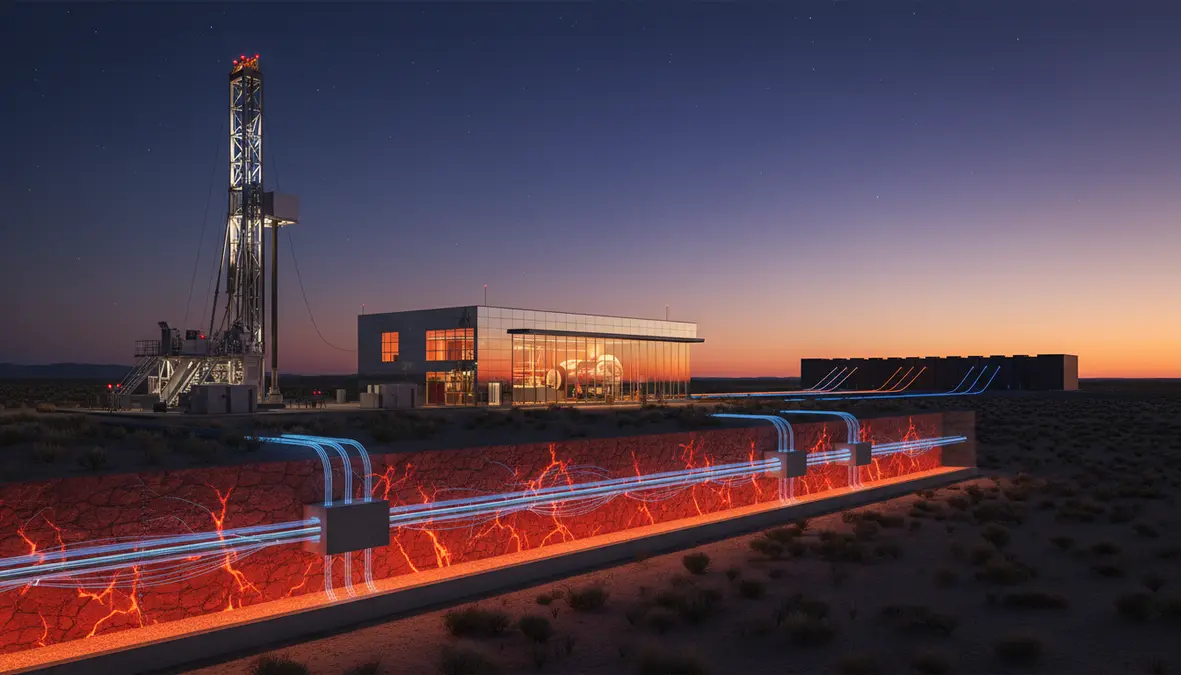
Conventional geothermal works only where nature already cooperated — Iceland, the Geysers in California, Kenya's Rift Valley — places with hot rock, natural fractures, and water already in the system. That is roughly one percent of Earth's land area. EGS is the engineering bet that you can manufacture those conditions: drill into hot but dry rock anywhere on the planet, create or enhance fractures to make a permeable subsurface reservoir, circulate water through it, and return superheated fluid to the surface to spin a turbine. The U.S. Department of Energy estimates the technically recoverable EGS resource at over 5 terawatts in the continental United States alone — orders of magnitude more than current electricity demand.
What changed in the last five years is not the physics — it is the toolbox. The shale revolution gave the oil and gas industry two things EGS desperately needed: horizontal directional drilling at depth and plug-and-perf hydraulic stimulation at industrial throughput. Fervo Energy's founders came directly out of that world and brought the playbook with them. The same rigs, the same casing strings, the same fiber-optic distributed acoustic sensing (DAS), the same proppants and stimulation models that doubled U.S. oil production now point downward at hot granite instead of sideways at oil-bearing shale.
"For thirty years EGS was a science project. The shale industry handed us a complete subsurface engineering stack — drilling, stimulation, monitoring, modeling — that we did not have to invent. We just had to point it at heat instead of hydrocarbons."
The Four EGS Architectures Competing in 2026
Open-Loop Stimulated EGS (Fervo)
Paired horizontal wells with engineered fractures between them. Water injected down one well, heated by contact with the rock, produced from the other. Highest thermal output per well-pair; carries induced-seismicity management as a tradeoff.
Closed-Loop Geothermal / AGS (Eavor)
A sealed multilateral well system — fluid never contacts the rock. Slightly lower thermal yield, but no fracturing, no seismicity risk, and a permitting story that works almost anywhere. Eavor-Loop is the reference design.
Pressurized Geothermal Storage (Sage)
Use the wellbore as a pressurized reservoir: pump water in when grid power is cheap or surplus, release it under pressure when prices spike. Geothermal that doubles as a multi-hour energy storage asset.
Ultra-Deep Millimeter-Wave Drilling (Quaise)
A gyrotron-based drilling system aimed at vaporizing rock at depths of 10–20 km, where temperatures pass 500°C and water becomes supercritical — an order-of-magnitude jump in energy density. Still pre-commercial in 2026.
Why Hyperscalers Are the First Real Customers
Wind and solar are now the cheapest electrons on Earth, but a hyperscale AI campus running 24/7 cannot operate on cheap-when-the-sun-is-up. Google's and Microsoft's 24/7 carbon-free energy commitments require matching every hour of load with carbon-free generation on the same regional grid — a vastly harder problem than annual offset accounting. The math forces them toward firm clean power: nuclear, long-duration storage, or geothermal. SMRs are 5–10 years from commercial deployment for most projects. Long-duration storage is real but needs a clean primary source to charge. EGS, with its 90%+ capacity factor, is the firm clean option that can actually break ground in 2026.
| Firm Clean Source | Time to Commercial Megawatt | Capacity Factor | Honest 2026 Caveat |
|---|---|---|---|
| Large nuclear (Gen III+) | 10–15 years for new build in the U.S. | ~93% | Permitting and cost overruns dominate; no new U.S. greenfield in this decade. |
| Small Modular Reactors (SMRs) | 5–8 years to first commercial unit | ~92% | Most designs still pre-licensing or first-of-a-kind in 2026; cost curves unproven. |
| Enhanced Geothermal (EGS) | 2–4 years from greenfield lease | 90%+ | Resource maps still maturing; induced seismicity must be actively managed. |
| Solar + 4-hour battery | 1–2 years | ~30% (firm window) | Does not cover overnight or multi-day weather; not actually firm without LDES. |
| Long-Duration Energy Storage (LDES) | 2–4 years for commercial scale | n/a (shifting, not generating) | Needs an underlying carbon-free source; complementary to EGS, not a substitute. |
The Deals That Made EGS Bankable
The flywheel started with a small pilot. Fervo's 2023 Project Red in northern Nevada produced 3.5 MW into a Google PPA — modest by grid standards, but the first commercial EGS plant ever to deliver power to a major hyperscaler. The follow-on Cape Station in Beaver County, Utah, is targeting 400 MW in phased commissioning through 2026–2028, with the first 100 MW already under construction and signed offtake. Meta moved next, signing a geothermal PPA with Sage Geosystems for up to 150 MW of pressurized geothermal capacity east of the Rockies — the first geothermal power east of the Mississippi at hyperscale. Microsoft has signaled it will follow, with announced exploration of EGS for its Wisconsin and Virginia AI campuses.
The financing story moved in lockstep. Geothermal projects historically struggled to bank because resource risk was unbounded — you might drill a multi-million-dollar well and find dry, impermeable rock. Repeatable horizontal drilling plus stimulation, validated at the Utah FORGE site under DOE's Earthshot for Enhanced Geothermal, brought the resource risk profile closer to oil and gas — and the project finance community knows how to underwrite that.
AI Is Helping Build the Thing That Will Power AI
A quietly important detail: the same machine learning tools the AI industry built for itself are now deployed across the subsurface workflow. Seismic interpretation, microseismic event detection, fracture network modeling, and reservoir simulation all run on neural surrogates that compress weeks of high-performance computing into minutes of inference. Operators run real-time digital twins of the subsurface, updating fracture geometry and flow paths as DAS fiber returns acoustic data from every meter of the wellbore. The next generation of EGS wells will be designed, drilled, stimulated, and operated with AI in the loop end-to-end — a feedback loop where AI compute demand pulls firm clean power, and the firm clean power supply chain is itself accelerated by AI.
What to Watch Through 2026–2027
- Cape Station Phase 1 commissioning. A successful 100 MW first phase from Fervo collapses the perceived execution risk for the entire EGS category and accelerates the next tranche of PPAs.
- The first East-of-the-Rockies megawatt. If Sage Geosystems delivers commercial power in Texas or the Gulf Coast at hyperscale, EGS stops being a Western U.S. story and becomes a national one.
- Cost curve toward $45/MWh. The DOE Earthshot target for EGS is roughly $45 per MWh by 2035. Watch each new project's LCOE for the slope of the learning curve, not just the absolute price.
- Induced seismicity protocols at scale. Open-loop stimulated EGS carries real seismic risk. Traffic-light protocols and continuous microseismic monitoring will define whether community acceptance survives the first commercial felt event.
- Closed-loop economics. Eavor-style architectures have to prove they can hit competitive LCOE without the higher thermal yield of stimulated systems. Their permitting advantage is real; the cost question is open.
- Geothermal brine lithium. Direct lithium extraction from geothermal brine at the Salton Sea and other plays is on track to become a meaningful co-product — possibly the deciding factor in a project's returns.
The Bigger Picture
For a decade the conversation about clean energy was a conversation about getting cheaper electrons onto the grid. The AI build-out has inverted it: cheap electrons are nice; firm, dispatchable, carbon-free electrons are the constraint. EGS is not the only answer — SMRs, long-duration storage, and a much smarter grid all matter — but it is the firm clean source that is breaking ground now, in 2026, at the scale a hyperscale campus actually needs.
It is also a reminder that the technologies that look unrelated rarely are. The shale revolution built the drilling stack. The AI revolution built the demand signal and the subsurface modeling tools. The climate imperative wrote the policy. EGS is what falls out when those three lines cross. The deepest natural resource on the planet — heat — is finally usable anywhere, by anyone, for the most compute-hungry industry in history. The next time you ask a chatbot a question, there is a non-trivial chance the electrons running the inference came up out of dry, hot rock that no one knew how to drill into a decade ago.