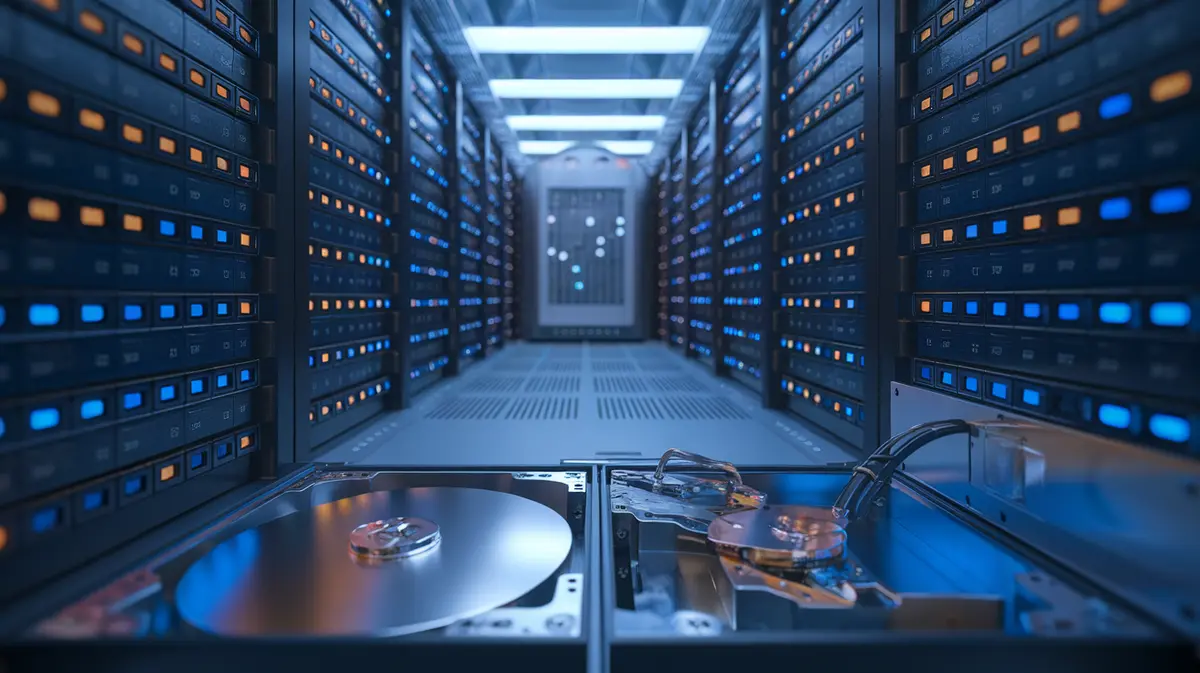
The AI Storage Crunch in 2026: Why Hard Drives Got Scarce, What HAMR and QLC Flash Actually Change, and Why Tape Quietly Came Back
- Internet Pros Team
- August 21, 2026
- AI & Technology
For twenty years the safe assumption about storage was that it would keep getting cheaper and nobody would have to think about it. In 2026 that assumption broke. Lead times on high-capacity hard drives stretched past a year, and cloud providers began rationing bulk capacity the way they once rationed GPUs. The cause is not a factory fire or a shipping crisis. It is that artificial intelligence turned data hoarding from a bad habit into a business strategy.
Why Demand Exploded and Supply Did Not
Before large models, most organizations deleted things. Logs aged out after ninety days, security camera footage was overwritten weekly, and raw sensor readings were discarded once the summary had been calculated. Every one of those deletions now carries an opportunity cost, because the discarded material is exactly the kind of proprietary data that makes a fine-tuned model useful. Retention policies quietly inverted, and the default became keep it, in case we train on it.
AI also generates enormous volumes of its own. Training runs write checkpoints measured in terabytes, repeatedly. Vector indexes and embeddings can rival the size of the documents they describe. Synthetic datasets, evaluation traces, and inference logs all accumulate, and none of them existed as a category five years ago.
Supply could not sprint. Only three companies still make hard drives at scale, and after a decade of flat consumer demand none had spare capacity waiting. Building it takes years and billions, and no executive wants to fund a factory for a boom that might be a bubble. So the price per terabyte did something it had not done in a generation. It went up, and stayed up.
For thirty years the cost of keeping data fell faster than our appetite to create it. AI reversed that ratio. Storage is now a capacity planning problem, not a line item you approve without reading.
What HAMR Actually Does
Hard drive capacity had been creeping rather than leaping, for a reason rooted in physics. To pack more bits onto a platter you need smaller magnetic grains, but small grains become thermally unstable and can flip on their own at room temperature, which is a polite way of saying your data rots. The fix is a more stable material, and the catch is that a conventional write head cannot flip it.
Heat-assisted magnetic recording solves that by putting a tiny laser in the head. For roughly a nanosecond it heats a spot a few dozen nanometers across, the material briefly becomes writable, the bit is set, and the spot cools and locks. The result is drives in the thirty to forty terabyte range inside the same enclosure, drawing about the same power. That is what data centers are actually buying: more terabytes per rack unit and per watt, in a building where floor space and electricity are the binding constraints.
Three Levers for More Capacity in the Same Box
- Heat-assisted recording. A laser in the write head makes a thermally stable medium temporarily writable, which is what breaks the density stall.
- Shingled recording. Write tracks that overlap like roof shingles for roughly a fifth more capacity. Reading is normal, but rewriting means rewriting the neighbors, so it suits archives rather than databases.
- Mechanical tricks. More platters, helium fill to reduce drag, and dual actuators, meaning two independent arm assemblies so that a much larger drive does not also become a much slower one per terabyte.
The trade-off nobody advertises is rebuild time. Capacity grew far faster than interface speed, so replacing a failed forty terabyte drive can take the better part of a day with the array degraded throughout. This is why serious deployments moved to erasure coding rather than mirrored sets, and why rebuild windows now belong in a risk register.
Flash Did Not Take Over, It Split the Job
Flash was supposed to make disk obsolete years ago. Instead the two settled into different jobs, and high-capacity QLC drives redrew the boundary rather than erasing it. QLC stores four bits per cell, which lowers cost per terabyte and reduces write endurance, and that fits AI work unusually well: training and inference read the same dataset repeatedly and rarely rewrite it. A sixty terabyte QLC drive delivers random reads no mechanical device can match, in a fraction of the space and power.
What flash did not do is get cheap enough for bulk. The cost gap against nearline disk remains wide enough that for data you must keep but rarely touch, the spinning platter is still the rational answer.
| Medium | Access time | Best fit | Trade-off |
|---|---|---|---|
| TLC NVMe flash | Microseconds | Active training data, vector indexes, transactional databases | Highest cost per terabyte by a wide margin |
| QLC NVMe flash | Microseconds | Read-heavy AI datasets, warm content, dense read caches | Limited write endurance; poor choice for rewrite-heavy work |
| Nearline hard disk | Milliseconds | Bulk object storage, backups, media libraries, general capacity | Long rebuilds, mechanical failure, and currently scarce |
| LTO tape | Minutes | Long-term archives, compliance retention, offline copies | Not online; needs a library, a process, and tested restores |
Why Tape Came Back
Tape never actually left, it just stopped being fashionable. It survived because the media costs a fraction of disk per terabyte, a cartridge on a shelf draws no power and needs no cooling, and modern generations hold tens of terabytes each.
Then ransomware turned its least convenient property into its best one. An attacker with full administrative control of your network cannot encrypt, delete, or silently corrupt a copy that is physically disconnected. Snapshots can be deleted, cloud buckets can be emptied with stolen credentials, and replication faithfully replicates the encryption. An air-gapped copy is the one backup class that survives a bad week intact.
What This Means for an Ordinary Business
Most companies are not buying racks of drives, but nearly all are paying for storage they have never examined. A few habits are worth adopting while prices are unfriendly.
- Measure data temperature. Almost nobody knows what fraction of their bytes were read in the past year. It is usually under ten percent, and you cannot tier what you have not measured.
- Price the restore, not the storage. Archive tiers are cheap to fill and expensive to empty in a hurry. Retrieval fees and egress charges are where archive budgets actually break.
- Treat retention as a cost control. Keep everything forever is now a recurring expense that deserves a policy and an owner.
- Test restores, not backups. Bigger datasets mean longer recoveries. Measure a real restore before an incident measures it for you.
- Keep one copy that attackers cannot reach. Immutable object storage with a lock, or tape. One copy, verified, out of reach of your own administrative credentials.
The Honest Limits
This is a shortage, not a permanent condition. Capacity is being added, and if AI spending cools the same investment that caused the crunch will produce a glut. Heat-assisted drives remain a manufacturing challenge, since a laser and a head that must survive years of continuous duty do not yield perfectly on the first ramp. QLC endurance ratings are workload-specific. And no clever choice of medium fixes an organization that does not know what it is storing or why.
What To Take From This
The shift worth noticing is not that one medium beat another. It is that storage rejoined the list of things a business has to plan. The companies handling it well are not the ones with the cleverest technology, but the ones who can say which of their bytes earn their keep, which are insurance, and which have been quietly billed to them every month by nobody in particular.
If your storage bill is growing faster than your data is useful, Internet Pros can help you measure what you keep, tier it sensibly, and make sure the copy you would need after a bad day is one you have tested.