Artificial Muscles in 2026: How Clone Robotics, Festo, and Artimus Robotics Are Building Soft Actuators That Move Like Living Tissue
- Internet Pros Team
- July 18, 2026
- AI & Technology
For a century, machines have moved the same way: a stiff electric motor spins a gear, and the gear yanks a rigid metal joint. It is powerful and precise, but it is nothing like you. Your body is driven by muscle - soft bundles of fiber that pull, give, and absorb a shock without shattering the thing they are holding. In 2026, one of the most quietly radical ideas in robotics has come of age around copying that trick: artificial muscles, the soft actuators at the heart of a field called soft robotics, machines that move less like a forklift and more like a living thing.
Why the Motor Was Always the Problem
The electric motor is brilliant at spinning, and terrible at almost everything a hand does. It is rigid, so a robot arm built from motors and gearboxes is strong but unforgiving - it hits an obstacle at full torque instead of yielding. It is heavy, concentrating mass at every joint. And it is fundamentally a rotary device, so engineers spend enormous effort converting spin into the pulling and grasping that real work requires. That stiffness is why traditional robots live behind safety cages: a machine that cannot give is a machine that can hurt you. Artificial muscles flip the design. Instead of a hard joint driven by a spinning shaft, they use a soft element that contracts and relaxes on command, built-in compliance and all.
"Nature never built a rotary joint. Everything that walks, grips, or flies is pulled by something soft. If we want robots that can work next to people, we have to stop bolting motors together and start growing muscle."
Four Ways to Build a Muscle
There is no single winning design. The leading teams are betting on different physics, each trading power, speed, and cost against how lifelike the motion feels.
1. Electrohydraulic (HASEL)
A liquid-filled soft pouch wrapped in electrodes. Apply high voltage and the fluid is squeezed sideways, making the pouch contract like a muscle fiber. Fast, quiet, and self-sensing - the frontier of the field.
2. Pneumatic (McKibben)
A rubber tube in a braided mesh. Pump in air and it bulges and shortens, pulling like a tendon. Cheap, strong, and proven, but it needs a compressor and plumbing.
3. Shape-Memory Alloy
A wire of nitinol that shrinks when heated by an electric current and relaxes when it cools. Silent and incredibly compact, but slow to reset and power-hungry.
4. Twisted-Coil Polymer
Ordinary fishing line or thread, twisted until it coils. Heat it and the coil contracts hard for its weight - astonishingly cheap muscle, still maturing in speed and control.
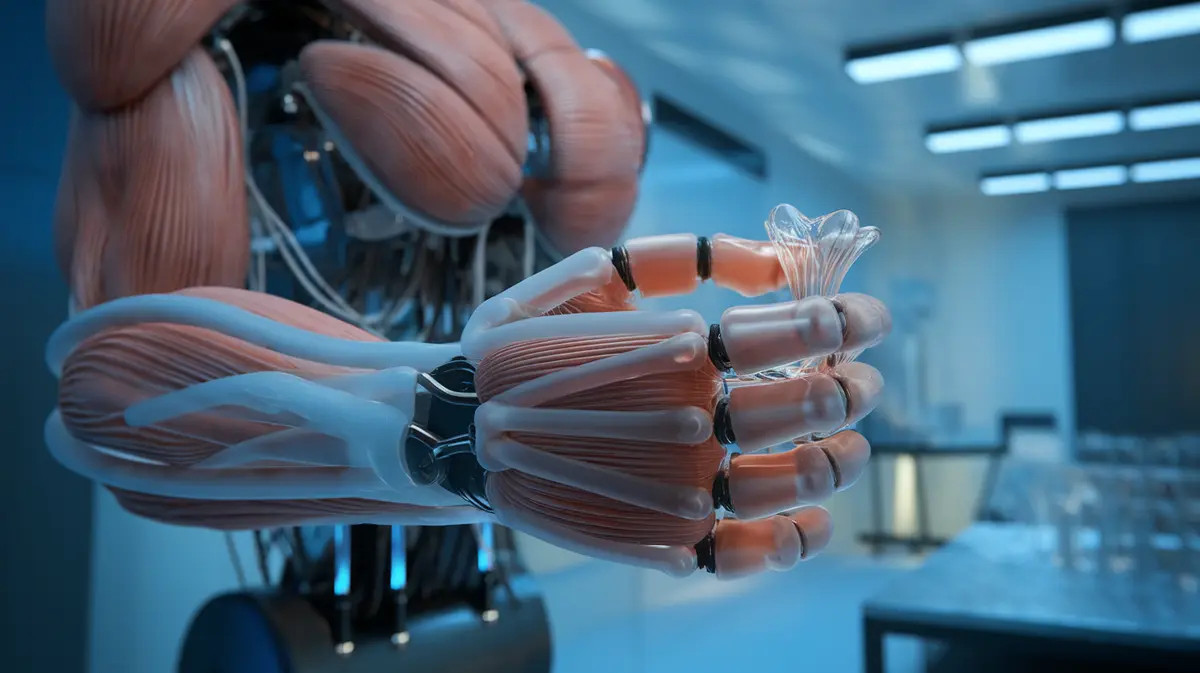
Two ideas are pulling ahead in 2026. HASEL actuators - short for hydraulically amplified self-healing electrostatic - are prized because they are driven purely by voltage, respond in milliseconds, and can even sense their own position, no separate sensor required. And water- or air-filled artificial muscle fibers arranged over a skeleton are being used to build robots that are eerily anatomical - bundles of thin actuators layered exactly where a bicep or forearm flexor would sit.
Who Is Building It
Clone Robotics has become the most striking name in the field, building a full musculoskeletal humanoid - a synthetic skeleton wrapped in hundreds of water-driven artificial muscles and mesh “myofibers,” a machine engineered to move by contracting muscle rather than spinning motors. Festo, the German automation giant, has shipped pneumatic artificial muscles and bio-inspired grippers for years, proving soft actuation can survive a factory floor. Artimus Robotics, spun out of university research, commercializes HASEL electrohydraulic muscles for industry. And academic labs at MIT, Stanford, and Harvard keep pushing the science - faster elastomers, self-healing materials, and control software that can coordinate hundreds of soft actuators at once.
Soft Muscle vs Hard Motor
| Trait | Artificial Muscle | Electric Motor |
|---|---|---|
| Motion | Pull / contract, like tissue | Spin, converted to motion |
| Around people | Soft and compliant, inherently safer | Stiff, usually needs a cage |
| Best at | Delicate grip, lifelike limbs, prosthetics | High-speed, heavy, repetitive work |
The Honest Trade-offs
Artificial muscle is not ready to replace the motor everywhere, and the challenges are real. Many designs demand awkward inputs - HASEL runs on thousands of volts (at tiny, safe currents), pneumatics need a compressor, and shape-memory wire fights its own waste heat. Durability is the great question: a muscle that stretches millions of times must not fatigue or tear, and self-healing materials are still young. Controlling hundreds of soft, squishy actuators is far harder than commanding a single precise motor, and raw power density still trails the best electric drives. But every one of these gaps is narrowing fast, and the payoff - machines that are safe to touch - is one motors can never offer.
Why It Matters for Business
Soft actuation quietly widens where robots are allowed to go. A gripper that gives can handle ripe fruit, glass, or a wriggling part without crushing it, opening automation to jobs rigid arms have always fumbled. Prosthetics and exoskeletons built from artificial muscle move with a natural, cushioned feel no gearbox matches. And the humanoid race - the same wave of “physical AI” drawing billions in investment - may not be won by whoever bolts the strongest motors together, but by whoever makes a machine that can safely share a kitchen, a warehouse aisle, or a hospital room with a human being. After a century of building machines that move like machines, 2026 is the year we started building ones that move like us.