Auracast in 2026: Why Broadcast Bluetooth Audio Is Replacing the Hearing Loop, What LE Audio and the LC3 Codec Actually Change, and How a Venue Can Set Up a Stream Anyone Can Join
- Internet Pros Team
- October 11, 2026
- AI & Technology
For thirty years, Bluetooth audio has been a private line: one phone, one pair of headphones. Auracast changes that. It lets a single transmitter send sound to an unlimited number of earbuds, headphones and hearing aids nearby, the way a radio station does. Airports, gyms, lecture halls and sports bars are starting to use it. It is also the first serious challenge to the hearing loop, which has been the default way to get venue audio into hearing aids for decades.
What Changed Under the Hood
Auracast is built on Bluetooth LE Audio, a rebuild of Bluetooth sound on top of Bluetooth Low Energy. The work began with the Core 5.2 specification, and the full set of profiles was finished in 2022. Three pieces matter:
- Isochronous channels. Classic Bluetooth audio streams to one paired device. LE Audio adds time-synchronised channels, including a Broadcast Isochronous Stream that any number of receivers can pick up without pairing.
- The LC3 codec. In the Bluetooth SIG’s listening tests, LC3 sounded better than the old SBC codec at roughly half the bit rate. Lower bit rates mean longer battery life, which matters a great deal for tiny hearing aids.
- The Hearing Access Profile. Hearing aids finally have a standard way to use Bluetooth, instead of each brand doing its own thing with particular phones.
Auracast is the consumer name for the broadcast part. A transmitter advertises a stream with a readable name, such as “Gate B12” or “TV 3 – News”. A phone or watch acting as a broadcast assistant scans for streams and tells your earbuds which one to join. The earbuds then receive the audio directly, so the phone is only the remote control.
A hearing loop needs copper wire in the floor and a telecoil in the hearing aid. Auracast needs a small transmitter and the earbuds people already carry.
Auracast Versus the Assistive Listening Systems You Already Know
| System | What the listener needs | Strengths | Weak spots |
|---|---|---|---|
| Hearing (induction) loop | A hearing aid with a telecoil | Essentially no delay, no pairing, proven for decades | Installation means cutting floors or walls; some small hearing aids no longer include telecoils; mono only |
| Infrared | A borrowed receiver and headset | Signal stays inside the room, which suits courtrooms and boardrooms | Needs line of sight; receivers must be handed out, cleaned and charged |
| FM / RF | A borrowed receiver and headset | Long range, works outdoors | Same receiver logistics; signal can leak to the room next door |
| Auracast | Compatible earbuds, headphones or hearing aids | Uses devices people already own; stereo; several languages at once; cheap to install | Phones and earbuds must support LE Audio; small delay; device support is still uneven |
Where It Is Showing Up First
- Silent TVs. Gyms, waiting rooms and sports bars can give each screen its own stream, so customers listen to the one they are watching.
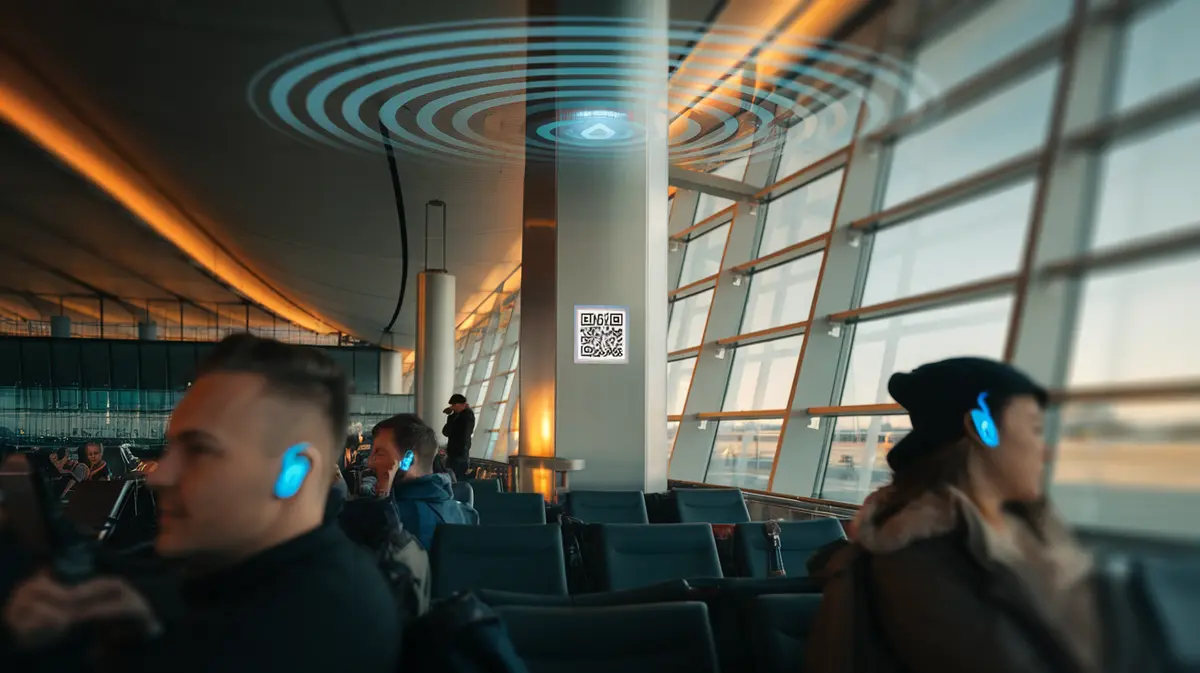
- Travel hubs. Gate announcements go straight into the ears of travellers who would otherwise miss them under noise-cancelling headphones.
- Conferences and places of worship. A venue can run one stream per language for interpretation, and listeners pick the one they want.
- Classrooms and lecture halls. The instructor’s microphone reaches students with hearing aids without a separate receiver.
- Sharing at home. Two people can listen to one phone or TV with their own earbuds, each at their own volume.
The Honest Limitations in 2026
Device support is the biggest gap. Android added LE Audio in version 13, and recent Samsung and Google phones can join broadcasts, but support depends on both the phone and the earbuds. Apple support has lagged Android, so check current iOS release notes before you assume iPhone users can join. Many earbuds sold before 2023 will never support LE Audio, because the radio hardware or firmware cannot be upgraded.
Latency. Broadcast delay is usually in the tens of milliseconds. That is fine for announcements and lectures. For live speech that people also hear in the room or see on a screen, test lip sync carefully, because a delay that is too long becomes an echo.
Compliance. In the United States, the 2010 ADA Standards require assistive listening systems in many assembly areas and require a share of receivers to work with hearing aids. Those rules were written around loops, infrared and FM. Auracast can be part of the answer, but it does not automatically satisfy them. Ask your accessibility consultant before ripping out an existing system.
Privacy. An open broadcast can be heard by anyone in range, including people outside the room. A stream can be encrypted with a Broadcast Code, which works like a Wi-Fi password.
How a Venue Sets Up a Stream Anyone Can Join
- Pick a certified transmitter. Look for Auracast or LE Audio broadcast certification, not just “Bluetooth 5.x”. A version number alone does not mean broadcast audio.
- Feed it a clean source. Take audio from a mixer output or the TV’s audio out, not from a microphone placed near a speaker.
- Name streams for humans. “Main Hall – English” beats “BT-TX-0042”. The name is the whole user interface.
- Decide open or encrypted. Public spaces should usually be open. Boardrooms, legal or medical settings should use a Broadcast Code, which should be changed when staff turn over.
- Post a QR code. The Bluetooth SIG has defined a QR code format that carries the stream name and code, so supported phones can join in one scan. Put the plain-text name and code on the sign too.
- Plan coverage. Treat range like Wi-Fi. Walls and bodies absorb the signal, so large rooms may need more than one transmitter.
- Test with real devices. Try at least one Android phone, one iPhone, and a pair of LE Audio hearing aids from the back row before opening day.
- Keep a fallback. Keep the existing loop or a few loaner receivers until most of your visitors can join.
Quick Checklist Before You Buy
- Which spaces need audio access, and what system is there today?
- How many separate streams do you need, for screens, rooms or languages?
- Open or encrypted, and who will manage the codes?
- Who will update transmitter firmware and test it every quarter?
The Bottom Line
Auracast turns the earbuds already in people’s pockets into assistive listening devices, multilingual receivers and personal TV speakers. In 2026 it is a practical addition for gyms, waiting rooms, training rooms and event spaces, as long as you test with real devices and keep a fallback while support catches up. The hearing loop is not gone yet, but new venues now have a second option that is far cheaper to install.
Planning audio for a meeting room or venue?
Internet Pros designs and installs conference room audio-visual, wireless and network systems, including broadcast audio that visitors can join from their own devices. Contact our team to plan a setup that works for every listener.