Autonomous Ships in 2026: How Maritime Autonomy, Remote Operations Centres, and the IMO MASS Code Are Quietly Rewriting Ocean Freight
- Internet Pros Team
- August 10, 2026
- AI & Technology
Around eighty percent of world trade by volume travels on a ship, and almost none of it is visible to the people whose lives depend on it. That invisibility is why maritime autonomy has advanced further than most technology audiences realize while attracting a fraction of the attention given to self-driving cars. There are vessels operating today that cross harbours, run coastal routes, and survey the seabed with nobody at the wheel - and there are very good reasons why the container ship carrying your inventory across the Pacific still has a full crew aboard, and probably will for a long time.
What Autonomy Actually Means at Sea
The word does far too much work in shipping headlines. The maritime industry settled on a scale of degrees rather than a binary, and it is worth internalizing because almost every real deployment sits in the middle of it, not at the end.
| Degree | What It Means | Who Is Responsible | Where It Is in 2026 |
|---|---|---|---|
| One: decision support | Automation advises, crew aboard operates the ship | Bridge team | Widely deployed and commercially normal |
| Two: remotely controlled, crew aboard | Shore centre can take the con, crew remain as fallback | Shared, shore-led | In service on ferries, tugs, and short-sea routes |
| Three: remotely controlled, no crew | Nobody aboard, an operator ashore supervises and intervenes | Remote operations centre | Trials and limited coastal operations |
| Four: fully autonomous | The system decides and acts without human input | The operating company and its software | Research, small uncrewed craft, defence programmes |
The commercially interesting territory is degrees one and two. A system that reduces the workload on a fatigued bridge team at three in the morning delivers measurable safety value without requiring anyone to rewrite maritime law, and it can be retrofitted to a hull that will still be trading in 2045.
The Problem Autonomy Is Actually Solving
It is tempting to assume the goal is eliminating crew costs. On a large container ship, crew is a surprisingly small slice of operating expense compared with fuel, and the harder pressure is that the industry cannot recruit enough qualified officers. The shortfall in certified senior officers has been widening for years, and a career that means months away from family in an era of instant communication is a difficult sell.
The second driver is safety. The overwhelming majority of marine casualties involve human factors - fatigue, distraction, misjudged closing situations, or a lookout that lapsed for ninety seconds. A radar and camera stack does not get bored at 0300, and that is exactly the failure mode statistics keep pointing at.
The third is fuel. Continuous optimization of speed, trim, routing, and engine load against real weather forecasts saves a meaningful percentage of bunker fuel on a long voyage, and with emissions rules tightening, a few percent of fuel is a compliance question rather than a rounding error.
"The business case is not the empty bridge. It is the tired officer who now has a second set of eyes that never blinks, and a ship that arrives having burned less fuel to get there."
Why the Sensor Problem Is Not the Automotive Problem
People assume maritime autonomy is an easier version of self-driving, because the ocean is empty. It is a different problem, and in several respects a harder one.
A ship already carries excellent long-range sensing. Marine radar sees for miles, and every commercial vessel broadcasts identity, position, course, and speed over AIS. Charts are digital and standardized. What the traditional stack does not do is see anything that fails to broadcast and fails to return a strong radar echo - a small fishing boat riding low, a partially submerged container, a kayak, a navigation buoy that has drifted. That is precisely the gap that cameras, thermal imaging, and sensor fusion are being brought in to close.
Then the environment fights back. Spray coats lenses, fog erases the horizon, sun glare off water saturates sensors, the deck is pitching in three axes, and there are no lane markings, no traffic lights, and no road edges to anchor perception. A car that becomes uncertain can stop in half a second. A loaded container ship needs kilometres to stop and cannot hold station in a current. Every decision has to be made much earlier and with far less ability to undo it.
COLREGs: Rules Written for Judgement, Not for Code
The international collision regulations govern how vessels behave around each other, and they are the deepest technical obstacle in the field. They specify which vessel gives way in a crossing situation, how to behave in restricted visibility, and what lights and shapes mean. They also instruct mariners to act in accordance with the ordinary practice of seamen and to depart from the rules entirely where departure is necessary to avoid immediate danger.
That is a legal standard built around trained human judgement, and it does not compile. Worse, real traffic is negotiated socially: two masters in a crossing situation frequently resolve it by early, slightly exaggerated course changes that signal intent, and sometimes by a radio call. An autonomous system must be predictable enough that a human master reading its behaviour draws the right conclusion, while remaining legal enough to satisfy a court afterwards. Being technically correct and behaviourally confusing is the dangerous combination.
Why This Matters to Companies That Do Not Own Ships
Maritime autonomy leaks into systems that landlocked businesses depend on:
- Arrival predictability improves. Continuously optimized voyages and richer telemetry make estimated arrival times tighter, which changes how much safety stock a warehouse needs to hold.
- Port slots become the bottleneck. A vessel that can hold an exact schedule is only useful if the berth, crane, and drayage chain can meet it, which pushes automation inland.
- The attack surface moves ashore. A ship controlled or advised from a building on land turns a navigation system into a networked asset with an authentication story.
- Insurance and liability get rewritten. When a system rather than a master makes the avoidance decision, fault allocation becomes a software evidence question - which means logging becomes a legal requirement.
- Freight data gets better. Denser sensor telemetry feeds the supply chain visibility tools that logistics software vendors are already selling.
The Remote Operations Centre Is the Real Innovation
The most consequential change is not the empty bridge but the room ashore. A remote operations centre gives one operator oversight of several vessels at once, with the system escalating to a human when a situation exceeds its confidence. This is where the economics start to work: supervision scales in a way that crewing never has.
It also creates the discipline problem that automation always creates. An operator monitoring six quiet vessels for eight hours is a poor candidate for taking instant manual control of a complex crossing situation. Good designs therefore avoid sudden handovers and instead ask the operator to approve a proposed plan with plenty of time in hand. Connectivity has become the enabler here, because low-earth-orbit satellite service turned high-bandwidth video from ships into a routine expectation rather than a rare luxury - though any serious design still assumes the link will drop and requires the vessel to behave safely on its own until it returns.
Where It Genuinely Works Today
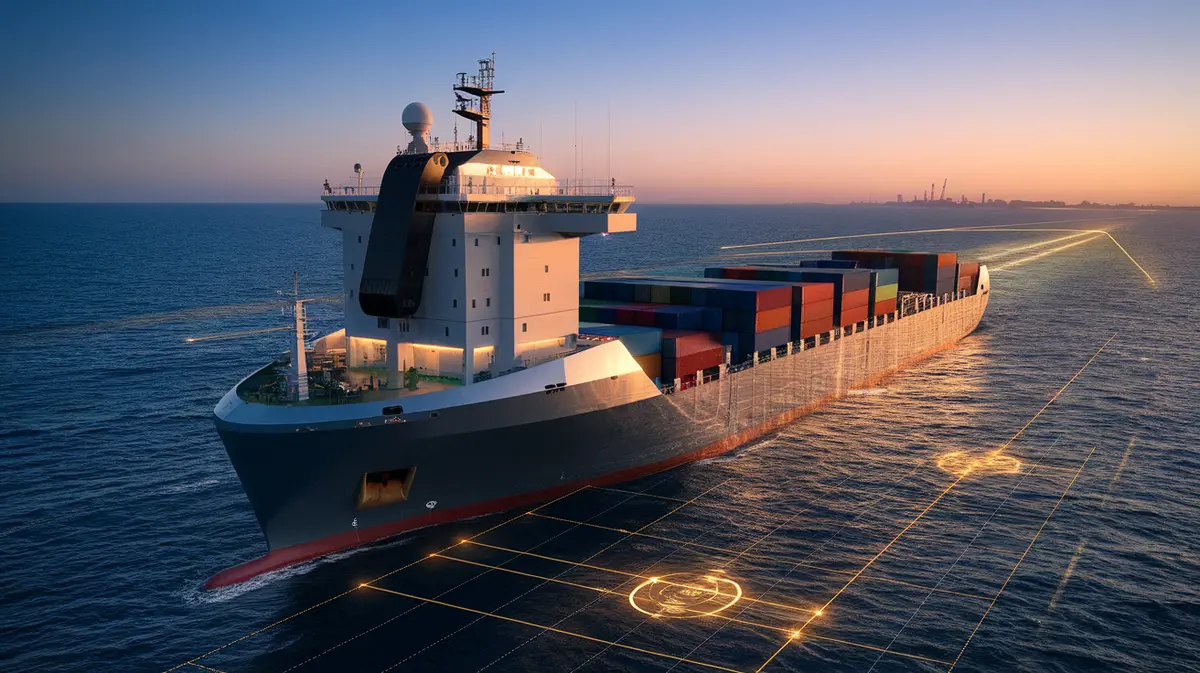
Autonomy has landed first in the places where the operating envelope can be tightly bounded. Short-sea and coastal container feeders on fixed routes, harbour tugs performing repeatable manoeuvres, ferries that automate the crossing while a master handles berthing, and uncrewed survey vessels mapping the seabed for weeks at a stretch are all in real service. Below deck, condition-based monitoring of engines and machinery has quietly become mainstream and probably saves more money today than anything happening on the bridge.
What is not happening is a crewless deep-sea ship crossing an ocean and berthing itself. Nothing about that is only a navigation problem - a crew also fights fires, patches leaks, secures shifting cargo, and repairs machinery a thousand miles from help.
Regulation Finally Caught Up Enough to Start
For years the blocker was legal, not technical: the core safety conventions were written assuming a competent crew aboard, with requirements for a proper lookout and a master in command. The international framework for autonomous ships has now taken shape as a non-mandatory code, with a mandatory instrument targeted for the early 2030s. That structure is deliberate - it lets flag states, class societies, and operators accumulate evidence under a common vocabulary before rules harden.
Practically, this means an operator today works through goal-based approval: demonstrate that an autonomous arrangement is at least as safe as the conventional one for a defined route and set of conditions. It is slower than a rulebook, but it is a path that exists, which was not true a few years ago.
The Limitations Worth Stating Plainly
- Verification is unsolved. Nobody has agreed how many sea miles or simulated encounters prove a collision avoidance system is safe enough.
- Maintenance still needs hands. Machinery that a crew would fix underway becomes a towed casualty on an uncrewed vessel.
- Piracy and boarding are unresolved. An uncrewed ship is a softer target and a harder recovery problem.
- Cyber risk is now safety risk. Remote control channels and position inputs are attack surfaces, and GNSS spoofing is already a documented reality in several regions.
- Retrofit economics are unforgiving. Ships last decades, so the fleet turns over slowly and any technology that cannot be added to an existing hull spreads very slowly.
The Sensible Way to Read This
Maritime autonomy is following the pattern that industrial automation almost always follows and that consumer coverage almost always misses. The dramatic version - the crewless ocean crossing - remains distant and may never be the point. The valuable version is already installed: better perception on a manned bridge, machinery that reports its own condition, voyages optimized continuously rather than at departure, and a shore team that can see and assist across a fleet.
For anyone whose business depends on things arriving, the practical takeaway is that ocean freight is becoming a data-rich, more predictable link in the chain rather than an opaque three-week gap. That change is worth more to most companies than an empty bridge ever will be.