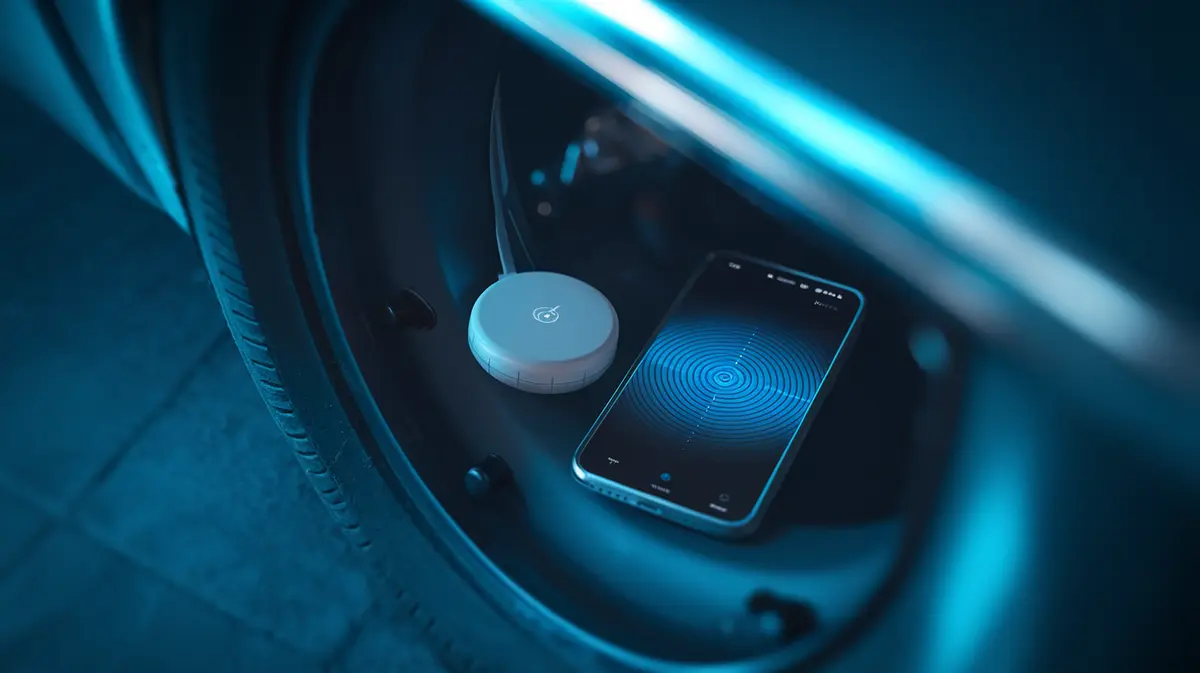
Bluetooth Item Trackers in 2026: Why a $30 Tag Can Follow a Car Across the Country, What Cross-Platform Unwanted-Tracker Alerts Actually Detect, and How to Sweep a Vehicle or Bag for a Hidden Tag
- Internet Pros Team
- October 16, 2026
- Networking & Security
A coin-sized tag costs about $30, runs for a year on a watch battery, and has no GPS or cellular radio. It can still report its location from almost anywhere people carry phones. That is great for lost luggage, and also a cheap way to follow a person, a company vehicle or a delivery without anyone noticing. Here is how these trackers work, what phones now do to warn you, and where those warnings fall short.
How a Tag With No GPS Finds Itself
An item tracker such as an Apple AirTag, Samsung SmartTag, Tile, Chipolo or Pebblebee does one simple thing: it sends out a short Bluetooth Low Energy signal every few seconds. It does not know where it is. The phones around it do the work.
Any nearby phone that belongs to the same finding network hears the signal, adds its own GPS position, and uploads an encrypted report. Apple’s Find My network uses hundreds of millions of iPhones, iPads and Macs. Google’s network, launched in 2024 and now called Find Hub, uses Android phones. The owner’s app downloads the reports and shows the tag on a map.
The design protects the owner’s privacy. Reports are encrypted with a key only the owner holds, so Apple or Google cannot read the location, and the person whose phone relayed it never knows. The tag also changes its broadcast ID regularly, so a stranger cannot follow one tag by its signal. The weak point: the network cannot tell a set of keys from someone else’s car.
A tracker is only as private as the phones around it allow. The same crowd that finds your lost bag can also find the person carrying a tag they never chose.
From Lost Keys to Stalking
Within months of the AirTag launch in 2021, police and domestic violence groups reported tags hidden in cars, coats and handbags. Apple added alerts for iPhone users and released an Android scanning app. That left a gap: an iPhone only warned about AirTags, an Android phone only warned about some tags, and many people never installed the extra app.
In May 2023 Apple and Google jointly proposed a common standard, now developed at the IETF as DULT (Detecting Unwanted Location Trackers). Alerts across platforms went live in May 2024 with iOS 17.5 and Android 6.0 or later. Samsung, Tile, Chipolo, Pebblebee and others have committed to support it.
What the Alerts Actually Detect
A tag that follows the standard behaves in two ways. When it is near its owner’s phone, it is in normal mode. When it has been away from the owner for a while, it switches to separated mode and broadcasts a flag that says so. Your phone watches for a separated tag that keeps showing up near you as you move between places. If one does, you get an alert such as “Unknown tracker traveling with you.”
| Feature | What it does | The limit |
|---|---|---|
| Phone alert | Warns when a separated tag moves with you | Can take hours, and usually needs you to change location |
| Play sound | Makes the tag beep so you can find it | Fails if the speaker has been removed |
| Precision finding | Points you to the tag with distance and direction | Works only with UWB tags and phones |
| Owner details | Shows the serial number and part of the owner’s phone number or email | Full identity is only given to police with a legal request |
| Disable instructions | Tells you how to remove the battery | Disabling it also tells the owner the tag went offline |
Where the Protection Falls Short
- Older or off-brand tags. Cheap tags and older models may not follow the standard and will not trigger any alert.
- Silent tags. AirTags with the speaker removed are sold online. Phone alerts still work, but the audible warning does not.
- Clones that keep changing identity. Researchers have built tags that switch to a new ID every few minutes so no single tag seems to follow you long enough to raise an alert. Others have shown ways to make ordinary Bluetooth devices report through a finding network.
- Phones that are not listening. Alerts need Bluetooth and location services turned on, and a supported phone. A child with no phone, or a car parked overnight with nobody inside, gets no warning.
- Real GPS trackers. Devices with their own cellular modem never touch Bluetooth finding networks, so DULT does not see them at all.
How to Sweep a Vehicle or Bag
Start with the phone
On an iPhone, open Find My > Items and look at Items Detected Near You. On Android, open Settings > Safety & emergency > Unknown tracker alerts and tap Scan now. A manual scan takes about 10 seconds and also finds tags that are not yet in separated mode.
Then search by hand
In a car, check wheel wells, under bumpers, behind the license plate, under seats, inside the spare tire well, the glove box and the trunk lining. In a bag, check the lining, inner pockets, and seams. Tags are about 3 cm across and about 1 cm thick. A magnetic or taped case is a strong hint that it was placed on purpose.
If you find one
If you feel unsafe, photograph the tag and the screen showing its serial number before you disable it, and contact the police. Removing the battery stops tracking, but it also tells the owner something changed. In that case, plan your next steps with a domestic violence advocate or the police first.
Item trackers in the workplace: a short policy
- Track assets, not people. Tags on tool cases, loaner laptops and equipment are fine. Tags on vehicles or bags that employees take home need clear written notice, and in some states consent.
- Use fleet tools for vehicles. A proper telematics system with a documented policy is safer legally than a consumer tag hidden under a seat.
- Register every company tag in an inventory so a staff member who gets an alert can check whether the tag belongs to the company.
- Teach staff to scan. Executives, people traveling alone and employees in a dispute with a former partner should know how to run a manual scan.
- Use item sharing for luggage. Apple and many airlines now accept a temporary shared location link for a lost bag, so travel tags can help without giving out permanent access.
The Bottom Line
Bluetooth item trackers are cheap, accurate and useful, and the networks that power them are very well designed for privacy. The cross-platform alerts from Apple and Google close the biggest gap, but they are a safety net, not a guarantee. Silent tags, clones and GPS trackers can still get past them. Turn on alerts, know how to run a manual scan, and give your business a clear rule for when tracking is allowed.
Need help with device security or asset tracking?
Internet Pros helps businesses set up mobile device policies, choose asset and fleet tracking that respects privacy law, and train staff to spot unwanted trackers and stalkerware. Contact our team to talk it through.