Counter-Drone Technology in 2026: How RF Detection, Radar, AI Vision, and Interceptor Drones Are Defending Airports, Stadiums, and Critical Infrastructure
- Internet Pros Team
- August 1, 2026
- Networking & Security
A quadcopter you can buy for the price of a laptop can close a major airport for hours, hover over a substation nobody is watching, film the inside of a fenced facility, or drop a package over a prison wall. None of that requires skill, funding, or intent to harm - most incursions are careless hobbyists. But the defender cannot tell the difference from the ground, and that asymmetry is why counter-drone technology, once a military specialty, became ordinary infrastructure security in 2026.
Why This Stopped Being a Defense Niche
Three things converged. Consumer drones got dramatically more capable - longer range, better cameras, obstacle avoidance, and autonomous flight that needs no skilled pilot. The number of aircraft in low airspace exploded as delivery, inspection, mapping, and agricultural operators went commercial. And the last few years produced a steady drumbeat of incidents: airport shutdowns from unidentified drones near runways, unexplained sightings over military installations and energy sites, and a persistent contraband problem at correctional facilities.
The uncomfortable part is the economics. The drone costs a few hundred dollars; the response - grounding flights, dispatching police, halting an event - costs orders of magnitude more. Any defense that is expensive per incident loses that trade, which is why the field has shifted toward cheap, always-on detection rather than dramatic countermeasures.
"We are defending million-dollar operations against thousand-dollar aircraft, and for most of the last decade our only real tool was a phone call."
Detection: Four Sensors, None of Them Sufficient Alone
Counter-UAS - shorthand C-UAS - splits cleanly into two halves: knowing something is there, and doing something about it. Detection is where nearly all of the real progress has happened, and it relies on four sensor types with genuinely different failure modes.
- Radio frequency (RF) sensing - listens for the control link and video downlink between drone and operator, and can often identify the model and locate the pilot. Cheap, passive, and long-range. Blind to drones flying a pre-programmed route with the radio off.
- Radar - detects the physical object regardless of whether it is transmitting. Works at night, in fog, and against radio-silent aircraft. Small drones have tiny radar signatures and fly low and slow, so the hard part is distinguishing them from birds and ground clutter.
- Electro-optical and infrared cameras - the confirmation layer. A radar track is a dot; a camera slewed to it tells you whether it is a drone, a bird, or a plastic bag, and whether it is carrying something. Limited by weather, darkness, and line of sight.
- Acoustic arrays - microphone arrays trained on rotor signatures. Short range and noise-sensitive, but inexpensive, entirely passive, and useful in cluttered urban settings where radar struggles.
- Remote ID - not a sensor but a regulatory layer: compliant drones broadcast an identifier and location, effectively a digital license plate. Enormously useful for sorting cooperative traffic from the rest - and, obviously, ignored by anyone deliberately misbehaving.
The Real Breakthrough Is Sensor Fusion
Any single sensor produces an unusable stream of false alarms. Radar flags every bird. RF flags a neighbor flying in his backyard a mile away. Cameras flag anything that moves. A security team that gets forty alerts a night stops reading them by the second week, and a system nobody reads is worse than no system at all.
What changed is the software layer. Modern C-UAS platforms fuse all four feeds into a single track, then apply machine learning trained on the acoustic, radar, and RF fingerprints of specific airframes to answer the questions that matter operationally: is this a drone, what type is it, is it heading toward the thing we care about, and has it been here before? Behavioral classification - loitering along a fence line versus transiting overhead - is what turns raw detections into a decision a human can act on. The measure of a good system in 2026 is not detection range. It is how few times it cries wolf.
| Sensor | Strength | Blind Spot |
|---|---|---|
| RF sensing | Passive, long range, can locate the operator and identify the model. | Useless against autonomous, radio-silent flight. |
| Radar | Sees the object itself, day or night, transmitting or not. | Tiny signatures; heavy clutter and bird confusion near the ground. |
| EO/IR cameras | Visual confirmation and payload assessment. | Weather, darkness, and needs to be told where to look. |
| Acoustic | Cheap, passive, effective in cluttered urban environments. | Short range, degrades badly in noisy settings. |
| Remote ID | Instantly sorts cooperative traffic from unknowns. | Only works on aircraft that choose to comply. |
Mitigation: The Half Almost Nobody Is Allowed to Use
The countermeasure side gets the attention - and is the part most organizations will never touch. Broadly, the options fall into electronic and physical categories. Electronic approaches interfere with the control link or navigation signal so the aircraft lands, hovers, or returns home. Physical approaches capture or disable the airframe directly: net-carrying interceptor drones, tethered nets fired from the ground, and at the high end, directed-energy systems used only in military settings.
Why interception is harder than it looks
Every countermeasure creates a second problem. Jamming a control link is indiscriminate - the same spectrum carries air traffic communications, GPS timing, and mobile networks, so using it near an airport can cause more disruption than the drone did. Interfering with navigation can send an aircraft somewhere less safe than where it was. And a disabled drone still falls, which over a packed stadium is a falling object with mass. Non-kinetic capture is favored in civilian environments for exactly this reason, and even then the debris question never fully goes away.
The Bottleneck Is Legal, Not Technical
This is the single most misunderstood point in the field. In the United States and most comparable jurisdictions, interfering with an aircraft in flight, intercepting its communications, or jamming radio spectrum is prohibited by long-standing law - and a drone is legally an aircraft. Authority to actually mitigate is narrowly delegated to a short list of federal agencies for a short list of covered sites. A stadium, a hospital, a data center, a chemical plant, or a private airfield generally has no such authority, no matter what a vendor implies at a trade show.
What is broadly permissible is passive detection: knowing a drone is present and where it is going, then handing that to whoever is authorized to respond. That gap - detection legal almost everywhere, mitigation legal almost nowhere - defines the market, and it is why the fastest-growing product category is the sensor rather than the interceptor. Any organization evaluating C-UAS should treat the legal review as the first step, not the last.
Where It Is Actually Being Deployed
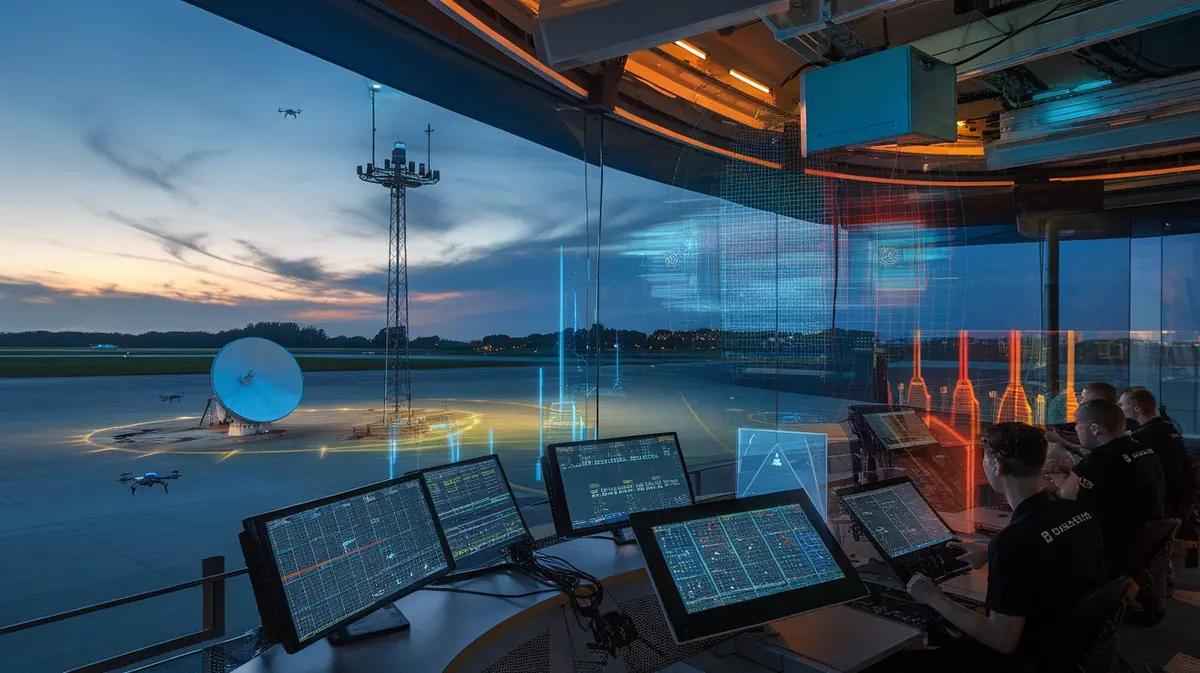
- Airports - the highest-stakes case, where a single unresolved sighting can halt departures and cascade across a network for a day.
- Energy and utilities - substations, pipelines, refineries, and increasingly the sprawling data center campuses that now sit alongside them.
- Stadiums and large events - temporary deployments where the crowd itself is the asset being protected and any falling object is unacceptable.
- Correctional facilities - the most persistent and least glamorous problem, where drone-delivered contraband is a routine operational reality.
- Corporate and industrial sites - protecting test tracks, prototype yards, and R&D campuses from aerial industrial espionage, which is far more common than most companies realize.
The Honest Trade-Offs
- False positives destroy trust. The failure mode is not a missed drone. It is an alert stream so noisy that operators mute it, which is how detection systems quietly become expensive decorations.
- The countermeasure may be worse than the threat. Near an airport or a crowd, the disruption caused by jamming or a falling airframe can exceed the disruption caused by the intruder.
- Autonomy is eroding RF detection. As more drones fly pre-programmed routes without an active radio link, the cheapest and most widely deployed sensor becomes the least reliable one, pushing costs toward radar.
- Detection is surveillance. These systems record radio activity and video across an area, which raises privacy questions in dense environments and deserves a policy before installation, not after a complaint.
- It is a subscription, not a purchase. New airframes and protocols appear constantly, so a system without regular signature updates degrades within a year or two - and vendor detection ranges are quoted under ideal conditions, not in rain or clutter.
What Ordinary Organizations Should Actually Do
Most businesses do not need a radar installation. They need three cheaper things they mostly do not have: a documented answer to what happens when a drone appears over the property, including who is called and who has authority to act - almost always law enforcement rather than your own team; a physical-security review that assumes aerial approach, since most site plans were drawn expecting intruders at ground level and leave rooftop equipment, skylights, and open staging areas exposed; and a policy for your own drones, because inspection and marketing flights carry Remote ID and airspace obligations of their own.
The Bottom Line
Low-altitude airspace stopped being empty, and the security assumptions built around a world where it was are no longer valid. Counter-drone technology in 2026 is best understood not as a weapons category but as an awareness category: radar, radio, optical, and acoustic sensing fused by machine learning that decides what is worth interrupting a human for.
The technology to see what is flying overhead is mature and affordable. The authority to do anything about it remains narrow and contested - and that, far more than any sensor limitation, is the story of the next several years. For most organizations the practical move is unglamorous and available today: find out what is actually in your airspace, and decide in advance who you call when something unwelcome shows up.