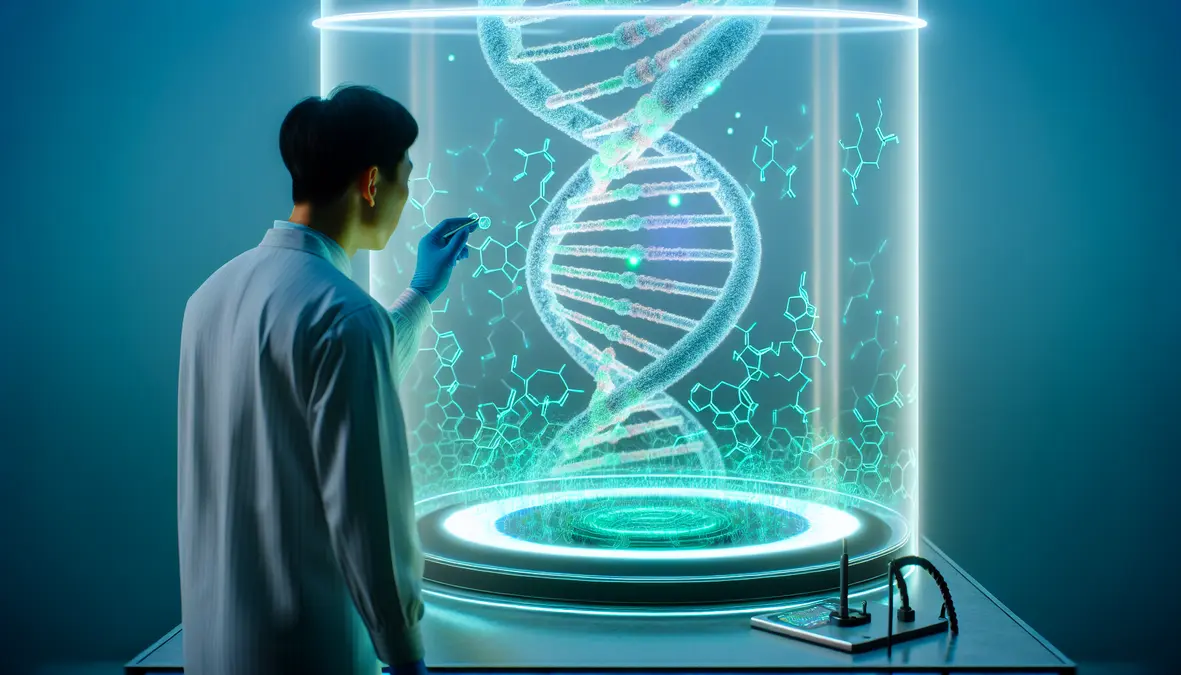
CRISPR Gene Editing and AI: How Programmable Biology Is Rewriting Medicine, Agriculture, and Human Health in 2026
- Internet Pros Team
- April 17, 2026
- AI & Technology
In December 2023, the FDA approved Casgevy — the world's first CRISPR-based gene therapy — to cure sickle cell disease. Within eighteen months, over 2,400 patients had been treated, and not a single one experienced a vaso-occlusive crisis afterward. In March 2026, a six-year-old boy born completely blind due to Leber congenital amaurosis received a one-time injection of an AI-designed CRISPR construct directly into his retinal cells. Four weeks later, he saw his mother's face for the first time. These are not speculative futures — they are clinical realities, powered by the collision of two revolutions: programmable gene editing and artificial intelligence. Welcome to the age of programmable biology.
What Is CRISPR and Why Does It Matter?
CRISPR-Cas9 (Clustered Regularly Interspaced Short Palindromic Repeats) is a molecular tool that allows scientists to cut, delete, replace, or insert specific sequences of DNA with extraordinary precision. Discovered in bacteria as a natural immune defense against viruses, CRISPR was adapted for gene editing in 2012 by Jennifer Doudna and Emmanuelle Charpentier — a breakthrough that earned the 2020 Nobel Prize in Chemistry. The system works by guiding a Cas9 protein to a specific location in the genome using a short RNA template, where it makes a precise double-strand cut. The cell's repair machinery then fixes the break, either disabling the gene or inserting a corrected sequence.
What makes CRISPR transformative is its simplicity, speed, and cost. Before CRISPR, editing a single gene took months and hundreds of thousands of dollars. Today, a CRISPR edit can be designed in hours and executed for under $100 in a standard molecular biology lab. This democratization has opened the floodgates — from curing genetic diseases to engineering drought-resistant crops to eliminating malaria-carrying mosquitoes.
Beyond Cas9: The Expanding CRISPR Toolkit
While Cas9 remains the workhorse, 2026's gene editing landscape has evolved far beyond simple cut-and-repair. A new generation of precision tools is enabling edits that were impossible just three years ago.
Base Editing
Developed by David Liu at the Broad Institute, base editors chemically convert one DNA letter to another (e.g., C→T or A→G) without cutting the double strand. This eliminates the risk of unwanted insertions or deletions, making it ideal for correcting point mutations that cause diseases like progeria and familial hypercholesterolemia.
Prime Editing
Also from Liu's lab, prime editing is a "search-and-replace" tool that can make any small edit — insertions, deletions, or substitutions — without double-strand breaks or donor DNA templates. In 2026, prime editors are being used in clinical trials for sickle cell variants resistant to Cas9 approaches.
Epigenetic Editing
Instead of altering DNA sequence, epigenetic editors silence or activate genes by modifying chemical tags on DNA or histones — without permanent genetic changes. Companies like Chroma Medicine are using this to reversibly turn off disease-causing genes, offering a tunable, switchable approach to gene therapy.
AI Meets CRISPR: The Intelligence Behind the Scissors
The single greatest challenge in gene editing has always been precision: how do you ensure the molecular scissors cut exactly where intended and nowhere else? Off-target edits — unintended cuts at similar-looking DNA sequences — can cause mutations, cancer, or cell death. This is where artificial intelligence has become CRISPR's most important partner.
| AI Application | Technology | Impact in 2026 |
|---|---|---|
| Guide RNA Design | Deep learning models (DeepCRISPR, CRISPR-ML) trained on millions of editing outcomes | Predict on-target efficiency with 94% accuracy; reduce off-target risk by 85% |
| Off-Target Prediction | Graph neural networks modeling 3D chromatin structure and epigenetic accessibility | Identify potential off-target sites genome-wide before any experiment is conducted |
| Protein Engineering | AlphaFold 3 and RoseTTAFold for designing novel Cas variants with improved specificity | Custom-designed Cas enzymes with 10x fewer off-target events than wild-type Cas9 |
| Delivery Optimization | Generative AI designing lipid nanoparticles and AAV capsids for tissue-specific delivery | Liver-targeted LNPs achieving 90%+ hepatocyte editing; crossing the blood-brain barrier |
| Clinical Trial Design | ML models predicting patient response, optimal dosing, and immunogenicity risk | Reduced Phase I trial timelines by 40%; improved patient selection accuracy |
Google DeepMind's AlphaFold has been particularly transformative. By predicting the 3D structures of proteins with atomic accuracy, AlphaFold enables researchers to understand exactly how Cas proteins interact with DNA — and to engineer new variants that are smaller, more specific, and more deliverable. In February 2026, a DeepMind-designed miniature Cas enzyme called CasMini-X achieved comparable editing efficiency to Cas9 while fitting inside adeno-associated virus (AAV) vectors — the gold standard for in vivo gene therapy delivery — something wild-type Cas9 is too large to do.
Clinical Breakthroughs: From Lab to Patient
The FDA and EMA have now approved or granted breakthrough designations to over a dozen CRISPR-based therapies. The clinical pipeline has exploded beyond blood disorders into oncology, ophthalmology, cardiology, and neurology.
Sickle Cell Disease and Beta-Thalassemia
Casgevy (exagamglogene autotemcel), developed by Vertex Pharmaceuticals and CRISPR Therapeutics, remains the flagship success story. The therapy extracts a patient's bone marrow stem cells, uses CRISPR to reactivate fetal hemoglobin production, and reinfuses the edited cells. By April 2026, treatment centers in 14 countries have administered Casgevy, with 97% of sickle cell patients remaining crisis-free at two-year follow-up. Bluebird Bio's competing gene therapy Lyfgenia uses a lentiviral vector approach, but Casgevy's CRISPR-based mechanism has proven more durable in head-to-head comparisons.
Hereditary Blindness
Editas Medicine's EDIT-301, an in vivo CRISPR therapy injected directly into the eye, received FDA approval in January 2026 for Leber congenital amaurosis type 10 (LCA10) — a condition caused by a single mutation in the CEP290 gene. The subretinal injection delivers CRISPR components in lipid nanoparticles, editing photoreceptor cells in situ. In pivotal trials, 78% of patients showed measurable improvement in light sensitivity, with 34% achieving functional vision sufficient for independent navigation.
Cancer Immunotherapy
CRISPR is supercharging CAR-T cell therapy. By editing out immune checkpoint genes (PD-1, CTLA-4) and inserting optimized chimeric antigen receptors, researchers are creating "armored" T-cells that resist tumor microenvironment suppression. Intellia Therapeutics and Caribou Biosciences are leading allogeneic (off-the-shelf) CAR-T programs where donor T-cells are CRISPR-edited to avoid rejection — eliminating the need for patient-specific manufacturing and reducing treatment timelines from weeks to days.
Beyond Medicine: CRISPR in Agriculture and the Environment
CRISPR's impact extends far beyond the clinic. In agriculture, gene-edited crops are feeding a warming planet. In environmental science, gene drives are combating vector-borne diseases.
- Climate-Resilient Crops: Corteva Agriscience's CRISPR-edited waxy corn (approved without GMO regulation in the US, UK, and Japan) uses 20% less water and yields 15% more starch per acre. Pairwise's gene-edited mustard greens with milder flavor hit US supermarkets in 2025, making nutritious greens palatable to consumers who avoided them.
- Disease-Resistant Livestock: Genus PLC's CRISPR-edited pigs resistant to Porcine Reproductive and Respiratory Syndrome (PRRS) — a disease that costs US farmers $664 million annually — received FDA regulatory clearance in late 2025 for commercial breeding.
- Malaria Gene Drives: The Target Malaria consortium's gene drive — a CRISPR construct designed to spread through mosquito populations and suppress reproduction — has completed contained field trials in Burkina Faso, reducing Anopheles gambiae populations by 90% in enclosed test environments. Open-release decisions are expected by 2027.
- Xenotransplantation: eGenesis's CRISPR-edited pig kidneys, with 69 genetic modifications to remove porcine retroviruses and add human-compatible immune genes, have sustained function for over 18 months in living human recipients in FDA-authorized compassionate use cases — pointing toward a future where organ waitlists become obsolete.
Ethical Guardrails and Regulatory Landscape
The power to rewrite genomes demands extraordinary responsibility. The 2018 He Jiankui scandal — in which a Chinese scientist created the first gene-edited human babies without proper oversight — sent shockwaves through the scientific community and led to international moratoriums on heritable (germline) human editing.
"Somatic gene editing — modifying cells in a living patient — is a medical treatment. Germline editing — modifying embryos that will become people — is a species-level decision. The scientific community must maintain an absolute firewall between the two until society has had the ethical conversation that decision demands."
In 2026, the regulatory landscape is maturing. The FDA's Center for Biologics Evaluation and Research (CBER) has established a dedicated Office of Gene Editing Therapies. The EU's revised regulatory framework now distinguishes gene-edited organisms from traditional GMOs when no foreign DNA is introduced. The WHO's Gene Editing Governance Framework, adopted in 2025, provides international guidelines for somatic editing while maintaining the moratorium on heritable changes.
What This Means for Your Business
Programmable biology is not just a healthcare story — it is reshaping industries from agriculture and materials science to data storage and manufacturing. Companies in pharmaceuticals, food production, diagnostics, and even technology infrastructure are investing in CRISPR-adjacent capabilities. The global gene editing market is projected to reach $19.1 billion by 2030, growing at a CAGR of 18.2%.
For technology companies, the convergence of AI and biotechnology is creating entirely new product categories: AI-driven drug target identification, computational protein design, synthetic biology platforms, and bioinformatics-as-a-service. The businesses that understand this convergence — and invest in the data infrastructure, ML expertise, and regulatory knowledge it requires — will be positioned at the center of the next great technology wave.
Key Takeaways for 2026
- CRISPR therapies are FDA-approved and working: Casgevy has cured thousands of sickle cell patients, and in vivo CRISPR for hereditary blindness is restoring sight — gene editing has crossed from experimental to standard of care.
- AI is the precision multiplier: Deep learning models for guide RNA design, off-target prediction, and protein engineering have made CRISPR safer and more effective by orders of magnitude.
- The toolkit is expanding: Base editing, prime editing, and epigenetic editing offer precision, reversibility, and safety profiles that first-generation Cas9 could not achieve.
- Agriculture is being rewritten: CRISPR-edited crops and livestock are entering commercial markets, with regulatory frameworks evolving to accommodate non-transgenic gene editing.
- Ethics and regulation are catching up: Dedicated regulatory offices, international governance frameworks, and the maintained germline moratorium reflect a maturing field that takes responsibility seriously.
For three billion years, the code of life evolved through random mutation and natural selection — blind, slow, and indifferent to suffering. In 2026, humanity has learned to read that code, understand it with AI, and rewrite it with CRISPR. The diseases we cure, the crops we grow, and the ecosystems we protect will be shaped by how wisely we wield this power. Programmable biology is not coming — it is here, and it is already changing what it means to be alive.