Direct Air Capture (DAC): How Carbon Removal Tech Is Scaling From Pilot Plants to Megaton Reality in 2026
- Internet Pros Team
- May 5, 2026
- AI & Technology
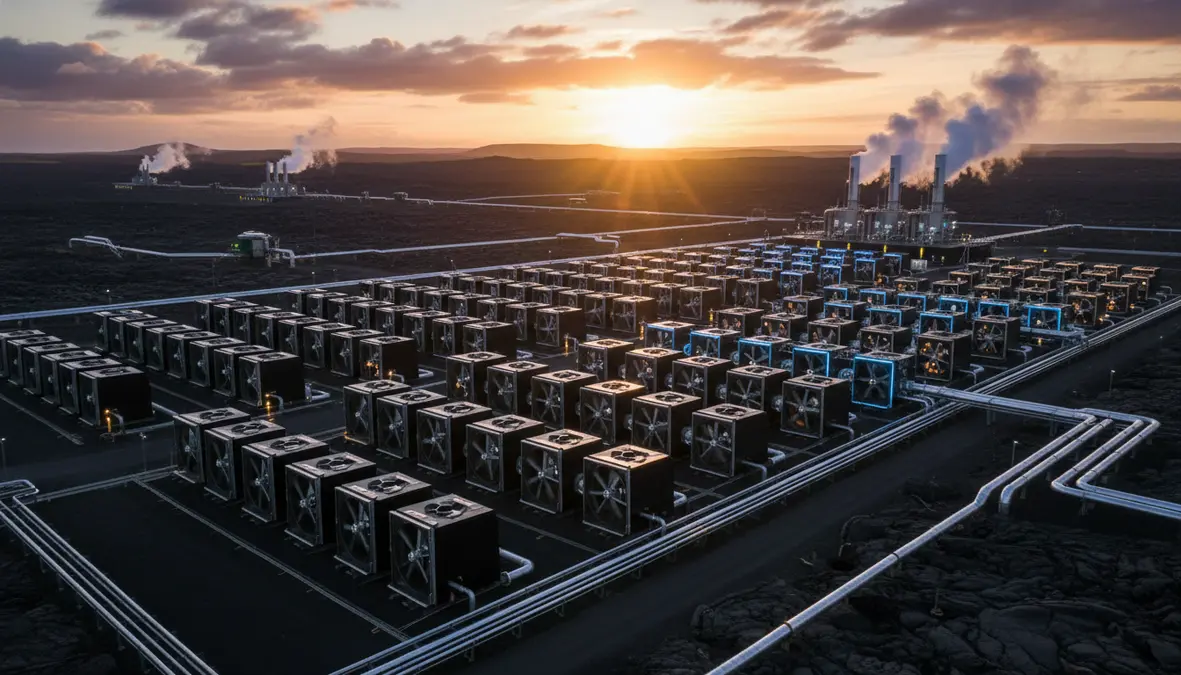
In the lava fields of southern Iceland, fans the size of shipping containers pull desert-dry air across honeycomb modules of porous sorbent. Every twelve hours the modules close, heat to 100°C, and release a pure stream of carbon dioxide that is piped, dissolved into water, and injected into nearby basalt where it mineralizes into stone within two years. The plant — Climeworks Mammoth — is the first commercial-scale direct air capture (DAC) facility on Earth, and in 2026 it shares the field with Occidental's Stratos in West Texas, Heirloom's limestone-loop plants in Louisiana, and a wave of new builds funded by the U.S. Department of Energy's Regional DAC Hubs. After a decade of pilot-scale skepticism, carbon removal has crossed a credibility threshold: real plants, real tons, real buyers, and a real cost curve that is finally bending the right direction.
Why DAC Suddenly Matters
Every credible 1.5°C pathway from the IPCC includes negative emissions — not just stopping new CO₂, but pulling existing CO₂ back out of the atmosphere. Even with aggressive decarbonization, agriculture, aviation, cement, and industrial process emissions leave a residual five to ten gigatons of annual CO₂ that has to be balanced by removals if net zero is to mean anything. Trees, soil, and ocean alkalinity will do part of the work. The rest has to come from engineered systems that can be measured to the molecule, sequestered for a thousand-plus years, and operated at megaton scale. DAC is the only technology family that meets all three criteria today.
For most of the 2010s, DAC was a research curiosity priced at $600 to $1,000 per ton — too expensive to compete with reforestation credits at $5 to $25. What changed is a stack of policy, capital, and engineering shifts: the U.S. Inflation Reduction Act's expanded Section 45Q tax credit now pays $180 per ton of CO₂ captured and geologically stored from atmospheric sources; the DOE's $3.5 billion Regional DAC Hubs program funded four megaton-class facilities; and corporate buyers led by Microsoft, Google, Stripe, Shopify, and the Frontier coalition signed multi-billion-dollar advance market commitments. The result is a 2026 industry with real revenue, real off-take, and a measurable learning curve.
Solid Sorbent DAC
Climeworks, Heirloom, and Carbyon use amine-functionalized solids or limestone that adsorb CO₂ at ambient temperature, then release it under heat or pressure swing — modular, low water use, easier to scale in dry climates.
Liquid Solvent DAC
Occidental's Stratos and Carbon Engineering's technology pull CO₂ into a potassium hydroxide solution, regenerate it in a calciner at 900°C, and exploit oil-and-gas heritage in heat integration and pipelines.
Electrochemical DAC
Verdox, Mission Zero, RepAir, and Holocene drive capture and release with electricity instead of heat, promising lower energy intensity and direct compatibility with intermittent renewables.
The Megaton Plants Going Live
The 2026 industry is no longer a slide deck. Climeworks Mammoth in Hellisheidi, Iceland, ramped to its 36,000-ton-per-year nameplate during 2025 and is the first plant whose full lifecycle — capture, transport, mineralization, and verification — is independently audited end-to-end. Occidental's Stratos in Ector County, Texas, came online in mid-2025 with a 500,000-ton-per-year design capacity and a long-term off-take agreement with Microsoft for 500,000 tons over six years. Heirloom's second commercial plant in Louisiana, supported by the South Texas DAC Hub funding, is targeting first capture in late 2026 and uses calcium-loop chemistry that requires no novel materials and runs on standard cement-industry kilns.
CarbonCapture's Project Bison in Wyoming and the four DOE-funded hubs — Cypress (Louisiana), South Texas (Occidental-led), Pelican (Battelle/Climeworks), and Bismarck (North Dakota) — represent a combined permitted capacity of more than four million tons per year by 2030. That is still a rounding error against a five-gigaton residual emissions problem, but it is also a 100x increase in installed DAC capacity in five years — the kind of curve that solar PV walked from 2005 to 2015.
The Cost Curve and the Energy Question
DAC is fundamentally an energy problem. Pulling a molecule of CO₂ out of air at 420 parts per million is thermodynamically expensive — roughly 1.6 to 2.5 megawatt-hours of energy per ton captured, depending on technology. Solid sorbents need low-grade heat (80–120°C) that pairs well with geothermal, waste heat, or heat pumps; liquid solvents need high-grade heat (700–900°C) that today still mostly comes from natural gas. The honest cost picture in 2026:
| Technology | 2026 Cost / ton CO₂ | Energy / ton | Lead Operators |
|---|---|---|---|
| Solid sorbent (amine) | $450 – $700 | ~2.0 MWh thermal + electric | Climeworks, Carbyon |
| Liquid solvent (KOH/Ca) | $380 – $600 | ~2.4 MWh, mostly thermal | Occidental, 1PointFive |
| Calcium loop / mineral | $300 – $450 | ~1.8 MWh thermal | Heirloom, CarbonCapture |
| Electrochemical | $500 – $800 (early) | ~1.3 MWh electric | Verdox, RepAir, Mission Zero |
The industry target is widely stated as $100 per ton, the level at which DAC starts to compete with the marginal abatement curve for hard-to-decarbonize sectors. Most analysts now project that level reachable for early movers between 2032 and 2035, contingent on continued learning, cheap clean electricity, and modular factory-built capture units replacing one-off site builds.
AI in the Capture Loop
Quietly, machine learning has become a core lever in the DAC stack. Generative materials models from Microsoft MatterGen, Google DeepMind GNoME, and academic groups are screening millions of candidate metal-organic frameworks (MOFs) and amine variants for CO₂ selectivity, water tolerance, and degradation resistance — collapsing what used to be a five-year synthesis-and-test cycle into months of in-silico prefiltering. On the operations side, plant-level reinforcement-learning controllers tune fan speeds, regeneration timing, and heat integration in real time, squeezing a measured 8 to 14 percent energy reduction out of running plants. Climeworks, Heirloom, and Carbon Engineering all run digital twins of their facilities; the gap between the simulation and the SCADA data is the new playground for site engineers.
The Buyer Stack and the MRV Problem
A capture ton is only valuable if a buyer trusts it was actually captured, durably stored, and not double-counted. The buyer side of the market has organized fast around high-quality removal: Frontier, the $1B+ advance market commitment backed by Stripe, Alphabet, Shopify, Meta, and McKinsey, has signed off-take with more than a dozen DAC suppliers; Microsoft alone has contracted for more than 4 million tons across DAC and biomass-with-storage projects through 2030. JPMorgan and Salesforce have followed.
Underneath those contracts is a maturing measurement, reporting, and verification (MRV) stack. Isometric, Puro.earth, Carbon Direct, and Sylvera operate registries with publicly auditable methodologies; the EPA's Class VI well program governs geologic sequestration permitting; and the EU's Carbon Removal Certification Framework, finalized in 2025, sets the first regional rules for what counts as a real, durable removal. Without trustworthy MRV, the market collapses into greenwashing. With it, every captured ton becomes a tradable, audited asset.
"The next decade of DAC is not about whether the chemistry works — it does. It is about whether we can drive the cost curve and build the policy scaffolding fast enough to matter on the climate timeline."
From Pilot to Planetary
DAC will not save the climate by itself. It is one wedge among many — and a small one against the still-overwhelming need to cut emissions at the source. But the shift from research demos to working megaton plants in 2026 changes the conversation. Carbon removal is now a real industry with an installed base, a cost trajectory, and a customer base. The companies, regions, and policy frameworks that get the next ten years right will determine whether DAC scales to the gigaton range humanity needs by 2050, or stalls at the boutique tier of premium climate credits. Either way, the lava fields of Iceland and the dusty pads of West Texas are no longer experiments. They are the start of a planetary infrastructure build.