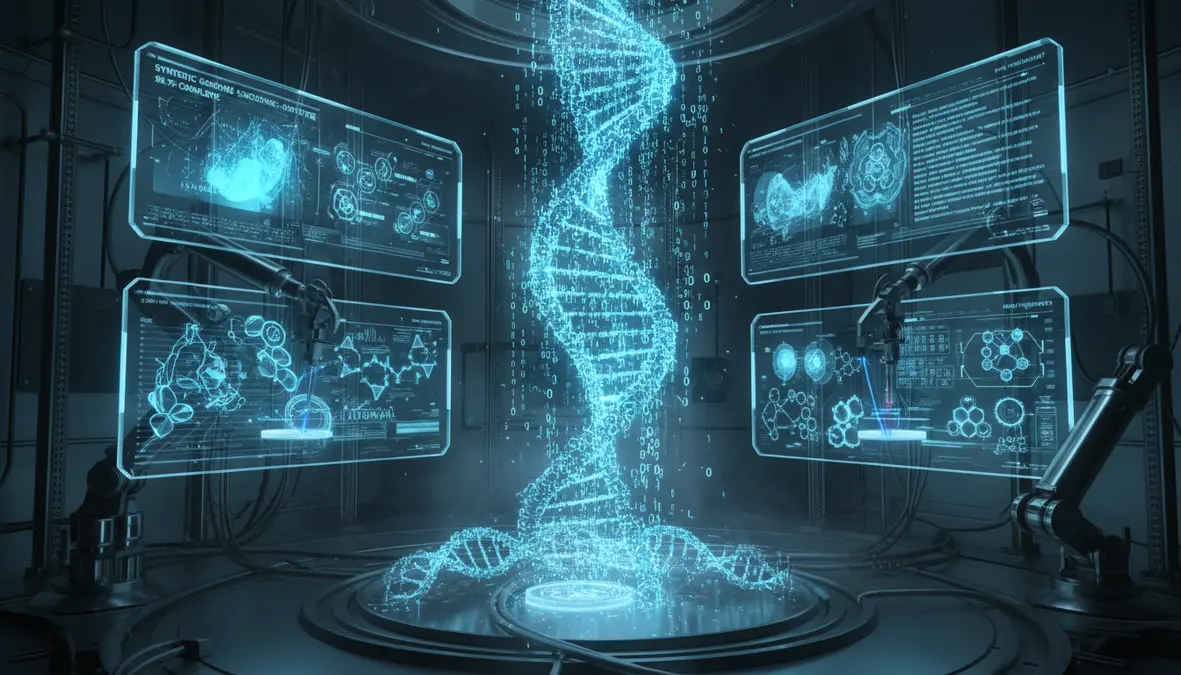
DNA Digital Data Storage: How Synthetic Biology Is Building the Ultimate Archive in 2026
- Internet Pros Team
- March 21, 2026
- AI & Technology
In January 2026, Microsoft and the University of Washington announced that their joint DNA storage research project had successfully encoded and retrieved 1 petabyte of data — the equivalent of 500 billion pages of text — using synthetic DNA molecules stored in a container no larger than a sugar cube. The read-back accuracy was 99.9999 percent. This milestone, combined with Twist Bioscience's new enzymatic DNA synthesis platform that reduced the cost of writing DNA by 100x compared to 2023 prices, has moved DNA digital data storage from a laboratory curiosity to a commercially viable technology that could fundamentally reshape how civilization archives its most critical information.
The Data Storage Crisis That DNA Can Solve
Humanity is generating data at a staggering rate. By 2026, the global datasphere is estimated to exceed 180 zettabytes — 180 trillion gigabytes — and growing at 25 percent annually. Yet the storage industry faces a compounding crisis: traditional magnetic and flash storage media degrade within 5 to 15 years, consume enormous amounts of energy for temperature and humidity control, and require constant migration to new media formats as older technologies become obsolete. The world's tape archives, disk farms, and solid-state arrays already consume an estimated 3 percent of global electricity, and that figure is climbing as data production outpaces storage capacity manufacturing.
DNA offers a radically different approach. A single gram of synthetic DNA can theoretically store 215 petabytes (215 million gigabytes) of data — the entire contents of every movie, song, book, and website ever created could fit in a volume smaller than a shoebox. DNA is stable for thousands of years when stored in cool, dry conditions (intact DNA has been recovered from fossils over 700,000 years old), requires no electricity to maintain, and will never become obsolete as a storage format — because biology will always need to read DNA, there will always be technology to decode it.
| Property | Magnetic Tape | SSD / Flash | DNA Storage |
|---|---|---|---|
| Density | ~10 GB per cm³ | ~50 GB per cm³ | ~215 PB per gram |
| Longevity | 10–30 years | 5–10 years | Thousands of years |
| Energy (at rest) | Climate-controlled vaults | Powered storage arrays | None (ambient storage) |
| Format Obsolescence | Frequent migration needed | Interface changes every decade | Universally readable (biology) |
| Cost per GB (2026) | $0.02 | $0.05 | ~$5.00 (declining rapidly) |
How DNA Data Storage Works
The process of storing digital data in DNA involves three fundamental steps: encoding (writing), storage, and decoding (reading). During encoding, binary data (the ones and zeros that computers use) is translated into the four nucleotide bases that make up DNA: adenine (A), cytosine (C), guanine (G), and thymine (T). A simple mapping might assign A = 00, C = 01, G = 10, and T = 11, though modern encoding schemes use sophisticated error-correction codes, redundancy, and indexing to ensure data integrity and enable random access to specific files within a DNA pool.
Step 1: Synthesis (Writing)
Once the binary-to-nucleotide encoding is complete, a DNA synthesizer chemically assembles the designed DNA sequences base by base. Twist Bioscience's silicon-based synthesis platform can produce millions of unique DNA sequences in parallel on a single chip, while new enzymatic synthesis methods from companies like DNA Script and Ansa Biotechnologies are achieving write speeds of 10 kilobytes per second — 1,000x faster than chemical methods — without toxic reagents.
Step 2: Storage (Archiving)
Synthesized DNA is dried, encapsulated in silica microspheres or sealed in inert gas environments, and stored at ambient temperature. Research from ETH Zurich has demonstrated that DNA encapsulated in silica glass spheres remains intact and fully readable after simulated aging equivalent to 10,000 years. No electricity, no cooling, no maintenance — just a vial on a shelf.
Step 3: Sequencing (Reading)
To retrieve data, the DNA is rehydrated and fed into a DNA sequencer — the same machines used in genomics research. Next-generation sequencing platforms from Illumina, Oxford Nanopore, and Element Biosciences can read billions of DNA bases per run. The sequenced bases are then decoded back to binary data using the same encoding scheme, with error-correction algorithms repairing any degradation.
"DNA is the ultimate storage medium — it's been perfected by 3.8 billion years of evolution. We're not inventing a new format; we're borrowing one from nature that already solves the problems of density, durability, and longevity that no human-engineered storage technology has been able to match."
2026 Breakthroughs Accelerating Commercialization
Several critical advances in 2025 and 2026 have pushed DNA data storage past key cost and performance thresholds that previously blocked commercial adoption.
- Enzymatic DNA synthesis — Companies like DNA Script (Paris) and Ansa Biotechnologies (Berkeley) have developed template-independent enzymatic synthesis that uses natural enzymes, similar to how cells copy DNA, rather than harsh chemicals. This reduces synthesis costs by 100x, eliminates toxic waste, and enables write speeds approaching 10 kilobytes per second.
- Random access retrieval — Microsoft Research and the University of Washington demonstrated a fully automated end-to-end DNA storage system with random access capability, allowing users to retrieve specific files from a DNA pool without reading the entire archive — analogous to reading a single file from a hard drive rather than scanning every sector.
- CATALOG's Shannon platform — Boston-based CATALOG Technologies deployed its Shannon DNA storage platform for the U.S. Intelligence Community, encoding classified archival data into DNA at a cost below $10 per gigabyte for the first time, with retrieval times under 12 hours for terabyte-scale datasets.
- Error-correction breakthroughs — New coding schemes based on fountain codes and LDPC (Low-Density Parity-Check) codes have achieved error rates below one in a billion bases, making DNA storage as reliable as enterprise tape systems while maintaining the density and longevity advantages.
Who Is Using DNA Storage Today
While DNA storage is not yet a replacement for SSDs or cloud storage for everyday computing, it is already finding real-world applications in specific high-value use cases where its unique advantages — extreme density, zero-energy archival, and millennial durability — justify the current cost premium.
Government and Intelligence Archives
The U.S. Intelligence Community, through IARPA's Molecular Information Storage (MIST) program, is funding DNA storage systems for long-term classified data archival. The appeal is clear: DNA archives require no power, resist electromagnetic pulses, and can be stored in geographically distributed vaults with no digital attack surface. Several NATO allies have initiated similar programs for national archive preservation.
Cultural Heritage and Media
UNESCO's Memory of the World program has partnered with Twist Bioscience to encode the complete works of Shakespeare, the Universal Declaration of Human Rights, and selected endangered language recordings into DNA capsules stored in the Arctic World Archive in Svalbard, Norway — alongside the GitHub Arctic Code Vault. These DNA time capsules are designed to preserve humanity's cultural heritage for 10,000+ years.
Challenges on the Road to Mainstream Adoption
Despite extraordinary progress, DNA data storage faces several challenges before it can compete with conventional storage for broader enterprise use. Write speed remains the primary bottleneck: even at 10 kilobytes per second, encoding a single terabyte would take over three years. Read latency is measured in hours rather than milliseconds, making DNA unsuitable for data that needs frequent access. And while costs are falling exponentially, DNA storage remains 100x more expensive per gigabyte than magnetic tape for write operations, limiting current applications to cold archival data that is written once and rarely read.
However, the trajectory mirrors the early days of other transformative storage technologies. Flash memory was 1,000x more expensive than hard drives when it was introduced in the 1990s; today it has largely replaced them. Industry roadmaps from Microsoft, Twist Bioscience, and CATALOG project that DNA write costs will fall below $1 per gigabyte by 2030 and below $0.01 per gigabyte by 2035, at which point DNA storage would be cost-competitive with tape for archival workloads while offering superior density, durability, and sustainability.
"The question is not whether DNA will become a mainstream storage medium — the physics and economics guarantee it. The question is how quickly we can scale synthesis and sequencing to meet the data deluge. Every 18 months, we're seeing a 10x improvement in DNA write throughput. At that rate, DNA storage reaches cost parity with tape before the end of this decade."
What This Means for Your Business
DNA digital data storage represents a paradigm shift in how organizations think about long-term data preservation. Businesses generating large volumes of compliance, regulatory, or archival data — healthcare records, financial transactions, legal documents, media libraries — should monitor DNA storage developments closely. Organizations with petabyte-scale cold storage requirements could begin evaluating pilot programs with providers like CATALOG and Twist Bioscience, particularly for data that must be retained for decades or longer under regulatory mandates like HIPAA, SOX, or GDPR.
At Internet Pros, we help businesses navigate the evolving data infrastructure landscape — from cloud storage optimization to emerging technologies like DNA archival systems. Whether you need guidance on long-term data strategy, compliance-driven storage architecture, or understanding which next-generation storage technologies are ready for enterprise adoption, our team stays at the forefront of innovation to ensure your data is secure, accessible, and future-proof. Contact us today to discuss how your organization can prepare for the storage revolution ahead.