Formal Verification in 2026: How Lean 4, Dafny, and AI-Assisted Proofs Are Turning Probably Correct Code Into Mathematically Certain Software
- Internet Pros Team
- July 30, 2026
- Software Development
Every test suite ever written shares one quiet limitation: it only checks the cases someone thought to check. Ship the code and reality supplies the inputs nobody imagined - the empty array, the leap second, the 4GB upload, the two requests that arrive in the wrong order. Formal verification takes a different position entirely. Instead of sampling behavior, it proves a mathematical statement about the program that holds for every possible input, forever. That idea is decades old and was long dismissed as too slow and too academic for real work. In 2026 it is having its moment - and the reason is that most new code is now written by machines.
What Formal Verification Actually Means
Start with a distinction that does most of the work. A test is an experiment: run the code with one input, compare the output to what you expected. A proof is an argument: show that a property must hold for all inputs, by reasoning about the logic of the program rather than executing it.
To build that argument you need two things. First, a specification - a precise statement of what correct means. Not a paragraph in a ticket, but a formal claim: this sort function always returns a permutation of its input in non-decreasing order; this parser never reads outside its buffer; this account balance never goes negative. Second, a verifier - a tool that mechanically checks that the code satisfies the spec, refusing to accept a hand-wave in place of a step.
"Testing can show the presence of bugs, but never their absence. A proof is the only tool we have that turns that sentence around."
Why 2026 Made This Urgent
For fifty years the bottleneck in software was writing it. That bottleneck is gone. AI coding agents now produce enormous volumes of plausible, well-formatted, confidently-explained code, and the constraint has moved downstream to a much harder question: how do you know any of it is right? Reading it line by line does not scale, and neither does trusting the model that wrote it. What does scale is a machine-checkable proof.
This flips the economics of formal methods. The historic objection was that writing proofs is far more expensive than writing code, often by five or ten times. But if a model can draft both the implementation and the proof, and a verifier - which is small, deterministic, and auditable - decides whether the proof is valid, then the expensive human step largely disappears. You stop trusting the generator and start trusting the checker. That is a much better place to put your trust.
The Toolchain Engineers Are Actually Using
| Tool | What It Is | Best Suited For |
|---|---|---|
| Lean 4 | A proof assistant and full programming language with an enormous community-built mathematics library, mathlib. | Deep proofs, mathematics, cryptographic arguments, and the training ground for AI proof models. |
| Dafny | A programming language where you write pre-conditions, post-conditions, and invariants, and an automated solver discharges them as you type. | Verifying ordinary application and library code without becoming a proof specialist. |
| Verus | Verification for Rust, layering proofs about behavior on top of the guarantees the borrow checker already gives you. | Systems code, kernels, and performance-critical infrastructure. |
| TLA+ | A specification language for designs rather than code, used to model-check distributed protocols before anyone builds them. | Consensus algorithms, replication, and concurrency bugs that testing almost never surfaces. |
| SMT solvers (Z3 and friends) | The automated reasoning engines underneath most of the above, deciding whether logical constraints can be satisfied. | Invisible infrastructure - they are what makes modern verification feel fast. |
Where Proven Code Is Already Running
Cloud Access Control
Amazon applies automated reasoning to permissions and networking, and its Cedar authorization language was built with proofs about its own evaluation semantics. When a tool tells you a bucket is not publicly reachable, that is a proof, not a scan.
Operating System Kernels
The seL4 microkernel carries a machine-checked proof that its implementation matches its specification - no buffer overflows, no privilege escalation from a code defect. It runs where failure is not survivable: avionics, defense, medical devices.
Compilers and Crypto
Verified compilers prove the machine code they emit behaves like the source they were given, and verified cryptographic libraries ship in browsers used by billions - closing the gap between a correct algorithm and a correct implementation.
The AI Twist: Machines That Write the Proofs
The genuinely new development is proof search by language model. Proving a theorem is a search problem with an unforgiving success criterion, which makes it close to ideal for AI: a model proposes a step, the verifier accepts or rejects it instantly, and that signal trains the next attempt. Systems built on this loop have gone from failing at high-school competition problems to solving them at medal level in a few short years.
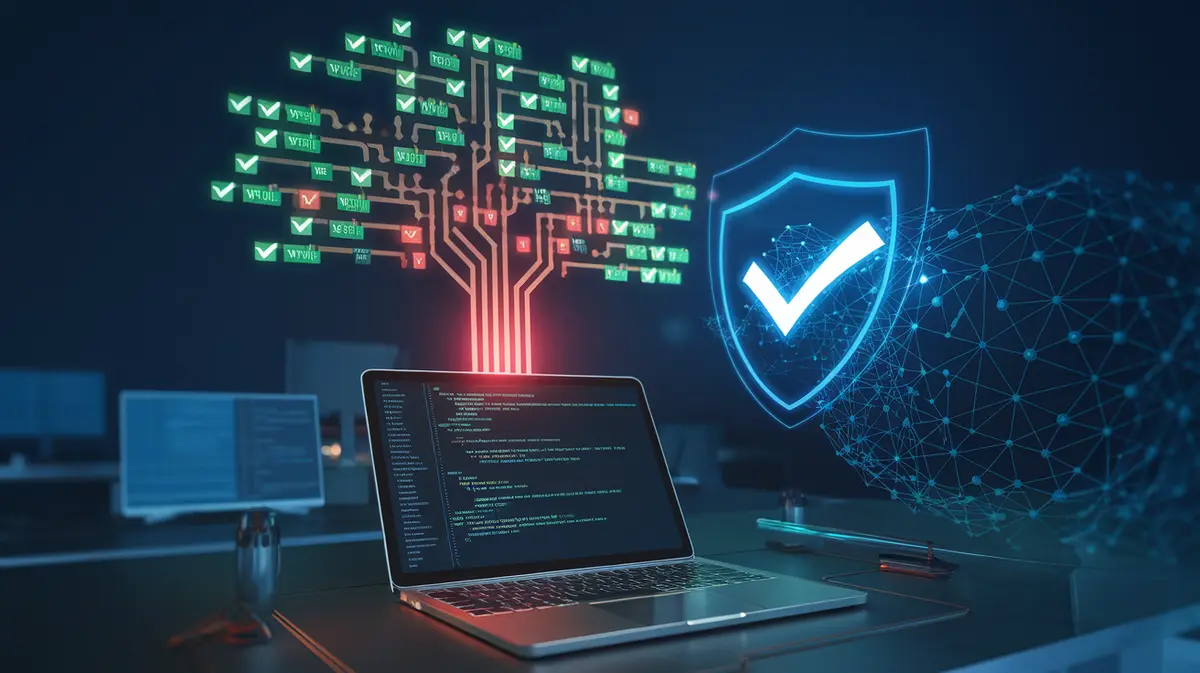
Point the same machinery at software and you get a workflow that looks like this: an engineer states the property that matters, an agent drafts both the implementation and a candidate proof, the verifier rejects everything that does not hold, and the agent iterates until it passes. Notice what the human is doing - specifying intent, not grinding through lemmas. That is exactly the division of labor that made this practical.
The Honest Trade-Offs
- You can prove the wrong thing. A proof is only as good as its specification. Verify that a function never crashes and it may still compute nonsense, correctly and reliably, on every input.
- The spec is the hard part. Writing down precisely what correct means is genuinely difficult work, and it is the one step AI cannot do for you - it is where your business rules live.
- Proofs stop at the boundary. Verification covers the code inside the boundary you drew. Hardware faults, misconfigured deployments, a bad third-party dependency, and a person clicking approve on a phishing email all sit outside it.
- It is still not free. Automation has cut the cost dramatically, but verified code takes longer than unverified code. Full proof is worth it for a payment engine or a kernel, and hard to justify for a marketing landing page.
- Maintenance is real. Change the code and the proof must change with it. Verification is a commitment, not a one-time audit you file away.
What This Means If You Build or Buy Software
You almost certainly should not verify your whole system. The useful move in 2026 is to identify the small number of places where being wrong is expensive and apply real rigor there, while the rest of the codebase lives on tests and review as it always has. In practice that short list looks like:
- Authorization and access control - who is allowed to see or change what. Most catastrophic breaches are logic errors here, not broken cryptography.
- Money movement - balances, ledgers, refunds, retries. Properties like no value created or destroyed are exactly the kind of invariant a verifier is good at.
- Concurrency and distributed state - the bugs that appear once a month at 3 a.m. and never reproduce on a laptop. Model-check the protocol before writing the code.
- Anything parsing untrusted input - the classic entry point for memory-safety and injection attacks.
There is also a lighter version available to everyone today, and it is where most teams should start. Strong static types, a memory-safe language, exhaustive case handling, property-based testing, and design documents written precisely enough to be checkable all sit on the same continuum as full proof. They deliver a large share of the benefit for a small share of the effort, and they make later verification far easier if you ever need it.
The Bottom Line
Formal verification is not a promise that software will never fail. It is a promise about a specific claim, proved against a specific specification, inside a specific boundary - and that narrowness is precisely why it is trustworthy. What changed in 2026 is not the mathematics, which has been sound for decades. What changed is that machines now write most of the code and can also write most of the proofs, which means the cheapest way to trust a program is no longer to read it. It is to check it.
The teams that will pull ahead are not the ones proving everything. They are the ones who know which few properties they cannot afford to get wrong - and who can hand a verifier the question instead of hoping the next test run catches it.