Grid-Enhancing Technologies in 2026: How Dynamic Line Rating, Advanced Conductors, and HVDC Are Unlocking Transmission Capacity Without New Towers
- Internet Pros Team
- August 8, 2026
- AI & Technology
There is a strange fact at the center of the electricity system: most transmission lines are not full. They are rated as if it were a windless 40-degree afternoon, because that is the worst case the rating assumes, and the vast majority of hours are not that. The result is a network that routinely carries far less power than the metal is physically capable of moving, at a moment when data centers, factories, and electrified everything are queuing up for connections that take years to grant. Grid-enhancing technologies - the unglamorous family of sensors, conductors, and controllers that squeeze more out of the wires already strung between towers - became one of the most consequential infrastructure stories of 2026 precisely because they can be deployed in months rather than a decade.
Why the Bottleneck Moved From Generation to Wires
For most of the last twenty years, the hard problem in electricity was making enough clean power cheaply. That problem is not solved, but it is no longer the binding constraint. Solar and wind projects are now frequently cheaper to build than the transmission upgrades required to connect them, and the queue of projects waiting for an interconnection study has become the single longest line item in a developer schedule.
Demand moved at the same time. A large AI training campus asks for hundreds of megawatts at a single point - a request comparable to a mid-sized city arriving overnight, with none of the decades of gradual planning a city provides. Add electric vehicle charging, industrial electrification, and heat pumps, and load growth returned to a system that spent two decades planning around flat demand.
Building new transmission is the obvious answer and the slowest one. A major line involves routing studies, environmental review, landowner negotiation across hundreds of parcels, multi-state cost allocation arguments, and litigation - commonly a ten-to-fifteen-year process where the physical construction is among the shorter phases. That timeline mismatch is what makes the existing network so interesting.
"The cheapest megawatt of transmission capacity is the one already hanging between two towers that nobody is allowed to use because the rating assumes a hot day with no wind."
Dynamic Line Rating: Measuring Instead of Assuming
An overhead conductor is limited by temperature, not by current directly. Push too much power through and the aluminum heats, expands, and sags toward whatever is beneath it - a tree, a road, a person. The rating exists to keep that clearance safe.
The temperature the conductor actually reaches depends on how much heat it sheds, and the dominant variable is wind. A modest breeze perpendicular to a line cools it dramatically. Static ratings ignore this entirely by assuming a near-worst case at all times, which is defensible engineering and enormously wasteful in practice.
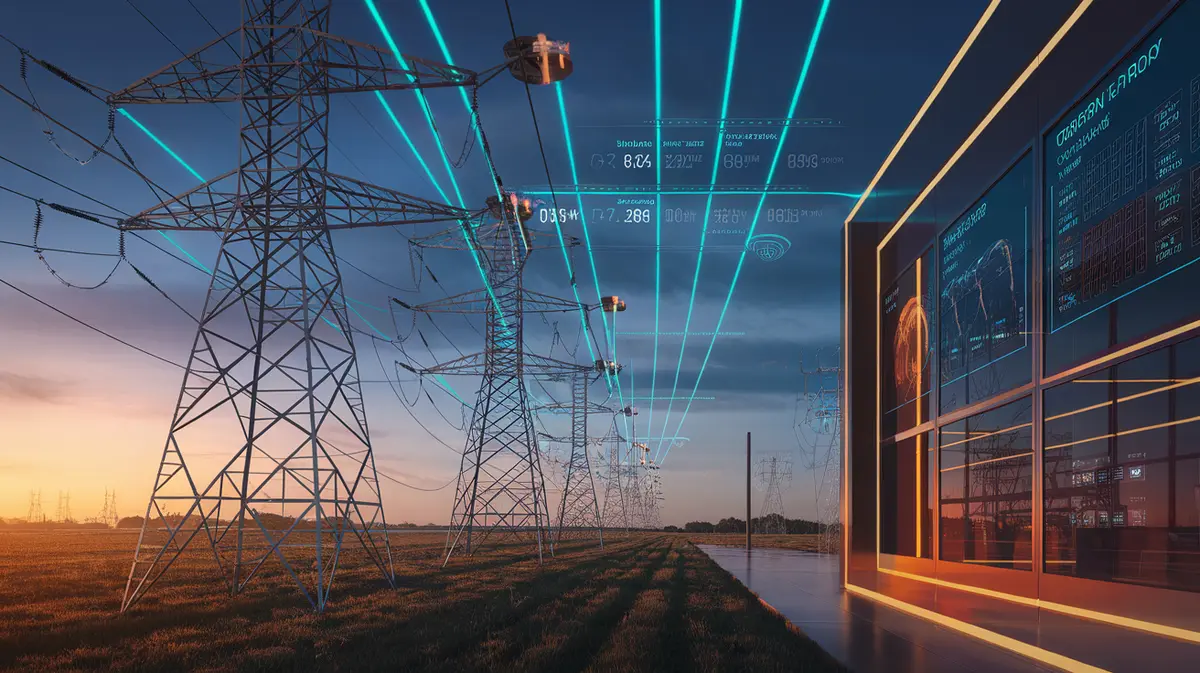
Dynamic line rating replaces the assumption with measurement. Weather stations along the corridor, sensors clamped to the conductor, or modeled weather data feed a calculation of the line true thermal capacity right now, updated continuously and pushed into the control room. The capacity gains are frequently in the range of ten to thirty percent, and - usefully - the gains often correlate with wind generation, since the same breeze that is spinning turbines is cooling the line that needs to carry their output.
| Approach | What It Does | Typical Timeline | Main Limitation |
|---|---|---|---|
| Dynamic line rating | Rates lines on real conditions rather than worst case | Months | Gains vary hour to hour; cannot be relied on as firm capacity |
| Advanced reconductoring | Swaps conductor for a composite-core type that carries more current with less sag | 1-3 years | Requires outages and existing structures in good condition |
| Power flow control | Pushes current off congested paths onto underused parallel ones | Months to a year | Only helps where an alternative path actually exists |
| Topology optimization | Software reconfigures switching to reroute flow around bottlenecks | Months (mostly software) | Operator trust and contingency validation are the hard part |
| New HVDC line | Moves bulk power long distances with low losses and full controllability | 7-15 years | Permitting and cost allocation, not technology |
Advanced Conductors: Replacing the Wire, Keeping the Towers
The second lever is changing what hangs between the towers. Conventional conductors use a steel core for strength wrapped in aluminum strands that carry the current. Steel sags as it heats, which caps how hard the line can be pushed.
Advanced conductors replace that core with a carbon fiber or composite material that barely expands with temperature and weighs less, allowing more aluminum in the same diameter and higher operating temperatures without the sag penalty. The practical outcome is roughly double the current-carrying capacity on the same right-of-way, using the same towers, with lower line losses at typical loading.
This matters enormously because the right-of-way is the scarce asset. Acquiring a new corridor is the part that takes a decade; restringing an existing one is a construction project measured in months per segment. The constraint is that the towers must be structurally sound and the work requires outages, which have to be scheduled around the seasons when the line can be spared.
Why Interconnection Queues Became a Business Problem
Grid capacity stopped being a utility concern and started being a site selection concern:
- Power availability now drives location. Data center siting decisions increasingly start with grid capacity maps and only then consider land, fiber, and tax treatment.
- Queue position is an asset. Projects with an advanced interconnection study carry real value, which has produced speculative queue entries that clog the process further.
- Study serialization compounds delay. Because each study assumes the projects ahead of it, one withdrawal can force restudies for everything behind it.
- Flexible interconnection is the pressure valve. Agreeing to curtail during rare peak hours can cut a wait from years to months - a trade many loads will accept.
- Behind-the-meter generation is the workaround. On-site turbines, fuel cells, and storage are being deployed less for economics than to avoid the queue entirely.
Power Flow Control and the Software Layer
Electricity does not follow the path an operator wishes it would. It distributes across every available route according to impedance, which means one line can hit its limit while a parallel path a few miles away sits half empty. The whole network then gets constrained by the congested element.
Power flow control devices - modular units installed on the line that inject impedance to nudge current away from an overloaded path - address this directly. They are comparatively small, can be relocated as system needs change, and install in a fraction of the time of any structural work.
Topology optimization attacks the same problem with no new hardware at all. Substations contain many switches, and the network configuration is largely a choice. Software that searches the enormous space of possible switching arrangements can often find a configuration that relieves a bottleneck by rerouting flow through underused assets. The physics is straightforward; the difficulty is operational. Every reconfiguration must remain valid under contingency analysis - the requirement that the system survive the sudden loss of any single element - and control room operators are, correctly, conservative about accepting a recommendation from an optimizer during a stressed hour.
Where HVDC Still Wins
None of the above eliminates the need for new long-distance capacity, and for that, high voltage direct current remains the strongest tool. DC lines suffer lower losses over long distances, need narrower corridors for equivalent capacity, and offer something alternating current cannot: precise control over exactly how much power flows, in which direction, independent of the surrounding network. Modern voltage source converters can also support grid stability rather than merely consuming it, which matters more as rotating generation retires.
The honest caveat is that HVDC constraints are rarely technical. Converter stations are expensive and the equipment order books are long, but the decade-long timelines come from permitting, routing, and the perennial argument over who pays for a line whose benefits are spread across several states or countries.
The Honest Limitations
- Dynamic ratings are not firm. Capacity that depends on wind cannot be counted on for a planning standard that must hold on the worst day, so it relieves congestion more readily than it supports new firm connections.
- Regulatory incentives are misaligned. Utilities in many jurisdictions earn a return on capital assets, and a sensor package that defers a large capital project is financially unattractive under that structure.
- Sensors add operational burden. Thousands of field devices need calibration, communications, cybersecurity treatment, and a validated data pipeline into systems that were never designed to receive changing ratings.
- Reconductoring needs outages. Taking a line out of service to upgrade it is only possible when the rest of the network can absorb the flow, which is hardest exactly where congestion is worst.
- They buy time, not exemption. Under sustained load growth, unlocking twenty or thirty percent more capacity postpones the need for new corridors by years - it does not remove it.
What This Means Outside the Utility Industry
For most businesses, the practical consequence is that electricity has quietly rejoined the list of things that constrain growth plans. A manufacturer adding a line, a company building compute capacity, a developer planning fleet charging - each now faces a question that used to be a formality: can the local grid actually deliver, and when.
The organizations handling this well are treating it as a planning input rather than a procurement step. They engage the utility before the site is chosen, ask what capacity exists today versus what requires an upgrade, and evaluate whether flexibility - agreeing to reduce load during a handful of stressed hours each year, or pairing the connection with on-site storage - can convert a multi-year wait into a manageable one. Increasingly the answer is yes, because a grid operator would much rather serve a load that can bend than build for a peak that occurs twelve hours a year.
There is a broader lesson here that applies well beyond power lines. The instinct when a system runs out of capacity is to build more of it. Frequently the faster and cheaper move is to find out how much of the existing capacity is being wasted by a conservative assumption nobody has revisited in forty years - and then measure, rather than assume. The grid is simply the largest and most expensive example currently making that discovery.