Industrial 3D Printing in 2026: How Additive Manufacturing Graduated From Prototypes to Production - and Why Rocket Engines, Jet Parts, and Spare-Parts Warehouses Are Now Printed
- Internet Pros Team
- August 12, 2026
- AI & Technology
For thirty years, 3D printing carried a reputation it could not shake: a wonderful way to make a prototype, a hobby machine for plastic trinkets, and not much more. That era is over. In 2026, additive manufacturing is producing flight-certified rocket engines, jet-engine fuel nozzles, titanium hip implants, and mission-critical spare parts - not as experiments, but as everyday production. The quiet story is not that printers got a little better. It is that additive manufacturing crossed the threshold from making models of parts to making the parts themselves, and that shift is starting to rearrange how supply chains work.
From Prototype Toy to Production Tool
Traditional manufacturing is subtractive or formative: you cut material away from a block, or force it into a mold. Additive manufacturing builds a part layer by layer directly from a digital file - fusing metal powder with lasers, jetting binder into powder beds, or extruding engineering polymers. The practical consequences are radical. Complexity is free: an internal cooling channel that would be impossible to machine costs nothing extra to print. Tooling disappears: there is no mold to amortize, so making one part costs the same per unit as making fifty. Consolidation becomes normal: assemblies that once required dozens of separate components, each with its own supplier, weld, and failure point, can be redesigned as a single printed piece.
What kept all of this in the prototype lab for decades was consistency. A production part must come out identical every time, and early metal printers could not promise that - porosity, residual stress, and unpredictable defects made every build a gamble that only deep-pocketed aerospace programs could afford to qualify. That is the problem the last few years actually solved.
Where Printed Parts Already Fly, Heal, and Deploy
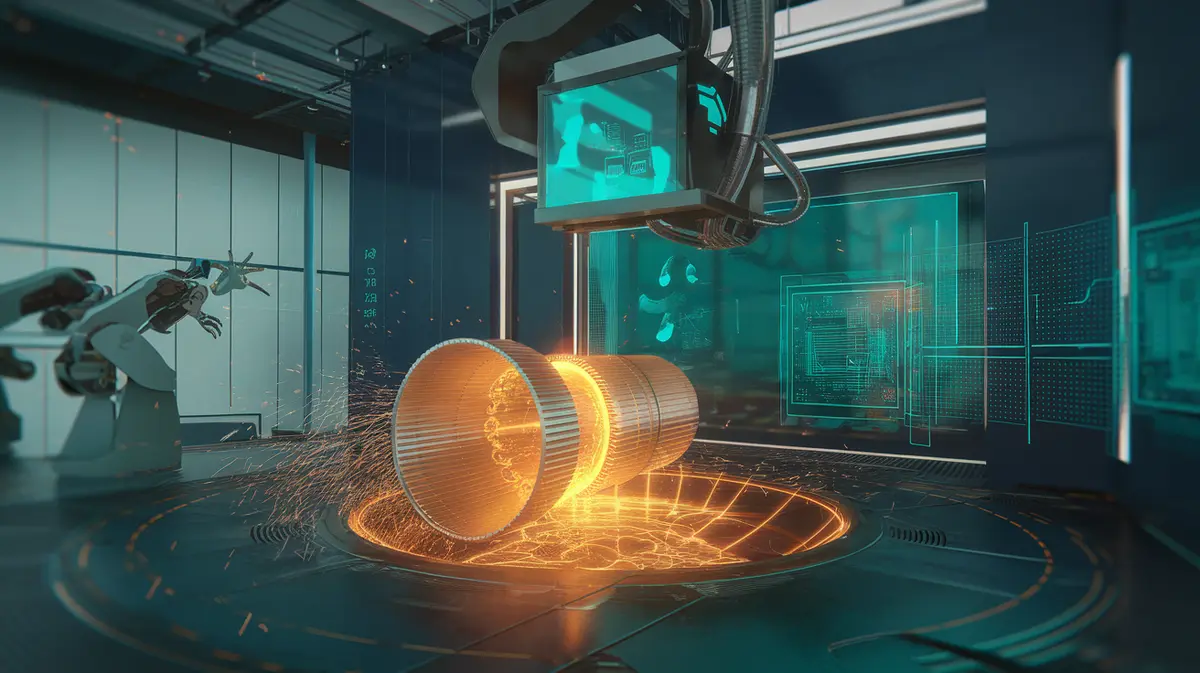
Aerospace led the way, because it is the one industry where the economics were obvious from the start: parts are expensive, volumes are low, and every gram saved is worth real money over an aircraft lifetime. The famous example is the jet-engine fuel nozzle that consolidated roughly twenty brazed components into one printed part - stronger, lighter, and produced by the tens of thousands. Rocket companies pushed further: modern launch vehicles fly with engines whose combustion chambers, injectors, and turbopump components are largely printed, cutting part counts from thousands to hundreds and compressing design-test cycles from years to months.
Medicine followed with a different advantage: personalization. Titanium spinal cages, hip cups with bone-mimicking lattice surfaces that encourage osseointegration, cranial plates matched to a patient scan, and the overwhelming majority of modern hearing-aid shells and clear dental aligners are additively manufactured. When every unit is unique, molds make no sense - printing is not the alternative, it is the only option.
Defense and heavy industry supplied the third proof point: availability. Militaries and mining, rail, and energy operators run decades-old equipment whose original suppliers are long gone. Printing an out-of-production gearbox housing at a forward depot in days - instead of waiting nine months for a foundry slot - reframed additive manufacturing as a readiness technology, not a novelty.
| Process | How it works | Best suited for |
|---|---|---|
| Laser powder bed fusion | Lasers melt fine metal powder layer by layer | Complex, high-value metal parts: engine components, implants |
| Binder jetting | Liquid binder glues powder; part is sintered afterward | Higher-volume metal parts at lower cost per unit |
| Directed energy deposition | Metal wire or powder melted onto a surface by laser or arc | Very large structures and repair of worn components |
| Polymer powder and extrusion | Nylon and engineering plastics fused or extruded | Jigs, fixtures, housings, end-use plastic parts |
What Actually Changed by 2026
AI moved inside the build chamber
The biggest cost in metal printing was never the machine time - it was scrap and inspection. Modern systems watch every layer with cameras, photodiodes, and thermal sensors while machine-learning models flag defects as they form, correct laser parameters mid-build, and produce a per-part quality record. That in-process monitoring is what turns qualification from "CT-scan every part" into "trust the audited process," and it is the single biggest reason printed parts are getting certified faster and cheaper than they were even three years ago.
Machines scaled up and sped up
Production printers now run eight or more lasers simultaneously over build volumes measured in meters, with automated powder handling and build-plate exchange so machines print around the clock. Cost per printed kilogram has fallen steadily, and binder jetting has matured into a genuine bridge toward mid-volume production runs that were previously casting-only territory.
Materials caught up
The printable menu expanded from a handful of alloys to hundreds: high-conductivity copper for heat exchangers and induction coils, refractory alloys for hypersonics, aluminum blends designed specifically for printing, and flame-retardant certified polymers for aircraft interiors and rail.
The Digital Warehouse: Printing as Supply-Chain Insurance
The strategic shift is bigger than any single part. After a decade of pandemic shocks, canal blockages, and tariff whiplash, manufacturers are quietly replacing physical inventory with digital inventory: a validated part file, a locked process recipe, and a network of qualified print sites. Instead of casting ten thousand spares and warehousing them for twenty years, you store the file and print on demand, near the point of use. Shipping lines print parts in port, railways print obsolete brackets, and appliance makers keep discontinued components "in stock" forever without a warehouse shelf. The part travels as data and becomes physical only at the last moment - manufacturing behaving, for the first time, like software distribution.
What 3D Printing Still Cannot Do
Honesty matters, because the hype cycle burned people before. Additive manufacturing still loses to injection molding and stamping at high volumes - if you need a million identical parts, the mold wins on cost every time. Printed metal parts almost always need post-processing: heat treatment, support removal, and machining of critical surfaces, which can be half the total cost. Powder handling demands real safety discipline. And qualification, while dramatically cheaper than it was, is still the long pole for safety-critical parts. The winning strategy in 2026 is not "print everything" - it is knowing which 5 to 15 percent of your part catalog is complex, low-volume, or supply-fragile enough for printing to win decisively.
How a Smaller Business Can Actually Start
- Start with tooling, not products. Printed jigs, fixtures, and assembly guides routinely cut tooling costs and lead times by large margins, with zero certification burden.
- Use a service bureau before buying a machine. Upload a file, get a quote, hold the part in your hand in a week - learn which parts make economic sense before committing capital.
- Audit your spares. List the parts whose supplier is gone, whose minimum order is absurd, or whose lead time hurts. Those are printing candidates.
- Redesign, do not just replicate. Printing a part designed for casting wastes the technology. The wins come from consolidation and geometry that machining could never make.
- Treat part files like crown jewels. A digital inventory is only as good as its version control and security - a tampered file becomes a defective physical part.
Quick reality check: is a part a good printing candidate?
Score it on four questions. Is annual volume under a few thousand units? Is the geometry complex or consolidated from an assembly? Is the current lead time or minimum order painful? Would a lighter or better-performing version be worth money? Two or more yes answers - get a quote from a print bureau this week.
The revolution was never about printing everything. It is that for the hardest 10 percent of parts - the complex, the customized, the discontinued, and the stranded-at-sea - manufacturing now behaves like software: stored as files, shipped as data, and made real only where and when it is needed.
Additive manufacturing spent three decades as the technology of the future. In 2026 it is simply part of how demanding things get made - and the companies quietly benefiting most are not the ones with the biggest printers, but the ones who figured out which of their parts deserve one. The machines are ready. The remaining question is whether your part catalog, your spares strategy, and your design team are.