Laser Inter-Satellite Links in 2026: How SpaceX Starlink, Telesat Lightspeed, Amazon Kuiper, and Mynaric Are Connecting Satellites With Beams of Light Instead of Radio
- Internet Pros Team
- July 7, 2026
- AI & Technology
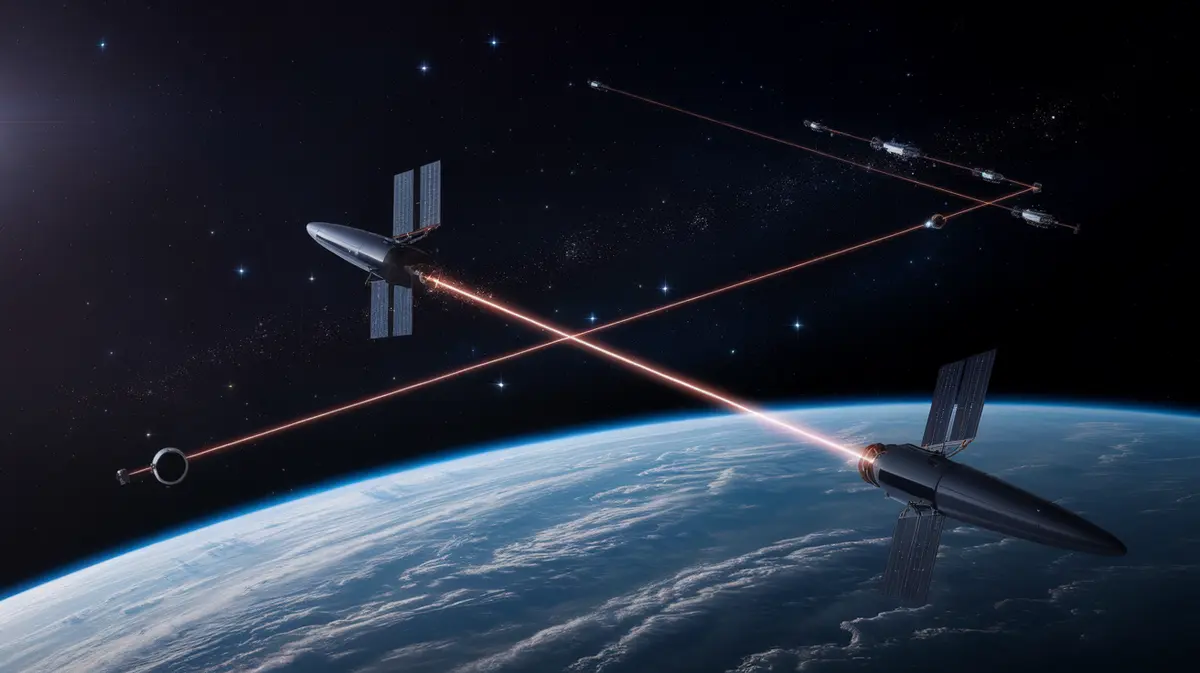
For decades, a satellite was a radio relay: it caught a signal from the ground, and it beamed one back down. To send data from one satellite to another, the message had to fall all the way to a ground station and climb back up. In 2026 that model is being torn up. Thousands of satellites are now talking directly to each other across the vacuum of space using beams of infrared light - laser inter-satellite links - stitching low Earth orbit into a single high-speed mesh network that can carry your data most of the way around the planet without ever touching the ground.
What a Laser Inter-Satellite Link Actually Is
A laser inter-satellite link (LISL) - also called an optical inter-satellite link, or OISL - is a point-to-point connection between two satellites made of light instead of radio waves. Each satellite carries an optical terminal: essentially a small telescope with a laser, typically operating in the invisible near-infrared around 1550 nanometers, the same wavelength that fills the fiber-optic cables under the ocean. One terminal fires a tightly focused beam; the other catches it and fires one back. This is the space version of free-space optical communication (FSO) - sending data as modulated light through open space rather than through a glass fiber. The result is a data link that can move tens of gigabits per second between two spacecraft flying thousands of kilometers apart.
Why Light Beats Radio in Space
Satellites have always had radio. So why switch? Because a laser beam is fantastically narrow. A radio antenna sprays its signal across a wide cone, so most of the energy - and much of the potential eavesdropper's opportunity - spreads uselessly into space. A laser packs the same power into a beam so tight it is almost a thread, which means far more of the signal reaches the target, far more data fits on the link, and there is almost nothing off to the side for anyone to intercept. Light also carries vastly more bandwidth than radio, and optical spectrum is not licensed and congested the way radio bands are. And because a signal in the near-vacuum of space travels close to the true speed of light - about 47% faster than the same signal creeping through solid glass fiber - a chain of laser-linked satellites can beat a terrestrial fiber route on long intercontinental hops.
"The moment satellites could talk to each other with lasers, the constellation stopped being a bunch of individual relays and became a network. Data can now cross an ocean in orbit, at nearly light speed, and only come down where it needs to. That is a fundamentally different piece of infrastructure than the satellite internet of five years ago."
The Hard Part: Hitting a Moving Target From Thousands of Kilometers
The very thing that makes a laser powerful - its razor-thin beam - also makes it brutally hard to aim. Two satellites can be racing along at more than 27,000 km/h in different directions, separated by the distance from New York to London, and the beam that connects them is narrower than a pencil at that range. Miss by a whisker and the link is dead. Solving this is called acquisition, tracking, and pointing (PAT): the terminal first sweeps a small search pattern to find the partner's beam, then locks on and uses fast, fine steering mirrors to hold the connection to within millionths of a degree while both spacecraft hurtle through orbit, vibrate, and flex with temperature. Getting PAT to work reliably, cheaply, and at mass-production scale is the engineering story that took LISLs from a handful of exotic demonstrations to tens of thousands of terminals in orbit.
Where the Technology Is Being Deployed
- LEO mega-constellations. Laser crosslinks let a satellite hand your traffic to a neighbor overhead instead of down to a ground station, so the network reaches oceans, poles, and remote regions with no local infrastructure.
- Fewer ground stations. Because data can hop across orbit to a satellite that is over a gateway, operators need far fewer expensive ground stations - and can serve places no one can build one.
- Direct-to-cell and backhaul. Optical links carry the heavy backhaul between satellites, freeing the radio spectrum for the last hop down to phones and terminals on the ground.
- Military and government networks. A laser link is extremely hard to detect, intercept, or jam, which is why defense agencies are building optically-meshed constellations for resilient, low-probability-of-intercept communications.
- Deep space. The same free-space optical idea, scaled up, is now beaming data back from missions far beyond the Moon, promising far higher data rates than deep-space radio ever could.
Radio-Frequency Crosslink
Wide beam, licensed and congested spectrum, lower data rate, easier to point but easier to intercept and jam. Mature, forgiving, and everywhere - but a bottleneck as constellations scale.
Laser (Optical) Crosslink
Hair-thin beam, unlicensed optical spectrum, tens of gigabits per second, extremely hard to intercept or jam - at the cost of exacting pointing and sensitivity to a rare cloud of debris or misalignment.
Laser Crosslinks vs. Radio at a Glance
| Property | Radio-Frequency Link | Laser Optical Link |
|---|---|---|
| Beam width | Wide cone | Extremely narrow thread |
| Data rate | Hundreds of Mbps to a few Gbps | Tens of Gbps and rising |
| Spectrum | Licensed, crowded, regulated | Unlicensed optical band |
| Interception / jamming | Easier - signal spreads out | Very hard - beam is a thread |
| Pointing difficulty | Forgiving | Demands precision PAT |
| Maturity | Decades of flight heritage | Scaling to volume in 2026 |
Who Is Building It
The clear front-runner is SpaceX Starlink, which has flown tens of thousands of optical terminals and routes a large share of its traffic over laser links today - the biggest optical mesh network ever built. Telesat Lightspeed is designing its constellation around optical crosslinks from the start for enterprise and government backhaul, and Amazon Kuiper has demonstrated its own optical inter-satellite links as it scales up. On the terminal side, Germany's Mynaric (with its CONDOR product) and Tesat-Spacecom are marquee suppliers of the laser hardware, while CACI supplies optical terminals to U.S. defense programs. The U.S. Space Development Agency is deploying a laser-meshed military constellation, and software firms like Aalyria (spun out of Google) are building the orchestration layer that routes traffic dynamically across a sky full of moving nodes.
The Honest Trade-Offs
Laser links are transformative, not magical. The pointing precision required is unforgiving, so terminals must be built and tested to exacting standards at a scale never attempted before. A laser beam that leaves orbit and tries to reach the ground can be blocked by a single cloud, which is why space-to-space links thrive but ground stations still lean on radio or need multiple geographically-spread optical sites. Aligning two independently vibrating spacecraft is a control-systems challenge, and each terminal adds cost, mass, and power to a satellite. And a global laser mesh only works if the routing software can re-plan paths in real time as hundreds of satellites rise and set over every point on Earth every few minutes.
What It Means for Business
You will never see the laser, but you will feel it. Laser inter-satellite links are quietly turning satellite internet from a patchy last-resort into fast, low-latency, genuinely global connectivity - coverage over oceans and remote sites, competitive latency on intercontinental routes, and secure links that are hard to intercept. For any business that operates ships, aircraft, rigs, remote sites, or far-flung field teams - or that simply wants a resilient second path when terrestrial fiber is cut - a laser-meshed sky is becoming a real option rather than a novelty. The lesson of 2026 is the same one that keeps repeating across technology: the most important infrastructure is the kind you stop noticing, and the network is moving up into orbit on a beam of light.