Solid-State LiDAR in 2026: How Laser 3D Sensing Went Chip-Scale, Why Cameras Alone Are Not Enough, and What FMCW Changes
- Internet Pros Team
- August 20, 2026
- AI & Technology
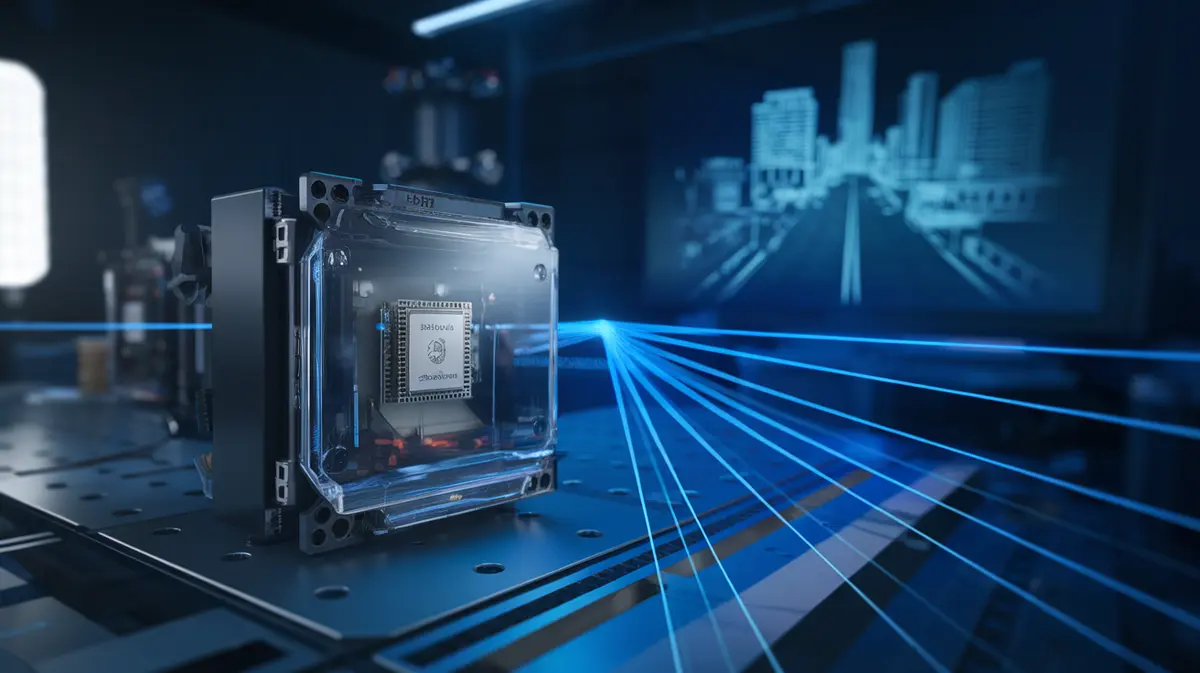
A decade ago the symbol of a self-driving car was the spinning bucket bolted to its roof: a mechanical laser scanner that cost more than the vehicle underneath it and looked, frankly, ridiculous. In 2026 that device has largely vanished. Its replacement is a sealed rectangle the size of a deck of cards, with no moving parts, priced closer to a smartphone camera than a luxury sedan. The technology did not merely get cheaper. It changed shape, moved onto silicon, and quietly spread into warehouses, construction sites, farm equipment, drones, and building security, where nobody is arguing about robotaxis at all.
What LiDAR Actually Measures, and Why That Matters
A camera records brightness and color. Everything else it appears to know about the world, including how far away things are, is inferred by software from patterns of light. LiDAR skips the inference. It emits a pulse of infrared light, times how long the reflection takes to return, and multiplies by the speed of light. The output is not a picture but a point cloud: hundreds of thousands of measured coordinates per second, each one an actual distance rather than an estimate.
That distinction sounds academic until something goes wrong. A camera-based system can be fooled by a flat billboard showing a photograph of a road, by low sun directly in the lens, or by an unfamiliar object it was never trained to recognize. A laser rangefinder does not need to know what an object is in order to know that something solid is eleven meters ahead. In safety engineering that property has a name: it fails differently. Systems that fail differently can be combined so that one covers the blind spot of the other.
Cameras interpret the world and can be confidently wrong. A laser rangefinder simply measures it. The value of lidar is not that it sees better, but that it fails in ways cameras do not.
What Solid-State Really Means
The original scanners aimed a laser by physically rotating it. That worked, but spinning precision optics in a device exposed to potholes, vibration, road salt, and fifteen years of temperature cycling is an unpleasant reliability problem, and every unit had to be hand-aligned in a clean room. The industry spent a decade removing motion from the design, and there is more than one way to do it.
Four Routes to a Sensor With No Spinning Parts
- MEMS mirrors. A microscopic mirror etched into silicon tilts to steer the beam. Technically it still moves, but it is a chip rather than a motor, and it is manufactured by the millions rather than assembled by hand.
- Flash lidar. Illuminate the entire scene at once and capture the returns on a detector array, much like a camera with a flash. Simple and rugged, with range limited by how much light one pulse can spread across a wide field.
- Optical phased arrays. Steer the beam by shifting the phase of light across an array of waveguides, with no moving element anywhere. This is the purist solution and the hardest to manufacture at range.
- Silicon photonics integration. The quiet revolution underneath all of the above: lasers, splitters, and detectors printed onto wafers in a semiconductor fab instead of assembled from discrete optical components.
The receiver side changed just as much. Modern units use arrays of single-photon avalanche diodes built in standard CMOS processes, so the detector is fabricated on the same kind of line that makes image sensors. Once a component moves from an optics bench to a semiconductor fab, it inherits the economics of semiconductors, and the cost curve bends downward. That is the whole story of why lidar got cheap: not a breakthrough in physics, but a migration into an industry that already knew how to make ten million of something.
Time of Flight Versus FMCW
Most sensors shipping today are direct time-of-flight: send a pulse, time the echo. A newer approach, frequency-modulated continuous wave, emits a beam whose frequency sweeps continuously and compares the returning light against the outgoing signal. It measures distance and, in the same instant, velocity, because motion shifts the returned frequency. It also ignores sunlight and rival lidars almost entirely, since only light matching its own sweep pattern produces a valid reading.
| Approach | Measures | Strength | Trade-off |
|---|---|---|---|
| Time of flight (pulsed) | Distance | Mature, low cost, high point rates, broad supplier choice | Vulnerable to bright sun and interference from other lidars |
| FMCW (coherent) | Distance and instant velocity | Immune to ambient light and crosstalk; longer effective range | Costlier, more complex optics, fewer proven suppliers |
| Flash | Distance across a whole scene | No steering at all; rugged and compact for short range | Range limited by spreading one pulse over a wide field |
Knowing velocity per point, rather than deducing it by comparing consecutive frames, matters most in the situations that are hardest for autonomy: a pedestrian stepping out from between parked cars, or debris on a highway that is stationary while everything around it is not. Whether that advantage justifies the cost is the live commercial argument of the next two years.
The Uses That Have Nothing To Do With Cars
Automotive volume drove the price down, but the interesting adoption is happening elsewhere, because cheap depth sensing is useful anywhere a machine or a measurement has to interact with physical space.
- Warehouse and industrial robots. Autonomous forklifts and mobile robots navigate by depth rather than by floor markings, and safety zones can be enforced by measurement instead of by fencing.
- Construction and facilities. Handheld and drone-mounted scanners capture as-built conditions in an afternoon, producing models accurate enough to catch a misplaced duct run before it becomes a change order.
- Agriculture and forestry. Sensors on harvesters and sprayers measure crop height, canopy density, and obstacles in conditions where dust and glare defeat cameras.
- Buildings and security. Ceiling-mounted units count occupancy, detect falls, and monitor perimeters while capturing only shapes and distances, not faces, which is why some privacy-sensitive sites prefer them to cameras.
- Consumer devices. Depth sensors in phones and headsets anchor augmented reality objects to real surfaces and let anyone produce a rough but usable 3D scan of a room.
The Honest Limits
LiDAR is not a solution to perception, only one input to it. Heavy rain, dense fog, and blowing snow scatter infrared light and degrade returns, which is exactly where radar keeps its advantage. Dark, matte, and wet surfaces reflect poorly. Cheap sensors buy their low price with shorter range or sparser point clouds, and a sparse cloud at distance is a fine obstacle detector and a poor classifier. Nothing in a point cloud tells you the light is red or the sign says stop, so cameras are not optional.
There is also a data problem that buyers consistently underestimate. A handful of sensors generate a punishing stream of points, and turning that into decisions requires real onboard compute, real power, and software that most organizations end up buying rather than writing. The sensor is usually the cheapest part of the finished system.
What To Take From This
The pattern worth noticing is not about lasers. It is that an expensive, hand-built instrument became an ordinary component the moment it could be manufactured like a chip, and that its first market, cars, turned out to be neither the largest nor the most interesting one. The same sequence has played out with accelerometers, GPS receivers, and image sensors, and each time the durable value went to the people who found a mundane use for the newly cheap part rather than the headline application that funded it.
If you are evaluating sensing, automation, or the networks and compute that have to carry the resulting data, Internet Pros helps businesses separate the technology that will pay for itself from the technology that merely demonstrates well.