Long-Duration Energy Storage (LDES): How Iron-Air, Vanadium Flow, and Thermal Batteries Are Solving the Grid's 100-Hour Problem in 2026
- Internet Pros Team
- May 9, 2026
- AI & Technology
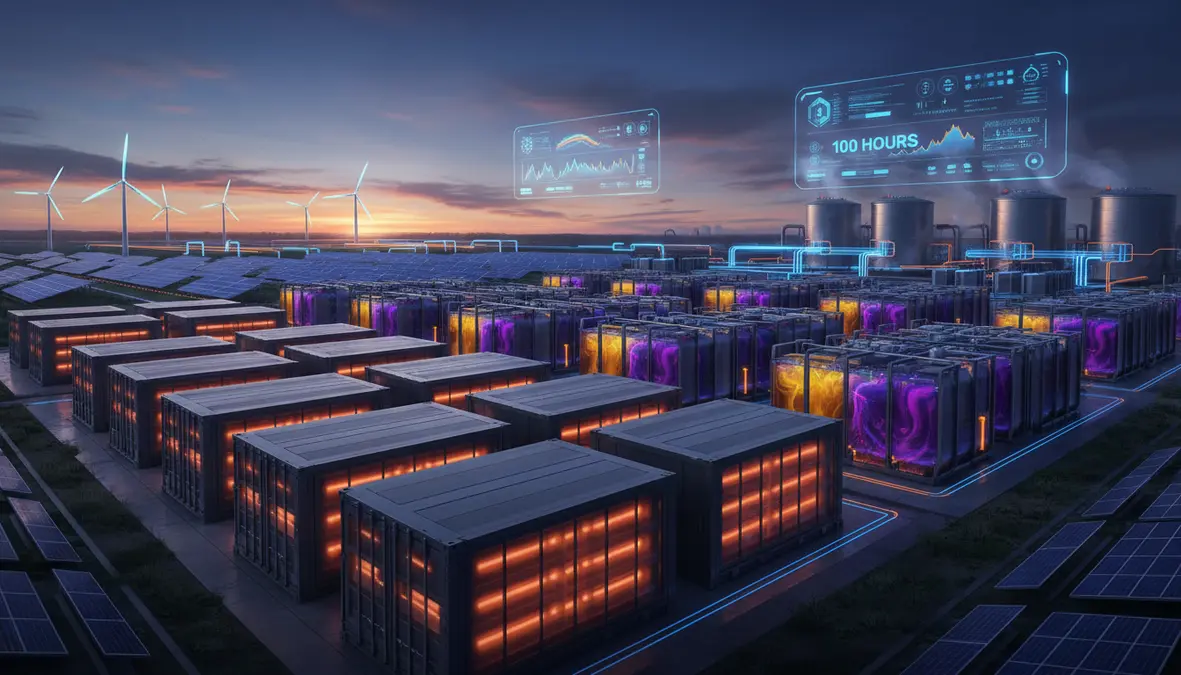
The electric grid runs on one unforgiving rule: supply must equal demand every second of every day. For most of the last century, fossil fuel plants delivered dispatchable power on command. Wind and solar do not, and that imbalance is now the central engineering problem of decarbonization. Lithium-ion batteries — the workhorse of grid storage since 2020 — discharge for four hours and stop. To carry a region through a still, cloudy week, you need a battery that lasts 100 hours, costs a fraction per kilowatt-hour stored, and uses earth-abundant materials. That is the Long-Duration Energy Storage (LDES) problem, and in 2026 the answers are no longer hypothetical. Form Energy is commissioning utility-scale iron-air installations in Maine, Minnesota, and Georgia. ESS Inc., Invinity Energy Systems, and Largo Inc. are deploying multi-megawatt vanadium and iron flow systems. Antora Energy, Rondo Energy, and Electrified Thermal Solutions are storing electricity as red-hot carbon and brick. Energy Vault stacks gravity blocks, Hydrostor compresses air into salt caverns, and Highview Power liquefies it. The 100-hour grid is finally being built.
The Four-Hour Wall Lithium Was Never Meant to Break
Lithium-ion is extraordinary technology, but it was designed for laptops, phones, and electric vehicles — not for sitting still and discharging for days. Beyond about four hours of duration, the economics collapse: every additional hour of storage requires roughly one full extra battery, because the energy and power components scale together. The capital cost of a 100-hour lithium system would be more than 25 times that of a 4-hour system at the same power rating — a number no utility regulator will approve and no balance sheet will tolerate.
The grid problem is not the daily evening peak — lithium handles that beautifully. It is the multi-day stretches of low wind and overcast sky that meteorologists call dunkelflaute, the seasonal mismatch between summer solar surplus and winter heating demand, and the hurricane that knocks out a transmission line for five days. Without storage that lasts much longer than four hours, every gigawatt of renewables still requires a backup gas plant burning fossil fuel for a few percent of the year — the climate math does not close.
"You cannot decarbonize a grid with four-hour batteries. The unit you actually need is the multi-day battery, and getting its installed cost below twenty dollars per kilowatt-hour is the most important number in clean energy."
The Five Chemistries Defining LDES in 2026
Unlike lithium — where one chemistry dominates — LDES is a multi-horse race. Five families of technology have credibly graduated from pilot to commercial scale this year, each with a different sweet spot:
Iron-Air Batteries
Form Energy's breakthrough chemistry rusts iron pellets to discharge and reverses the rust to charge. 100-hour duration, ~$20/kWh installed cost target, and the active material is literally rust. Best for week-scale grid backup.
Flow Batteries
Vanadium (Invinity, Largo, Sumitomo), iron (ESS Inc.), and zinc-bromine (EOS Energy) systems pump liquid electrolyte through stacks. Power and energy scale independently, 25,000+ cycles, and effectively zero capacity fade.
Thermal & Heat Batteries
Antora stores electricity as 1,800°C glowing carbon blocks; Rondo and Electrified Thermal Solutions use refractory brick. Round-trip is electricity-to-heat-to-process, ideal for industrial decarbonization at cement, steel, chemicals, and food.
Mechanical Storage
Energy Vault stacks composite blocks with cranes; Hydrostor compresses air into purpose-built underground caverns; Highview Power liquefies air at -196°C. Long lifespans, geography-dependent, and no chemistry to degrade.
A fifth family — green hydrogen and electrofuels — converts surplus renewables into hydrogen, ammonia, or methanol that can be stored for months and reburned in turbines or fuel cells. Round-trip efficiency is brutal (30-40%), but for true seasonal storage the alternatives are scarce. Plug Power, Nel Hydrogen, ITM Power, and several Saudi and Australian giga-electrolyzer projects are betting that the math works at scale.
Who Is Shipping LDES at Utility Scale
| Company / Project | Technology | Where It Wins |
|---|---|---|
| Form Energy | Iron-air, 100-hour duration | Multi-day grid backup. Active deployments with Great River Energy (MN), Xcel (CO), Georgia Power, and a 1.5 GWh Maine project. |
| ESS Inc. | Iron flow battery, 4-12 hour | Behind-the-meter commercial and industrial sites. SoftBank Energy and Honeywell partnerships scaling Energy Warehouse modules. |
| Invinity Energy Systems | Vanadium redox flow, 4-12 hour | UK and Australian utility-scale; merging power-and-energy decoupling with 25-year asset life on regulated rate base. |
| Antora Energy | Solid carbon thermal at 1,800°C | Industrial decarbonization — providing process heat to cement, glass, steel, chemicals and food without burning gas. |
| Rondo Energy | Refractory brick heat battery | Charged on cheap solar, discharges as steam or hot air. Customers include Calgren Renewable Fuels and major LATAM cement makers. |
| EOS Energy | Zinc-bromine "Znyth" battery | Domestic-content, non-lithium ARC-classified asset under 48E IRA bonus credits — popular for U.S. Treasury-Department-favored projects. |
| Energy Vault | Gravity blocks + hybrid lithium | Storage-as-a-service contracts with utilities; Rudong China project commissioning at 100 MWh. |
| Hydrostor | Advanced compressed-air, 8-24+ hour | Goderich Ontario commercial site, Willow Rock 500 MW California project, and Silver City Australia all in active build. |
| Highview Power | Liquid-air energy storage (LAES) | UK Carrington 50 MW / 300 MWh facility; geography-independent siting wherever a small cryogenic plant fits. |
The Economics: Why $20/kWh Is the Holy Grail
The U.S. Department of Energy's Long Duration Storage Shot set a deliberately ambitious target: a 90% reduction in the levelized cost of storage by 2030, hitting roughly $0.05 per kWh delivered, which corresponds to a capital cost in the neighborhood of $20 per kWh of storage capacity. Lithium-ion in 2026 still sits at $130-180/kWh installed for grid systems. Iron-air, mature flow batteries, and thermal storage all have credible roadmaps to the $20-40/kWh band — and at that number, multi-day storage becomes cheaper than building a single new gas peaker plant for the same firm-power output.
The U.S. Inflation Reduction Act further changes the math. Section 48E's standalone storage Investment Tax Credit, plus domestic-content and energy-community bonuses, can stack to a 50%+ effective subsidy on qualifying LDES projects. The European Union's Net-Zero Industry Act, the U.K.'s Capacity Market reforms, and Australia's Capacity Investment Scheme are all writing duration-weighted procurement rules that explicitly favor 8-, 24-, and 100-hour assets. For the first time, regulators are paying for when a battery discharges, not just whether one exists.
Where LDES Is Already on the Grid
2026 Flagship Deployments to Watch
- Lincoln Land Energy Center, Maine. 1.5 GWh of Form Energy iron-air storage — the largest LDES project in North America by energy capacity.
- Cambridge Crossing, Minnesota. Great River Energy's 150 MW / 15 GWh iron-air installation, designed to replace a coal plant with multi-day firm capacity.
- Willow Rock, California. Hydrostor's 500 MW / 4,000 MWh advanced compressed-air project sited at a former oil and gas field.
- Calgren Renewable Fuels, California. Rondo brick batteries displacing natural gas combustion for ethanol process heat — first commercial industrial heat-battery deployment in the U.S.
- Carrington CRYOBattery, U.K. Highview Power's 50 MW / 300 MWh liquid-air facility — National Grid contracted, fully geography-independent.
The Risks the Industry Is Still Working Through
LDES is not a solved problem. Round-trip efficiencies are lower than lithium (50-75% vs. 90%+), which matters when you're paying for the electricity going in. Flow batteries depend on vanadium markets that have historically been volatile. Iron-air, despite its earth-abundant inputs, is brand-new at scale — Form Energy's first commercial-scale modules are still finishing commissioning, and the long-term degradation curve under real cycling is still being characterized. Thermal storage moves the energy from electricity into heat, which is fantastic for industry but limited as a feedback to the electric grid. Gravity and compressed-air systems remain stubbornly site-dependent. And underwriting a 25-year LDES asset still requires utilities and lenders to develop new actuarial expertise that lithium's decade-deep operational record already provides.
Outlook: The 100-Hour Grid Is No Longer Theoretical
For a decade, "long-duration storage" was a slide in a clean-energy keynote — a hypothetical bridge between today's renewable buildout and tomorrow's carbon-free power system. In 2026 it has become physical infrastructure: rust pellets oxidizing in Maine, vanadium electrolyte cycling in Yorkshire, carbon blocks glowing white-hot in California, and air liquefying outside Manchester. The first multi-day, multi-gigawatt-hour systems are being commissioned, monitored, and paid for under standard utility tariffs.
For builders, the moment is to lock in supply contracts and interconnection queue positions before LDES procurement compresses lead times. For utilities, the math is finally favoring duration-weighted storage over single-cycle gas peakers in resource plans. For investors, LDES is becoming the cleantech asset class with a 25-year, regulator-blessed cash flow profile. And for the grid itself, the assumption that renewables are intermittent has quietly become a transitional artifact. The energy you generated last Wednesday will, increasingly, be the energy you consume next Tuesday — and the storage industry of 2026 is the reason why.