Organoid Intelligence: How Lab-Grown Brain Organoids Are Pioneering the Next Era of Biological Computing in 2026
- Internet Pros Team
- May 1, 2026
- AI & Technology
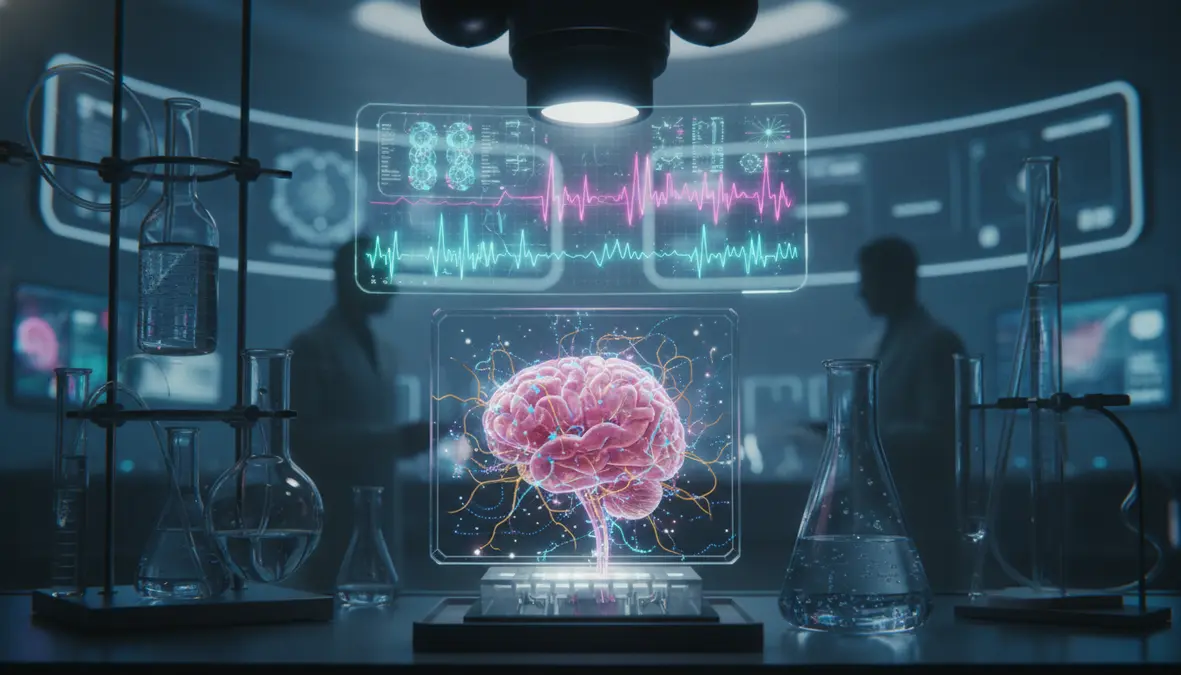
In a Lausanne laboratory, a cluster of sixteen pinhead-sized blobs of living human brain tissue sits inside a microfluidic chamber, bathed in nutrients, threaded with electrodes, and quietly learning. They are not metaphors for neural networks — they are neural networks, made of real neurons grown from human stem cells. In 2026, organoid intelligence (OI), sometimes called wetware computing or biological computing, has graduated from biology-paper curiosity into a small but rapidly maturing computing paradigm. Companies like FinalSpark, Cortical Labs, and Koniku — alongside academic groups at Johns Hopkins, Indiana University, and the Allen Institute — are wiring lab-grown brain organoids to silicon to do pattern recognition, real-time control, and adaptive learning at energy budgets that make GPU farms look obscene. The implications are radical, the science is real, and the ethics are unprecedented.
From Petri Dish to Processor
A brain organoid is a three-dimensional ball of neurons and glia, typically two to four millimeters across, grown in a bioreactor from induced pluripotent stem cells (iPSCs). Originally developed for disease modeling — Parkinson's, autism, Zika infection — organoids spontaneously self-organize into layered cortical structures with active synapses, oscillatory activity, and even region-specific identity. Around 2019, researchers noticed something striking: organoid electrical activity began to resemble the EEG signatures of a premature human infant. By 2022, the Cortical Labs DishBrain project had taught a planar culture of 800,000 neurons to play Pong. By 2026, vertically stacked organoids interfaced with high-density CMOS microelectrode arrays are running real workloads.
The defining shift is interface density. Modern multi-electrode arrays from MaxWell Biosystems and 3Brain pack four-thousand to twenty-six-thousand recording sites under a single organoid, and FinalSpark's Neuroplatform — the world's first remote-access wetware cloud — exposes sixteen organoids over the internet to researchers in fourteen countries. Read activity in, deliver dopaminergic and electrical "reward" or "punishment" signals out, and the organoid does the rest. The neurons are still doing what neurons have done for half a billion years; they are just plugged into a programming interface for the first time.
Living Neurons
iPSC-derived cortical organoids self-organize into layered tissue with active synapses, plasticity, and oscillatory dynamics absent from artificial networks.
Microelectrode Arrays
CMOS-based MEAs with thousands of electrodes provide high-bandwidth, two-way I/O between silicon and tissue at sub-millisecond latency.
Closed-Loop Training
Reward signals delivered as structured stimulation drive neurons toward task-correct behavior under the free energy principle — adaptive learning without backprop.
The 2026 Wetware Computing Stack
Organoid intelligence sits at the intersection of stem cell biology, microfluidics, electrophysiology, and software. The leading players in 2026 each tackle a different layer of the stack:
| Organization | Platform | Focus |
|---|---|---|
| FinalSpark | Neuroplatform (Switzerland) | Cloud-accessible biocomputing service running 16 live organoids 24/7 with remote API access |
| Cortical Labs | CL1 Biological Computer | First commercially shipping wetware computer combining cultured human neurons with silicon control |
| Koniku | Konikore | Hybrid biological-silicon chemical sensors for explosive detection and air-quality monitoring |
| Johns Hopkins (Hartung Lab) | OI Research Consortium | Foundational OI roadmap, ethical embedded research framework, and standardization |
| MaxWell Biosystems | MaxTwo HD-MEA | 26,400-electrode CMOS arrays — the de facto recording substrate for OI labs worldwide |
| Allen Institute & e11.bio | Connectomics + organoid maps | Whole-organoid synaptic wiring diagrams for closed-loop simulation and validation |
Why Biology Beats Silicon at Some Things
A rack of NVIDIA Blackwell GPUs training a frontier model burns ten to twenty megawatts. The human brain runs on roughly twenty watts. That six-order-of-magnitude gap is not waste — it is the consequence of computational principles silicon does not yet share: massively parallel asynchronous spiking, in-memory plasticity, sparse coding, and neuromodulatory gain control. Wetware computing tries to harvest those principles directly rather than imitate them in floating-point math.
In closed benchmarks, small organoid networks have shown two to three orders of magnitude better energy efficiency than equivalent ANNs on adaptive control tasks, faster one-shot learning on novel sensorimotor mappings, and graceful degradation under partial failure. They will not replace transformers for language modeling any time soon. But for low-power edge inference, real-time robotic control, chemical sensing, and online learning where data is scarce and energy is precious, biological substrates have legitimate, measurable advantages.
"We are not trying to recreate the brain. We are trying to harness the computational primitives that biology already evolved — plasticity, sparsity, energy efficiency — and offer them as a programmable substrate. The neurons are the hardware. The training protocols are the software."
What Researchers Are Actually Doing With Organoids
The 2026 application portfolio is narrow but genuine. Five categories define the active commercial and research deployments:
- Real-time game and control benchmarks: Pong, MountainCar, and CartPole remain the standard reference tasks because they expose closed-loop adaptation in seconds rather than hours. Cortical Labs' DishBrain published peer-reviewed evidence that cultured neurons learn Pong faster than randomly initialized neural networks under matched feedback conditions.
- Drug discovery for neurological disease: Organoids derived from Alzheimer's, Parkinson's, and ALS patients let pharma companies screen compounds on living human-genome neural tissue at unprecedented throughput — Vanqua Bio, System1 Bio, and AcuraStem are doing this commercially.
- Chemical and biothreat sensing: Koniku Konikore devices use olfactory receptor neurons to detect explosive vapors and pathogens at parts-per-trillion sensitivity that no silicon chemical sensor matches.
- Adaptive prosthetics research: Closed-loop interfaces between motor cortex organoids and robotic limbs are a stepping stone toward better implantable neural interfaces, complementing efforts at Neuralink, Synchron, and Precision Neuroscience.
- Foundational neuroscience tooling: The biggest near-term value is scientific. Organoids let neuroscientists run perturbation experiments — drugs, lesions, optogenetic stimulation — that ethics board policy forbids in living humans.
The Hard Limits That Define the Field
Wetware is real, but it is not magic. Five constraints currently bound what organoid computing can do:
First, scale. A typical organoid contains a few hundred thousand to a few million neurons. The human brain has 86 billion. The energy efficiency advantage scales beautifully; the raw computational ceiling does not — yet. Vascularized organoids that can grow past the diffusion limit of two to four millimeters are an active research target, and Stanford's Sergiu Pasca and others are working on cortical "assembloids" that fuse multiple region-specific organoids.
Second, longevity. Organoids must be kept alive in incubators with constant nutrient flow. FinalSpark reports an average lifespan of around one hundred days; the field is pushing toward years. Every day a culture lives is a day of accumulated calibration that is lost when it dies.
Third, reproducibility. No two organoids are wired identically. Unlike a CPU you can mass-produce to 0.1 nanometer tolerance, organoids self-organize stochastically, which makes benchmark comparison genuinely hard. Standardized differentiation protocols and connectome verification are emerging precisely to address this.
Fourth, I/O bandwidth. Even 26,000-electrode MEAs sample only a tiny fraction of the synapses inside an organoid. Optical interfaces using genetically encoded calcium indicators and voltage sensors promise vastly higher bandwidth, but they remain experimental.
Fifth, programming model. There is no PyTorch for wetware. Researchers train organoids with hand-tuned reward schedules borrowed from operant conditioning. The free energy principle from Karl Friston offers a unifying mathematical framework, but the developer experience today is closer to growing a garden than writing software.
The Ethics Are Unprecedented
An artificial neural network has no welfare interests; nothing it is told to do can hurt it, because there is no "it." A brain organoid is different in kind. It is a piece of living human-genome neural tissue capable of generating activity that, in some cases, mirrors the EEG of a fetal brain. Whether organoids have, can have, or will ever have anything resembling experience is genuinely unsettled — and unlike most AI ethics questions, the answer is at least partly empirical rather than philosophical.
The field is taking it seriously. The Johns Hopkins group, led by Thomas Hartung, has championed the "embedded ethics" approach: ethicists and IRB review built into research protocols from the start, not bolted on afterward. The 2023 Baltimore Declaration laid out core principles — informed donor consent for iPSC sourcing, welfare-conscious culture protocols, transparent reporting of any signs of integrated activity that might bear on consciousness questions, and a precautionary stance on increasingly large or sensorily integrated systems. Several countries are debating whether donor consent must be renewed if organoids are used commercially, and the EU is considering whether large vascularized organoids should fall under animal-research-style oversight.
A Practical Look at OI for Technologists
- Treat OI as a research substrate, not a product. If you are not solving a problem where adaptive online learning, ultra-low power, or rare-data sensing matters, GPUs and TPUs remain the right answer.
- Start with cloud access. FinalSpark's Neuroplatform exposes wetware over an HTTPS API. You can prototype without ever owning a bioreactor.
- Combine, don't replace. The most credible 2026 architectures pair a small organoid for adaptive control with conventional silicon for I/O, vision, and storage — hybrid systems beat either substrate alone.
- Take ethics seriously from day one. Document iPSC provenance, IRB approval, welfare protocols, and stop-conditions. Regulators are paying attention.
- Track the connectome work. Whole-organoid synaptic maps from the Allen Institute and e11.bio will turn empirical training into model-based design over the next two to three years.
A Genuinely New Kind of Computer
For seventy years, every advance in computing has been silicon. Vacuum tubes gave way to transistors, transistors to integrated circuits, integrated circuits to multi-billion-transistor systems-on-a-chip. Quantum and neuromorphic processors are real, but still trace their lineage to physics-of-the-inorganic. Organoid intelligence breaks that lineage. It is the first computing paradigm whose substrate is alive — capable of growing, healing, adapting, and, perhaps eventually, of things harder to name.
It will not displace GPUs in 2027 or 2030. But for a narrow, important class of problems — energy-bounded edge inference, real-time adaptive control, exquisite chemical sensing, and the pure scientific work of understanding our own minds — biological computing is no longer speculative. The neurons are firing, the electrodes are recording, the cloud APIs are live, and the ethics committees are convened. The next era of computing may be partly grown rather than fabricated, and the work to figure out what that means responsibly is already underway.