Perovskite-Silicon Tandem Solar Cells in 2026: How Oxford PV, Longi, JinkoSolar, First Solar, and Caelux Are Breaking the 30% Efficiency Barrier at Commercial Scale
- Internet Pros Team
- June 3, 2026
- AI & Technology
For 65 years, the single-junction silicon solar cell has been bumping its head against a hard physical ceiling — the Shockley-Queisser limit of roughly 29.4% efficiency. In 2026, that ceiling cracks. Oxford PV began commercial shipments of residential modules above 26.9% from its Brandenburg factory; Longi certified a 34.6% two-junction tandem cell in the lab; JinkoSolar hit 33.84% on a full-size wafer; First Solar turned its Evolar acquisition into a 2026 tandem roadmap; and Caelux, Tandem PV, and Swift Solar are building US gigawatt lines. Perovskite-on-silicon tandem photovoltaics have stopped being a lab curiosity and become the most important hardware story in clean energy this year.
Why Tandem Cells Beat the Silicon Ceiling
A conventional silicon solar cell is a single semiconductor junction tuned to absorb roughly the visible-light region. Photons with energy below silicon's 1.12 eV bandgap slip through unabsorbed; photons with much higher energy are absorbed but their excess energy is dumped as heat. Both losses are baked into the physics, and they pin a single-junction silicon device near 27% in practice.
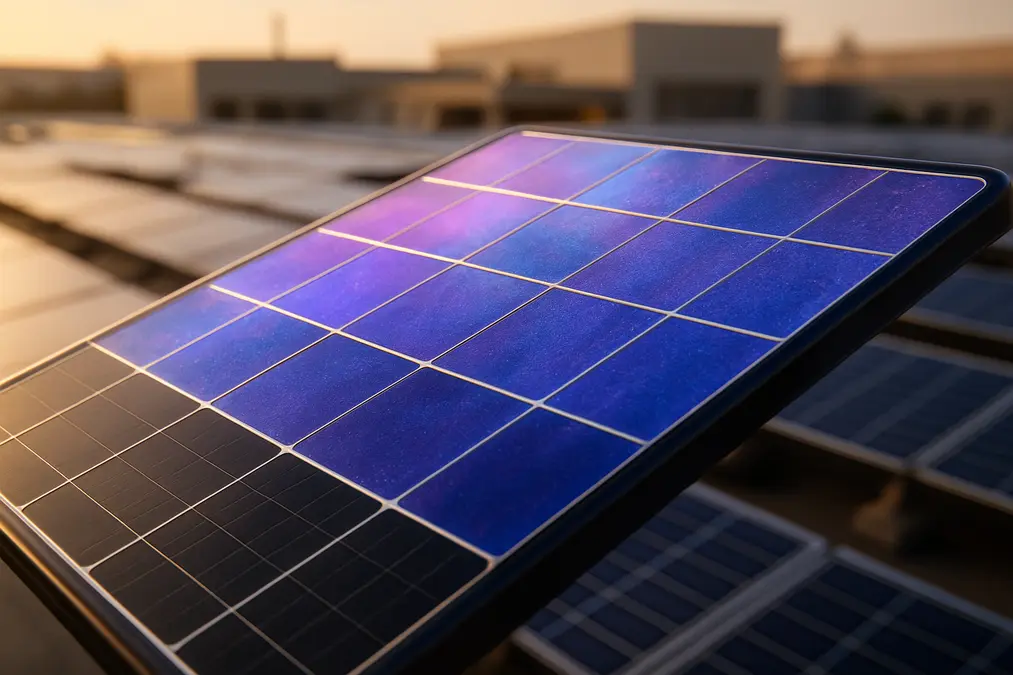
A tandem cell stacks a second, wide-bandgap absorber on top of the silicon. The top cell harvests the high-energy blue and green photons at higher voltage; the silicon underneath sees only the lower-energy red and infrared photons it was always good at. The combined device captures both ends of the spectrum with far less thermalization loss — pushing the theoretical limit above 43% for a two-junction device and unlocking real-world certified efficiencies that now exceed 34%.
The winning top-cell material in 2026 is metal-halide perovskite — a class of crystals built around a cation (formamidinium, cesium, methylammonium), lead, and a halide (iodide, bromide). Tune the halide ratio and the bandgap slides smoothly from 1.5 eV to 1.8 eV, letting engineers current-match the perovskite top cell to a TOPCon, HJT, or IBC silicon bottom cell. Perovskites can be solution-coated at near room temperature, blade-coated, slot-die printed, or vacuum-evaporated — all at a fraction of the capital cost per gigawatt of a silicon wafer fab.
"The reason tandem matters in 2026 is that silicon is no longer the bottleneck — land, transmission interconnect, and module shipping cost per watt are. Tandem lets you deliver 40% more energy from the same footprint and the same balance-of-system, which is the only lever big enough to keep up with AI data center load growth."
Who Is Actually Shipping Tandem Hardware
| Company | Approach | 2026 Milestone |
|---|---|---|
| Oxford PV (UK / Germany) | Spun out of Oxford University by perovskite pioneer Henry Snaith. Operates a former Meyer Burger heterojunction line in Brandenburg retrofitted for perovskite-on-silicon tandems. Targets residential and commercial rooftops where every watt per square meter counts. | Commercial shipments of residential modules certified at 26.9% module efficiency (versus ~22% for premium silicon), with US distribution agreements and a ramp toward gigawatt-scale capacity through 2027. |
| Longi Green Energy (China) | The world's largest crystalline-silicon manufacturer. Pursues a vertically integrated TOPCon / HJT bottom cell with an in-house perovskite top cell. Aggressively chases NREL chart records as a marketing and capability signal. | Certified 34.6% efficiency on a two-junction perovskite-silicon tandem cell — the current world record — with a pilot-scale fab targeting module sampling to utility customers. |
| JinkoSolar & Trinasolar (China) | The two largest module shippers globally. Both run pilot tandem lines on n-type TOPCon bottom cells, sized for utility-scale modules rather than premium rooftop. Strategy is gigawatt-scale cost-down rather than efficiency records. | JinkoSolar reached 33.84% on a full-size wafer; Trinasolar has crossed 30%+ on tandem prototypes. Both have signaled commercial tandem product launches before the end of 2026. |
| First Solar (USA, ex-Evolar) | Acquired Sweden's Evolar in 2023 to add a perovskite top-cell capability on top of its dominant US CdTe thin-film franchise. Operates the largest US-based solar manufacturing footprint and benefits substantially from the IRA 45X tax credit. | Public tandem roadmap targeting perovskite-on-CdTe and perovskite-on-silicon prototypes from its US R&D center, with productization timed to its Ohio, Alabama, and Louisiana capacity expansions. |
| Caelux, Tandem PV, Swift Solar (USA) | The leading US perovskite startups. Caelux coats perovskite directly onto solar glass that retrofits existing silicon module lines. Tandem PV builds full perovskite-silicon modules in San Jose. Swift Solar focuses on flexible, lightweight perovskite for EV, drone, and building-integrated PV. | Multiple US gigawatt-class fab announcements supported by DOE SETO funding and the IRA domestic content bonus, with first commercial product samples shipping to utility and rooftop customers in 2026. |
The Four Engineering Wins of Tandem
Strip away the headlines and the case for perovskite-silicon tandem rests on four advantages that compound:
More Watts From the Same Square Meter
A 26.9% tandem module delivers roughly 40% more energy than a 19% legacy silicon module on the same roof, the same racking, the same inverter. For a constrained rooftop, an interconnect-limited substation, or an AI campus chasing on-site solar, the watts-per-square-meter math is decisive.
Lower Balance-of-System Cost per kWh
Roughly two-thirds of utility-scale solar cost is now balance-of-system — land, racking, wiring, inverters, labor, permitting. Tandem amortizes all of it across more energy delivered, driving levelized cost of electricity below 2 cents per kWh at the best sites.
Drop-In Compatibility With Silicon Fabs
A perovskite top cell adds 3-5 process steps to a TOPCon or HJT line — orders of magnitude less capex than a greenfield wafer fab. The world's installed silicon capacity is not stranded; it is the foundation for the tandem buildout.
Bandgap Tunability for Local Conditions
Halide ratios in the perovskite are tunable to optimize for high-irradiance desert sites, diffuse-light northern roofs, or even semi-transparent BIPV windows. One material, many SKUs — without redesigning the silicon underneath.
The Honest Problems That Are Not Yet Solved
Long-term outdoor stability. Perovskite films degrade under heat, humidity, UV, and ion migration. The reference target is a 25-year warranty matching silicon. Best 2026 modules clear the IEC 61215 accelerated stress tests; real-world 25-year field data does not yet exist. Encapsulation, edge sealants, and self-assembled monolayer contacts are closing the gap.
Lead containment. Today's record perovskites contain trace amounts of lead. The quantity per module is tiny — comparable to a single lead-acid car-battery terminal — but RoHS compliance, end-of-life recycling, and public perception still demand robust glass-glass encapsulation and a clear take-back stream. Lead-free tin perovskite and double-perovskite alternatives remain a research priority.
Manufacturing yield at gigawatt scale. Lab-scale perovskite films are millimeters across; commercial modules are 2.4 m². Slot-die and blade coating uniformity, anti-solvent quenching at speed, and conformal deposition over silicon pyramid textures are the production engineering challenges that decide whether a 1 GW pilot ramps cleanly to 10 GW.
Supply chain for indium and high-purity precursors. Transparent conductive oxides such as ITO rely on indium, a constrained mineral. Lead iodide, formamidinium iodide, and cesium iodide all need semiconductor-grade purity. None of these are blockers — but each is a procurement risk that tandem fabs have to underwrite as they ramp.
What Tandem PV Means for Buyers, Operators, and Policy
- Procurement teams should re-spec rooftop and constrained-site projects. Where land or interconnect is the gate, a 26-30% tandem module changes the project NPV more than any racking, tracker, or inverter swap available in 2026.
- Hyperscaler PPAs are about to get cheaper at the long end. Tandem modules at sub-$0.25/W and LCOEs below 2 cents per kWh make 24/7 carbon-free energy contracts dramatically easier for Google, Microsoft, Amazon, and Meta to underwrite for new AI data centers.
- Domestic content matters more than nameplate. US-made tandems from First Solar, Caelux, Tandem PV, and Swift Solar qualify for IRA 45X manufacturing credits and the domestic content bonus. The 2026 buying decision is no longer just $/W — it is $/W after credits.
- Warranty language is now the negotiation. Until 25-year field data exists, tandem buyers should price the difference between a silicon-grade warranty and a tandem-grade warranty into their model, and demand glass-glass encapsulation, third-party accelerated-aging data, and lead-recovery clauses by default.
The Bottom Line
Perovskite-silicon tandem solar cells in 2026 are doing for photovoltaics what 3 nm finFET did for logic chips a decade ago — taking a mature, profitable, but ceiling-bound technology and breaking the ceiling without throwing away the installed manufacturing base. Oxford PV is shipping. Longi, JinkoSolar, and Trinasolar are racing for utility-scale launches. First Solar is converting Evolar IP into a US factory plan. Caelux, Tandem PV, and Swift Solar are building US capacity behind IRA economics. The lab record is 34.6%; the commercial module is past 26.9%; the trajectory clearly points to 30%+ commercial modules before the end of the decade.
For business leaders, the message is concrete: when you scope a 2026 rooftop, constrained-site, or hyperscale PPA, treat tandem the way you would have treated lithium-ion in 2014 — early enough that securing supply is cheap, late enough that ignoring it leaves real money on the table. The teams that build hands-on familiarity with Oxford PV, First Solar, and Caelux module specs over the next 12 months will be the ones writing the cheapest clean-energy contracts in the second half of the decade — exactly when AI compute demand makes every cent per kilowatt-hour matter.