Rare-Earth-Free Magnets in 2026: How Ferrite, Iron Nitride, and Smarter Motor Design Are Trying to Break the Neodymium Chokehold
- Internet Pros Team
- August 9, 2026
- AI & Technology
There is a small grey block, usually no larger than a domino, sitting inside almost every machine that spins. It is in the traction motor of an electric car, the hip actuator of a humanoid robot, the direct-drive generator of an offshore wind turbine, the fan that keeps a rack of AI accelerators from cooking itself, the speaker in a phone, and the servo in a surgical instrument. It is a sintered neodymium-iron-boron magnet, and the elements inside it are refined into usable form almost entirely in one country. For twenty years that was an economics footnote. In 2026 it became the first question in a procurement meeting.
Why a Handful of Elements Ended Up Inside Everything
Permanent magnets are not interchangeable commodities. Engineers care about three numbers: how strong a field the material produces on its own, how well it resists being demagnetized by heat or by the motor's own opposing field, and how much of that it retains at operating temperature. Neodymium-iron-boron wins on all three by a wide margin, and the addition of small amounts of dysprosium or terbium is what lets it survive the 150 to 180 degree environment inside a real traction motor.
That strength translates directly into product decisions. A stronger magnet means more torque from less volume, which means a smaller motor, which means less copper, less iron, less mass to accelerate, and a longer range from the same battery. Designers did not choose neodymium for sentiment - they chose it because every alternative made the finished machine bigger, heavier, and less efficient.
The awkward part is that "rare earth" is a misleading name. The elements are reasonably abundant in the crust. What is concentrated is the separation and metallization step - the chemistry that pulls chemically near-identical elements apart and turns them into magnet-grade alloy. That step is capital-intensive, environmentally difficult, slow to permit, and for decades was economically unattractive to anyone who did not already do it at scale.
"Nobody has a mining problem. Everybody has a separation and sintering problem. You can open a mine in five years and still have nowhere to send the concentrate."
What Actually Changed
Export licensing on magnet materials converted a theoretical chokepoint into a scheduling one. The immediate effect was not that magnets became unavailable; it was that lead times became unpredictable and paperwork became a gating item on production lines that had never modelled it. A licence that arrives in eight weeks instead of two is not a price problem - it is a stopped assembly line.
Demand made it worse from the other direction. Humanoid and mobile robotics programmes moved from pilots to fleet orders, and a general-purpose robot uses dozens of magnet-bearing actuators rather than one big motor. AI data centres added an unglamorous but enormous appetite for high-static-pressure fans and pumps. Wind, heat pumps, and electric vehicles kept growing. Several of the fastest-growing industries on the planet turned out to be competing for the same alloy.
| Approach | How It Avoids the Bottleneck | Realistic Status in 2026 | Main Trade-Off |
|---|---|---|---|
| Ferrite-assisted reluctance motors | Uses cheap strontium ferrite plus rotor geometry for most of the torque | In production for appliances, pumps, and some vehicles | Larger and heavier for the same output; needs sophisticated control |
| Externally excited synchronous motors | Replaces magnets entirely with a wound rotor fed by current | Shipping in several premium electric vehicles | More copper, brushes or a rotating transformer, lower part-load efficiency |
| Samarium-iron-nitrogen | Strong magnet chemistry that skips dysprosium and terbium entirely | Early commercial bonded magnets, small volumes | Decomposes at sintering temperatures, so shaping is hard |
| Iron nitride | Magnet built from iron and nitrogen - both effectively unlimited | Pilot production, niche applications | The high-performance phase is difficult to make in bulk and stabilize |
| Magnet-to-magnet recycling | Recovers alloy from end-of-life motors and drives without full re-separation | Commercial plants operating, feedstock-limited | Not enough scrap exists yet to matter at fleet scale |
The Cheapest Fix Is Usually a Different Motor
The most effective response to magnet scarcity is often not a new magnet at all. It is redesigning the machine so it needs less magnet, or none.
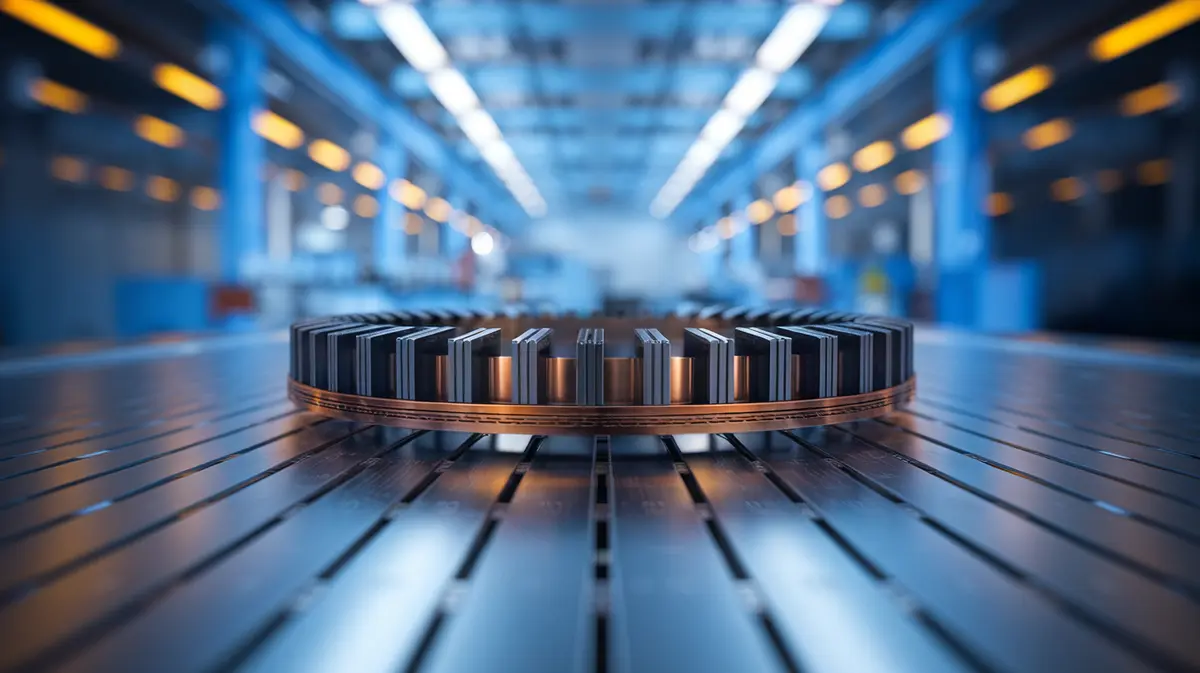
A synchronous reluctance motor generates torque from the rotor's shape - carefully cut flux barriers make the rotor strongly prefer one alignment, and the field drags it there. Add modest ferrite magnets to that rotor and the result is a ferrite-assisted machine that reaches a large fraction of neodymium-class performance using a material made from iron oxide and strontium carbonate. Externally excited designs go further and use no permanent magnet at all, energizing the rotor with current instead. Both approaches were considered impractical two decades ago for the same reason: they demand fast, precise control that only became cheap once silicon carbide power electronics and high-resolution position sensing became commodity parts.
This is the pattern worth noticing. The material constraint was relieved by progress in a completely different discipline. Better controllers made worse magnets acceptable.
Why This Reaches Companies That Do Not Build Motors
Magnet exposure hides several layers down in bills of materials that nobody has previously mapped:
- Cooling is the quiet one. High-density server and HVAC fans use magnet-bearing motors, so a data centre build can be delayed by a component nobody tracks.
- Robotics multiplies the count. A single humanoid or mobile manipulator carries dozens of actuators, turning a per-unit part into a per-joint part.
- Tier-three suppliers are invisible. Most firms know their direct suppliers and almost nothing about who supplies them, which is exactly where the exposure sits.
- Substitution is a requalification project. Changing a motor is not a purchasing decision - it changes thermal behaviour, noise, weight, and often certification.
- Design freedom is worth money now. Products specified so that two different motor architectures can be fitted are materially more resilient than products optimized around one.
The New Chemistries, Honestly Assessed
Samarium-iron-nitrogen is the nearest-term genuinely different magnet. Its intrinsic properties rival neodymium and it needs no heavy rare earths, so it sidesteps the most constrained part of the supply chain. The catch is manufacturing: the compound breaks down before it reaches the temperatures conventional sintering requires, so producers rely on bonded magnets - powder held in a polymer - which dilutes performance. Progress here is a processing story, not a physics one.
Iron nitride is the more radical bet, promising a strong magnet from two of the most abundant materials available. The difficulty is that the desirable crystalline phase is metastable and stubbornly hard to produce in bulk with consistent alignment. It has been fifteen years from laboratory demonstration to pilot lines, which is a fair indication of how hard the remaining problems are.
Tetrataenite - an iron-nickel ordering that forms naturally in meteorites over millions of years - remains the most romantic and least mature option. Laboratory routes to form it in days rather than geological time exist, but nothing about a manufacturable process at industrial volume has been demonstrated.
Recycling Is Real, Just Early
Magnet-to-magnet recycling avoids the hardest chemistry entirely. Rather than dissolving scrap back into individual elements, the process recovers the alloy in a form that can be reprocessed into new magnets - typically by using hydrogen to make the material crumble away from the assembly it is bonded into. It is dramatically less energy-intensive than primary production and produces no separation waste.
The limit is arithmetic. The magnets in cars and turbines built during the growth years are still inside working machines. Recycled feedstock cannot supply a market that is still expanding quickly, because the material has not come back yet. Recycling is a genuine structural answer for the 2030s and a partial one now, mostly from manufacturing scrap and retired industrial drives.
The Limitations Nobody Should Gloss Over
- Alternatives cost performance. Magnet-free and ferrite designs are typically larger, heavier, or slightly less efficient - acceptable in a pump, painful in an aircraft or a wearable robot.
- Qualification takes years. Automotive and industrial motor changes carry validation cycles that no procurement urgency shortens.
- New capacity is slow everywhere. Separation and metallization plants take years to permit and commission, regardless of who funds them.
- Price signals are unreliable. These markets are thin and policy-driven, so today's price is a poor guide to whether an alternative is worth developing.
- Diversification is not independence. Sourcing from a second supplier who buys refined alloy from the same origin changes the invoice, not the risk.
What to Actually Do About It
For most organizations the useful work is unglamorous and starts with visibility. Find out which of your products contain motors, which of those motors contain permanent magnets, and where those magnets come from - not where the motor was assembled. That single exercise routinely surprises companies that considered themselves software or services businesses right up until they counted the cooling fans in their own facilities.
From there the sensible moves are the ones that preserve options rather than predict a winner: qualify a second motor architecture where the packaging allows it, treat magnet content as a design constraint during specification instead of a sourcing surprise afterwards, and hold slightly more buffer inventory on the small number of parts where a substitute genuinely does not exist.
The larger lesson is one that keeps recurring across modern infrastructure. Decades of optimizing every supply chain for cost produced systems that are extraordinarily efficient and quietly brittle, with the fragility concentrated in unremarkable components nobody thought to name. The magnet is simply the current example - small, cheap, apparently boring, and sitting on the critical path of almost everything that moves.