Redox Flow Batteries in 2026: How Liquid-Electrolyte Tanks Are Solving the Long-Duration Grid Storage That Lithium Cannot
- Internet Pros Team
- July 29, 2026
- AI & Technology
The renewable grid has a night-shift problem. Solar stops at sunset, wind comes and goes, yet demand runs around the clock - and the lithium-ion batteries that dominate today can only cover a few hours before they run dry. To keep the lights on for a windless winter evening, the grid needs storage that lasts far longer, never catches fire, and does not wear out after a few years. In 2026, one of the most credible answers is not a better solid battery at all, but a tank of liquid. It is called the redox flow battery, and it is quietly becoming the workhorse of long-duration energy storage.
What a Redox Flow Battery Actually Is
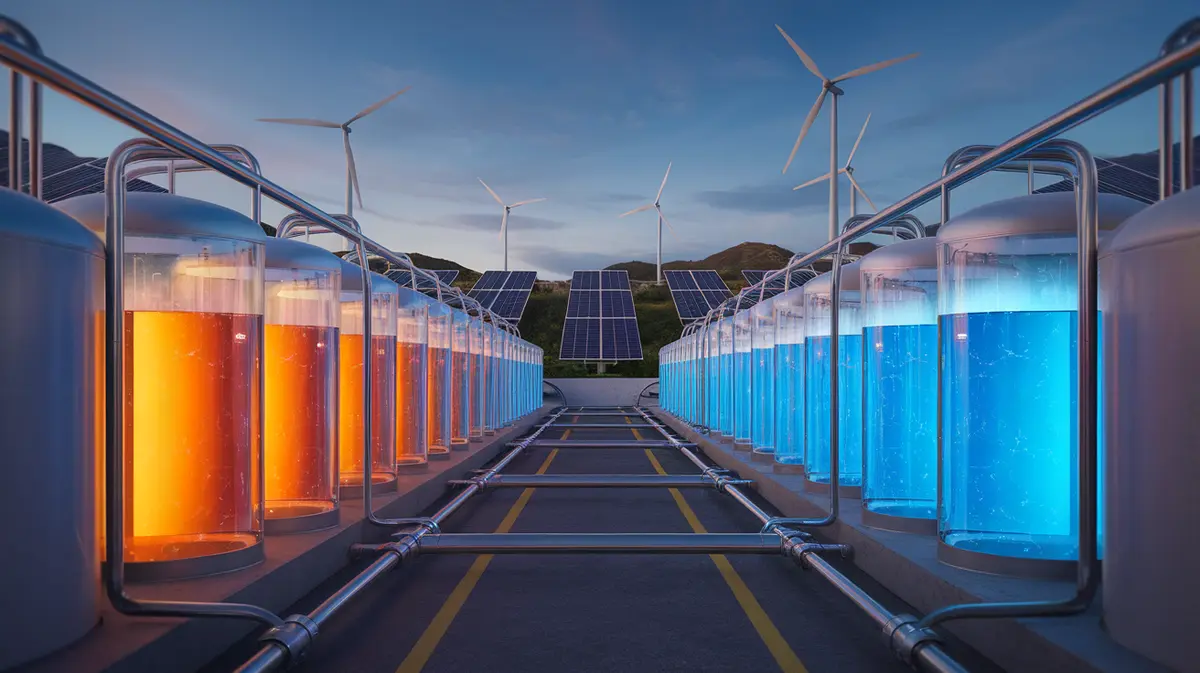
A conventional battery packs everything - the energy, the chemistry, the electrodes - into a single sealed cell. A flow battery pulls them apart. It stores its energy in two large tanks of liquid electrolyte, and pumps that liquid through a central stack where a thin membrane separates the two sides. As the fluids flow past the membrane, ions shuttle across and electrons move through an external circuit - charging when you push energy in, discharging when you pull it out. The word redox simply describes the reduction and oxidation reactions that store and release the charge as the liquid changes its chemical state.
"A lithium battery is like a fixed fuel tank welded to its engine. A flow battery is a generator with separate fuel tanks - want more range, add more fuel. That single design choice rewrites the economics of long-duration storage."
The Killer Feature: Power and Energy Are Decoupled
This is the idea that makes flow batteries special. In a lithium pack, how much power you can deliver and how much energy you can store are locked together - both scale with the number of cells. In a flow battery they are independent. The stack sets the power - how fast you can charge and discharge. The tanks set the energy - how long you can run. Want to go from a 4-hour system to a 12-hour system? You do not rebuild the battery; you just build bigger tanks and add more electrolyte. For long durations, that decoupling makes each extra hour of storage remarkably cheap.
Why Lithium Runs Out of Road for Long Durations
Lithium-ion is superb for phones, cars, and short grid bursts. But stretch it to grid-scale, all-night, multi-day storage and its weaknesses compound:
- Short duration: Most grid lithium systems are built for 2 to 4 hours - fine for the evening peak, useless for a still, cloudy stretch that lasts a day or more.
- Degradation: Lithium cells lose capacity with every cycle and calendar year, so a system sized today is smaller in a decade.
- Fire risk: Densely packed lithium can enter thermal runaway - the chain-reaction fires that have forced costly fire-suppression rules on grid installations.
- Materials pressure: The same lithium, nickel, and cobalt are being fought over by the entire EV industry.
Where Flow Batteries Shine
They Barely Wear Out
The liquid electrolyte is not consumed - it just changes state and changes back. Many systems are rated for 20,000 or more cycles across 20 to 25 years with little capacity loss.
They Do Not Burn
The electrolytes are typically water-based and non-flammable. No thermal runaway means far simpler siting, permitting, and safety costs.
Long Duration Is Cheap
Because adding hours means adding electrolyte rather than whole batteries, the cost per stored hour keeps falling as duration grows.
Vanadium vs. Iron: The Two Leading Chemistries
| Chemistry | Strengths | Trade-Offs |
|---|---|---|
| Vanadium (VRFB) | Same element on both sides means no cross-contamination and an extremely long life; the most proven, commercially mature flow chemistry. | Vanadium is a costly, price-volatile commodity, which raises the up-front bill. |
| Iron | Built on iron, salt, and water - cheap, abundant, non-toxic, and free of supply-chain drama. | Lower energy density means bigger tanks for the same storage; a newer, less battle-tested technology. |
| Emerging (zinc, organic) | Chase even lower costs or higher density using earth-abundant or engineered molecules. | Mostly still proving durability and scale outside the lab. |
Companies such as Invinity and CellCube have pushed vanadium systems into utility projects worldwide, while ESS Inc. has bet on iron flow for its cost and safety. The common thread in 2026 is momentum: multi-hour, multi-day storage that was a pilot-project curiosity a few years ago is now being ordered at grid scale.
"The grid does not just need more storage - it needs longer storage. A battery that runs for four hours cannot cover a night. The value of flow batteries is measured not in how much power they push, but in how many hours they keep pushing it."
The Honest Trade-Offs
Flow batteries are not a silver bullet, and the reasons they have not already taken over are real:
- Low energy density: They are big and heavy for the energy they hold, which rules them out for cars or phones - they are strictly stationary infrastructure.
- Round-trip efficiency: Pumps and membranes mean a bit more energy is lost per cycle than in top-tier lithium systems.
- Up-front cost: The initial price can be higher than lithium; the win comes over decades of use, not on day one.
- Complexity: Pumps, plumbing, and tanks add moving parts a sealed battery does not have.
The key insight is that these are the right trade-offs for the job. Nobody is putting a flow battery in a laptop. But for a warehouse-sized installation that must store an entire day of renewable energy, cycle daily for 25 years, and never risk a fire, being bulky is a price worth paying.
Why It Matters for a Renewable Grid
As solar and wind climb toward the majority of generation, the hardest problem shifts from making clean power to time-shifting it - moving midday sun and overnight wind to the moments people actually need it. That is a long-duration challenge, and it is exactly where lithium is weakest and flow batteries are strongest. Pair cheap renewables with storage that runs for 10 to 20 hours and the case for burning gas to cover the gaps starts to disappear.
For businesses and communities planning their own energy future, the lesson is to match the tool to the timescale. Need to smooth a few seconds or a couple of hours? Lithium still wins. Need to carry energy across a night, a calm spell, or a full working shift, safely and for decades? A tank of liquid electrolyte is looking like one of the smartest bets on the grid.
The Bottom Line
Redox flow batteries store energy in tanks of liquid electrolyte, decoupling power from capacity so that adding hours of storage is as simple as adding fluid. They barely degrade, do not catch fire, and last for decades - trading low energy density and higher up-front cost for exactly the long-duration, grid-scale reliability that lithium struggles to deliver. As renewables push toward the majority of the grid in 2026, flow batteries are emerging as the technology most likely to keep a clean grid running long after the sun goes down.