RISC-V: How the Open-Source CPU Architecture Is Reshaping Chips, Servers, and Embedded Systems in 2026
- Internet Pros Team
- April 21, 2026
- AI & Technology
In January 2026, RISC-V International announced that the cumulative number of RISC-V cores shipped worldwide had passed 25 billion — more than the total Apple has shipped of every chip it has ever designed. A few weeks later, the European Processor Initiative powered up Rhea, the first European-designed server CPU to reach silicon, built around RISC-V. Google confirmed that its newest Pixel modem, NVIDIA disclosed that its GPU management controllers, and Meta's MTIA-2 AI accelerator all run RISC-V firmware cores. After two decades of debate over whether an open instruction set could really compete with x86 and ARM, 2026 is the year RISC-V stopped being a research curiosity and became infrastructure — quietly displacing proprietary architectures one workload at a time.
What Is RISC-V?
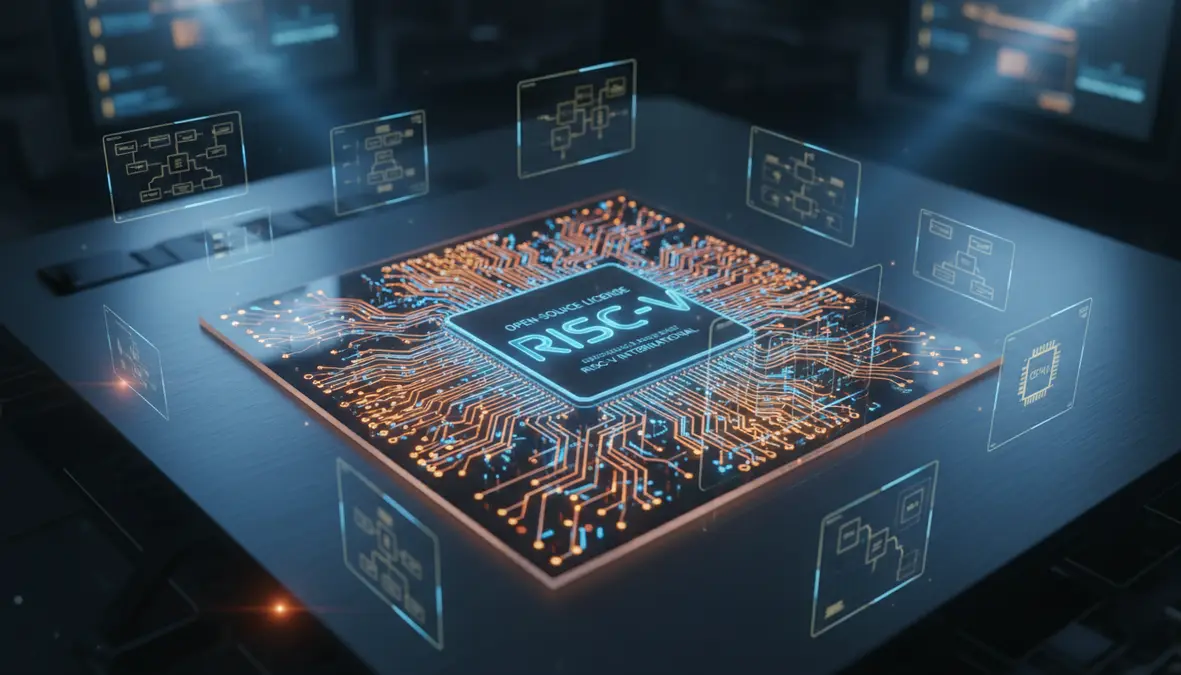
RISC-V (pronounced "risk-five") is a free and open instruction set architecture (ISA) — the contract between software and silicon that defines what instructions a CPU understands. Unlike x86 (controlled by Intel and AMD) or ARM (licensed for a fee from Arm Holdings), RISC-V is governed as an open standard by RISC-V International, a Swiss-based non-profit with more than 4,500 member organizations including Google, NVIDIA, Qualcomm, Intel, Samsung, Alibaba, and the Linux Foundation. Anyone can design, manufacture, and ship a RISC-V chip without paying royalties, signing an NDA, or asking permission.
Born at UC Berkeley in 2010 as a teaching project, RISC-V was designed from a clean slate to be modular: a small mandatory base integer instruction set (RV32I or RV64I), plus optional extensions for floating point, atomic operations, vector math, bit manipulation, and dozens of others. A microcontroller for a smart light bulb might implement just the base set; a server CPU implements the full RVA23 profile with vector, virtualization, and cryptography extensions. The same compiler, the same operating system, the same software stack — across a 1,000× range of performance and power.
Open and Royalty-Free
The ISA specification is published under a permissive license. Anyone can build a compliant core, ship it commercially, and never owe a license fee — eliminating the per-chip royalty that ARM has historically charged.
Modular Extensions
A small base ISA plus optional extensions (M, A, F, D, C, V, B, K, H) lets designers tailor silicon for the workload — scalar microcontrollers, vector AI accelerators, and out-of-order server cores all share one compiler and one OS.
Vendor-Neutral Standard
Governance sits with RISC-V International, a non-profit with thousands of member companies. No single vendor can lock customers in or block competitors — a structural answer to today's semiconductor concentration risk.
RISC-V vs. ARM vs. x86: Why Architecture Matters
Most software developers in 2026 will never write a line of assembly, but the choice of ISA shapes the entire stack underneath them. ARM's royalty model — a flat per-chip fee plus a hefty up-front architecture license — has long been a tax on chipmakers. x86 is even more closed, available only to Intel and AMD. RISC-V breaks both constraints, and the consequences ripple from the foundry up through the cloud.
| Dimension | x86 (Intel / AMD) | ARM | RISC-V |
|---|---|---|---|
| Licensing | Closed; only Intel & AMD | Per-chip royalty + architectural license | Free, open, royalty-free |
| Extensibility | Vendor-controlled extensions | Limited custom instructions | First-class custom extensions |
| Governance | Two companies | Arm Holdings (SoftBank) | Open non-profit consortium |
| Server Footprint (2026) | Dominant | Rapidly growing | Early but accelerating |
| Embedded Footprint | Niche | Dominant | Fastest growing — already leads MCU class in Asia |
| Geopolitical Exposure | US export controls | UK/Japan headquarters; export-controlled | Globally portable, no jurisdictional gatekeeper |
25 Billion Cores: Where RISC-V Is Already Winning
The first wave of RISC-V deployment didn't look like a revolution because it happened where nobody was looking — inside other chips. Today, almost every modern SSD controller, NVIDIA GPU, AMD platform security processor, and Western Digital storage device contains a small RISC-V core handling firmware, telemetry, or security tasks. These are hidden processors, never exposed to users or operating systems, but they account for the bulk of those 25 billion cores. Replacing the proprietary microcontrollers that previously did these jobs saves vendors millions in licensing per product line.
The second wave is now arriving in places users will notice. Microcontrollers from Espressif (the ESP32-C series), GigaDevice, and WCH already power millions of IoT devices, smart-home gadgets, and electric-bike controllers. Automotive suppliers including Bosch, Continental, and Infineon have committed to RISC-V for next-generation domain controllers and zonal architectures. And in 2025–2026, the first RISC-V smartphones, Chromebooks, and developer laptops reached consumers — modest in performance, but proof that the application class is no longer theoretical.
"RISC-V is no longer the future of computing — it's the present, just not yet evenly distributed. Every major hyperscaler now has a RISC-V program in production silicon. The only debate left is how fast the rest of the industry follows."
The Server Push: Tenstorrent, Ventana, and the Hyperscalers
For most of RISC-V's history, "server-class" was an aspiration. That changed in 2025. Ventana Micro's Veyron V2 reached customers as a 192-core, 3.6 GHz data-center CPU benchmarked within striking distance of AMD EPYC Genoa on integer workloads. Tenstorrent's Black Hole AI accelerator, designed by chip legend Jim Keller, pairs an array of RISC-V Tensix cores with a programmable mesh — a wholly different bet from NVIDIA's GPU-centric stack. Alibaba's XuanTie C930 powers cloud servers in Aliyun's east-China regions, and SiFive's P870 targets premium application processors with out-of-order execution and the full RVA23 profile.
Behind the merchant silicon, the more consequential shift is happening inside the hyperscalers. Google has confirmed that future TPU host controllers will use in-house RISC-V cores. Meta's MTIA-2 inference accelerator integrates RISC-V management cores. AWS Annapurna and Microsoft Azure Maia teams have publicly recruited RISC-V architects. The motivation is structural: avoiding ARM royalties on chips manufactured at hyperscale, and gaining the freedom to add custom instructions for AI primitives without negotiating with a third party.
The Vector Extension and the AI Connection
RISC-V's ratified Vector Extension (RVV 1.0) is one of its most consequential design choices for the AI era. Unlike x86 AVX-512 or ARM SVE, RVV is vector-length agnostic: the same compiled binary runs on cores with 128-bit vectors and on cores with 4,096-bit vectors, with the runtime adapting automatically. For machine learning workloads — where matrix-multiply throughput is everything — this is a massive software-portability win. A model compiled once with LLVM 18's RVV backend runs on a SiFive embedded core, a Tenstorrent training chip, and a future hyperscaler design without recompilation.
- RVV-accelerated llama.cpp now runs Llama 3 8B at 30+ tokens/sec on SiFive HiFive Premier P550 development boards.
- PyTorch and TensorFlow ship official RISC-V wheels via the Linaro toolchain since late 2025.
- Custom AI extensions like Tenstorrent's Tensix and SiFive's Intelligence X390 layer matrix-multiply primitives directly on top of RVV.
- Energy efficiency claims of 2–3× per inference watt over comparable ARM cores have driven Edge AI chip vendors toward RISC-V as a default.
The Software Story: Linux, Android, and the Toolchain
A new ISA is only as useful as the software that runs on it, and 2026 is the first year RISC-V can claim a fully tier-one software stack. The Linux kernel has had upstream RISC-V support since 5.17, and every major distribution — Debian, Ubuntu, Fedora, openSUSE, Alpine — now ships RISC-V images as a first-class architecture. Android added RISC-V as an officially supported platform in Android 16 (April 2026), with full ART runtime, SELinux, and Treble support. Chrome, Firefox, Node.js, the JVM, .NET 9, Go, Rust, Python, and PyTorch all build cleanly. Docker, Kubernetes, and containerd run RISC-V images via cross-arch builds with BuildKit and QEMU.
The toolchain story is equally healthy. GCC 14 and LLVM/Clang 18 ship optimized RISC-V backends with RVV auto-vectorization, profile-guided optimization, and link-time optimization. The RISC-V Software Ecosystem (RISE) project — backed by Google, Intel, Qualcomm, NVIDIA, Red Hat, and others — coordinates kernel, compiler, and library work to ensure that performance improvements land everywhere at once, not in proprietary forks.
Geopolitics, Supply Chains, and Sovereign Silicon
RISC-V's rise is not happening in a vacuum. Tightening US export controls on advanced ARM and x86 designs, the EU Chips Act, India's Semicon mission, and China's drive for technology self-reliance have all converged on the same answer: an ISA that no government can revoke and no foreign company can refuse to license. China alone now accounts for roughly half of new RISC-V silicon designs, with Alibaba, Huawei (HiSilicon), and the Chinese Academy of Sciences as leading contributors. The European Processor Initiative's Rhea CPU and India's Shakti and VEGA programs use RISC-V as the foundation for sovereign computing roadmaps.
For Western policymakers, this creates a delicate balance. RISC-V's openness is what makes it valuable to the US-led tech ecosystem — but the same openness means American export controls cannot stop Chinese chip designers from using it. In 2024, US lawmakers floated proposals to restrict American participation in RISC-V International; the proposals stalled after pushback from the very US companies that depend on the standard. The episode underscored what is now widely accepted in the industry: open standards are not a strategic weakness, they are the only way to maintain influence in a technology that nobody can keep proprietary forever.
What This Means for Developers and Businesses
For most software developers, the RISC-V transition will be invisible — the same Python, the same Java, the same Node, just a new target architecture in CI. For systems engineers, embedded developers, and chip designers, the implications are larger: a new fab-agnostic, vendor-neutral foundation on which to build differentiated products without paying a tax to a competitor. For businesses, the practical takeaway is that the cost curve of compute is about to flex in their favor as competition intensifies across every tier of silicon.
Key Takeaways for 2026
- RISC-V is at scale: 25+ billion cores shipped, embedded leadership in Asia, and a credible server roadmap from Ventana, Tenstorrent, SiFive, and Alibaba.
- Hyperscalers are committed: Google, Meta, NVIDIA, AWS, and Microsoft all ship production RISC-V silicon — usually as control or AI cores, increasingly as the main compute engine.
- Software is tier-one: Linux, Android 16, GCC 14, LLVM 18, PyTorch, and the JVM all treat RISC-V as a first-class architecture.
- AI is the killer app: The vector extension (RVV 1.0) and custom matrix extensions make RISC-V a natural fit for energy-efficient ML inference and training.
- Geopolitical resilience: An open ISA is the only architecture immune to sanctions, license revocation, or single-vendor capture — a structural advantage in a fragmenting world.
Computing rarely gets a new foundational layer. The last time the industry adopted a fundamentally new instruction set was the ARM transition in mobile in the 2000s, and before that the x86 PC era of the 1980s. RISC-V is the third such moment — not because its silicon is dramatically faster, but because its license is dramatically more open. In a world where compute is increasingly strategic, where every hyperscaler wants its own silicon, and where the cost of a royalty multiplied by billions of chips matters more than ever, the ISA that costs nothing wins by default. Twenty-five billion cores in, the question is no longer whether RISC-V matters. It is how much of computing it ends up running.