Smart Grids and Vehicle-to-Grid (V2G): How AI-Orchestrated Bidirectional Power Networks Are Turning EVs into the Backbone of the Renewable Grid in 2026
- Internet Pros Team
- May 5, 2026
- AI & Technology
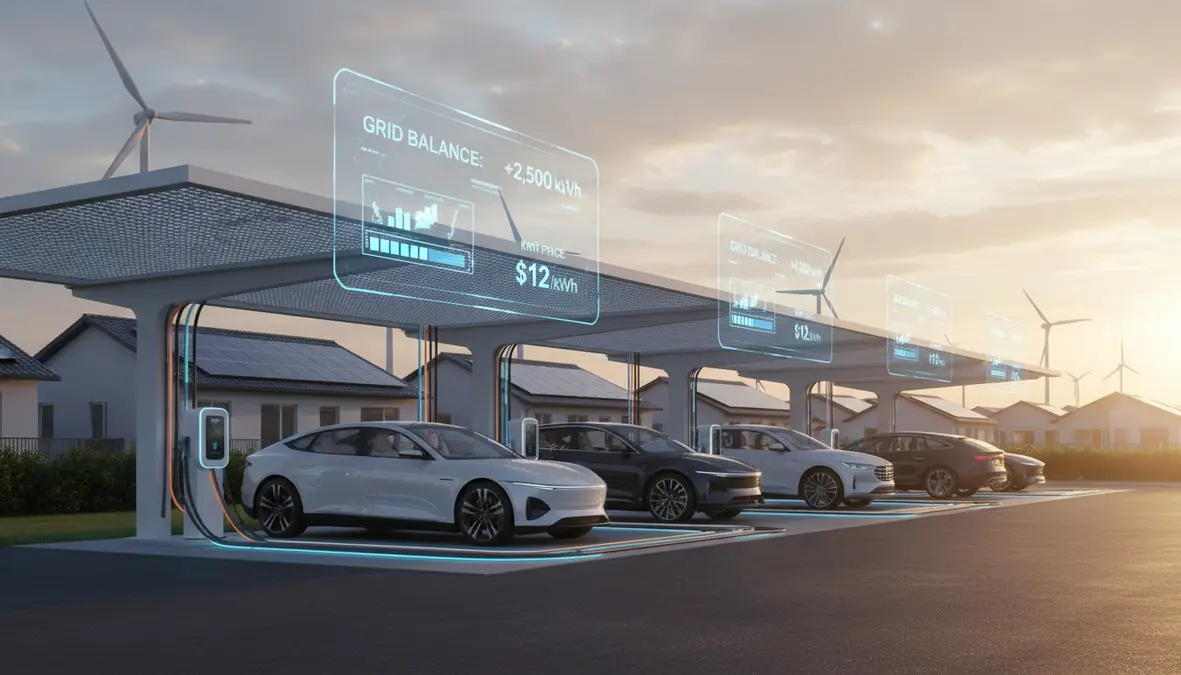
For a hundred years, the electric grid was a one-way street. Coal, gas, nuclear, and hydro generators pushed electrons one direction — out to homes, factories, and businesses — and consumers were just that: consumers. In 2026, that picture is being torn up by two converging forces: the explosive rollout of renewable generation, which is variable and decentralized by nature, and the arrival of 50 million electric vehicles on the road in North America and Europe alone, each one a 60-100 kWh battery on wheels parked 95% of the day. The marriage of these two — orchestrated by AI-driven Vehicle-to-Grid (V2G) systems — is creating the largest distributed battery in human history. The smart grid is finally getting smart.
From Dumb Wires to a Living Network
The traditional grid was designed for predictable, centralized generation flowing through passive transmission and distribution lines. But solar panels on rooftops, wind farms 800 miles offshore, residential battery storage, heat pumps, and EVs have flipped the topology. Power now flows in many directions, generation is intermittent, and load curves no longer follow the old industrial-era rhythms. The grid that ran on hand-tuned SCADA systems and once-a-year capacity planning cannot keep up.
A smart grid replaces the analog control loop with software. AI models forecast load and generation minute-by-minute, smart inverters react to local frequency deviations in milliseconds, and millions of edge devices — thermostats, EV chargers, residential batteries, water heaters — coordinate through open standards like OpenADR 3.0, IEEE 2030.5, and OCPP 2.0.1. The grid stops being a single machine and becomes a market of cooperating agents.
Bidirectional Power Flow
Modern EV batteries can discharge back into the home (V2H), the wall socket (V2L), or the utility grid (V2G) — turning every plugged-in vehicle into a dispatchable resource.
AI Orchestration
Reinforcement-learning controllers and time-series forecasters from Octopus Kraken, Tesla Autobidder, and AutoGrid Flex schedule charge and discharge cycles to maximize grid value while protecting battery health.
Open Standards
ISO 15118-20 plug-and-charge, OCPP 2.0.1, IEEE 2030.5, and OpenADR 3.0 finally let chargers, vehicles, utilities, and aggregators speak the same language across vendors.
The 2026 V2G Production Landscape
Bidirectional charging stopped being a science project in 2024-2025 and became a product line. The 2026 list of vehicles, chargers, and software platforms is long enough to support a real ecosystem.
| Player | Type | What They Do in 2026 |
|---|---|---|
| Ford F-150 Lightning | Vehicle | Intelligent Backup Power with Sunrun Home Integration System; up to 9.6 kW V2H delivering 3 days of typical home backup |
| GM Ultium Vehicles | Vehicle | V2H standard on Silverado EV, Sierra EV, Equinox EV, and Blazer EV via PowerShift bundle and GM Energy |
| Hyundai/Kia E-GMP | Vehicle | V2L on every Ioniq 5/6, EV6, and EV9; full V2G via ISO 15118-20 rolling out across the lineup in 2026 |
| Nissan LEAF (3rd gen) | Vehicle | The original V2G pioneer — CHAdeMO and CCS bidirectional, certified for utility participation in PJM and Octopus Power-Up programs |
| Wallbox Quasar 2 | Charger | 11.5 kW bidirectional DC charger for residential V2H and V2G, UL 9741 certified, NACS and CCS |
| Fermata Energy FE-15 | Charger + Software | Commercial-grade V2G platform; deployed at Duke University, BMW, Nissan dealers, and dozens of US utility pilots |
| Octopus Energy Kraken | Software / VPP | AI dispatch platform managing 50M+ devices and 30 GW+ of flexible load across 17 countries; Power-Up V2G tariffs in the UK pay drivers for grid services |
| Tesla Autobidder + Powerwall 3 | Software / Hardware | Manages the world's largest VPP fleets in California, Texas, and Australia; Cybertruck and 2026 Model 3/Y refresh add bidirectional support |
| dcbel r16 | Charger | 15 kW solar-integrated bidirectional inverter combining PV, battery, EV, and grid in a single home energy hub |
Why an Idle EV Is the Cheapest Battery on the Grid
A modern utility-scale lithium battery costs $250-$400 per kWh installed. A new home Powerwall is around $700/kWh. But an EV that the driver bought to use as transportation has an embedded battery whose marginal cost to the grid is essentially zero — the steel, motor, electronics, and installation are already paid for. If even 20% of those parked EVs participate in V2G during peak demand, they collectively dwarf every grid-scale storage project in the world combined. The math is so favorable that the economics of renewable integration look completely different in 2026 than they did in 2020.
"The grid does not need more power plants. It needs more flexibility. Every EV battery sitting in a driveway is the cheapest source of flexibility we have ever had — and the only thing standing between us and a zero-carbon grid is the software to coordinate them."
What AI Actually Does Inside a Smart Grid
"AI in the grid" is not a single thing — it is a stack of models running at different time horizons and physical scales:
- Sub-second control. Smart inverters use embedded ML to provide synthetic inertia, frequency response, and voltage support — replacing the spinning mass of retired gas turbines.
- Minute-to-hour dispatch. Reinforcement-learning agents (Tesla Autobidder, AutoGrid, Stem Athena) decide which EVs, batteries, and HVAC loads to call on for ancillary-services markets. A misstep costs millions; a good policy makes them.
- Day-ahead forecasting. Transformer and SSM-based time-series models forecast load, wind, solar, and price across thousands of distribution feeders at sub-kilometer resolution.
- Distribution-grid awareness. Computer-vision models on satellite and drone imagery detect vegetation encroachment, transformer hot spots, and storm damage across millions of miles of line — turning maintenance from reactive to predictive.
- Customer-level optimization. Home Energy Management Systems (HEMS) from Span, Lunar, Savant, and the new Matter Energy 1.0 spec let households autonomously chase cheap solar hours and avoid expensive evening peaks.
Battery Degradation: The Concern That Wasn't
The early V2G objection was that bidirectional cycling would prematurely wear out EV batteries. Six years of field data and academic studies (notably from the University of Warwick, NREL, and Geotab's real-world fleet telemetry) have settled the question: well-managed V2G can actually extend battery life, because shallow, frequent cycles between 30-70% state of charge are gentler than the high-state-of-charge dwell time most EVs sit in. The remaining factors — calendar aging and depth-of-discharge — are precisely what AI dispatch policies are best equipped to manage.
Regulation Catches Up: FERC 2222, the EU Clean Energy Package, and Open Standards
The economic potential is real, but for a decade, V2G was bottlenecked by regulators who treated batteries as either generators or loads — never both. FERC Order 2222 in the United States now requires every regional transmission operator to allow distributed energy resources, including aggregated EVs, to participate in wholesale energy markets. The EU's Clean Energy Package mandates dynamic tariffs for any household requesting one and forces grid operators to publish open data feeds. In the UK, Ofgem-approved tariffs from Octopus, OVO, and others already pay drivers for grid services without requiring them to understand a single line of the engineering underneath.
On the technical side, the long-awaited ISO 15118-20 standard ties together plug-and-charge authentication, bidirectional energy transfer, and charging schedule negotiation across vehicle, charger, and utility — finally letting a Hyundai plugged into a Wallbox enrolled in a PG&E program work without a single bespoke integration.
What Smart Grids Mean for Businesses in 2026
For a commercial fleet operator, V2G is not a science demo — it is a P&L line. A 100-vehicle delivery fleet earning $1,500-$3,000 per vehicle per year in grid services revenue covers a meaningful share of the lease cost. For real estate owners, bidirectional charging stations are becoming a tenant-attraction feature on the same level as fast Wi-Fi was in 2010. For software companies, the API surface around grid orchestration — energy management, demand response, settlements, OCPP integrations — is one of the largest greenfield enterprise software opportunities of the decade.
A Practical V2G Decision Guide
- Homeowner with rooftop solar? Combine a V2H-capable EV (Lightning, Silverado EV, Ioniq 5) with a bidirectional charger like the Wallbox Quasar 2 or dcbel r16 — payback under 7 years in most utility territories with time-of-use tariffs.
- Small business with depot charging? Pilot a V2G aggregator (Fermata Energy, Nuvve, Voltus) on a single charger before scaling. Most utilities co-fund the hardware.
- Utility planning capacity additions? A flexibility-first procurement order that includes managed EV charging routinely beats new gas peakers on levelized cost.
- Software builder? The high-leverage layers are forecasting, optimization, OCPP/ISO 15118 integrations, settlements, and customer-facing apps. The hardware abstractions are stabilizing fast.
The Grid Becomes a Platform
For a century, the electric grid was the most reliable infrastructure in modern life and the least innovative. In 2026, that quiet utility is becoming a programmable, AI-orchestrated, two-way platform — one where households earn revenue from their cars, where renewable power gets stored in millions of garages, and where utilities run software stacks that resemble cloud providers more than the regulated monopolies they evolved from.
The full transition will take a decade. Standards will keep evolving, cybersecurity at the grid edge is a serious open problem, and the politics of who profits from a more distributed grid is the next big regulatory fight. But the architectural verdict is in: the next grid is bidirectional, software-defined, and orchestrated by AI — and electric vehicles are not just transportation. They are the largest distributed battery humanity has ever built, and they are quietly being plugged in tonight.