6G Networks in 2026: How Terahertz Radio, Integrated Sensing and Communication, Reconfigurable Intelligent Surfaces, and the AI-Native Air Interface Are Defining the Successor to 5G
- Internet Pros Team
- May 26, 2026
- AI & Technology
Five years before the first 6G phone rings, the architecture of the next mobile generation is already largely decided. In 2026, 3GPP Release 21 has formally opened the 6G study item, ITU-R IMT-2030 has crystallized the headline KPIs, and the entire industry — NTT DOCOMO, Samsung, Nokia Bell Labs, Ericsson, Huawei, Qualcomm, and the EU Hexa-X-II flagship — has converged on the same five pillars: sub-terahertz radio, integrated sensing and communication (ISAC), reconfigurable intelligent surfaces (RIS), cell-free massive MIMO, and an AI-native air interface. The commercial launch is still pencilled in for 2030, but the choices being made in Yokosuka, Suwon, Sundbyberg, Murray Hill, and Beijing this year are the ones the 2030s will live with.
Why 6G Cannot Just Be "Faster 5G"
5G hit its first capacity walls almost exactly where the early white papers warned it would. Sub-6 GHz spectrum is congested, mmWave (24-40 GHz) is brittle outdoors, and even with carrier aggregation a flagship 5G handset peaks around 10 Gbps under perfect conditions. Meanwhile the demand side has run ahead: AI-native smart glasses, holographic XR, full-fidelity digital twins of factories and hospitals, and a fleet of autonomous robots that need microsecond-class closed-loop control.
The 6G targets in the ITU-R IMT-2030 framework reflect that gap directly: 1 Tbps peak and 100 Gbps user data rate, sub-1-ms air-interface latency (with a 1-microsecond stretch goal for industrial control), 10x the spectral and energy efficiency of 5G-Advanced, native joint sensing, and ubiquitous AI integration from the physical layer up. None of those numbers fall out of more bandwidth alone — they require a fundamentally different radio.
"5G was a faster pipe. 6G is a different kind of system — it senses the world, it learns the channel, and it bends the signal around obstacles using surfaces in the room. The handset is no longer the only intelligent thing in the link."
The Five Pillars of 6G in 2026
| Pillar | What It Does | Who Is Leading in 2026 |
|---|---|---|
| Sub-Terahertz Radio (100-300 GHz) | Tens of gigahertz of contiguous spectrum above 100 GHz to deliver hundred-gigabit links over tens of meters. The D-band (110-170 GHz) is the front-runner for the first 6G deployments; FR3 (7-24 GHz) covers the coverage layer. | NYU WIRELESS sub-THz channel measurements; Nokia Bell Labs, Samsung Research, and NTT DOCOMO 140 GHz testbeds; InP and SiGe BiCMOS front-ends from Keysight and Fraunhofer. |
| Reconfigurable Intelligent Surfaces (RIS) | Passive, programmable metasurfaces that re-aim radio waves around corners and fill coverage holes without active radios. A pane of "smart wallpaper" turns line-of-sight blockages into engineered reflections. | NTT DOCOMO & AGC glass-mounted RIS, Pivotal Commware Holographic Beam Forming, Greenerwave, Metawave, and the EU RISE-6G consortium. |
| Integrated Sensing & Communication (ISAC) | The same waveform that carries data is also a radar pulse — detecting people, vehicles, gestures, breathing, and intrusions while it communicates. Networks become a sensing fabric, not just a data pipe. | 3GPP SA1 ISAC use cases (TR 22.837), Ericsson and Huawei joint comms/sensing demos, NextG Alliance sensing roadmap, and academic groups at NCSU and Aalto. |
| Cell-Free Massive MIMO | Hundreds of small access points cooperate as one virtual antenna array. The notion of a "cell" disappears — every user is served by whichever combination of radios maximizes their link budget. | Linköping University theory (Björnson, Larsson), Ericsson & Nokia distributed MU-MIMO trials, Rakuten Open RAN dense pilots, NVIDIA Aerial GPU baseband. |
| AI-Native Air Interface | Neural networks replace fixed PHY blocks: learned channel estimation, AI beam management, autoencoder-based modulation, and semantic source coding that transmits meaning, not bits. | 3GPP Release 18/19 AI/ML study items, Qualcomm learned-PHY demos, AI-RAN Alliance (NVIDIA, T-Mobile, Ericsson, Nokia, Samsung, SoftBank), Hexa-X-II. |
What 6G Actually Looks Like in the Lab
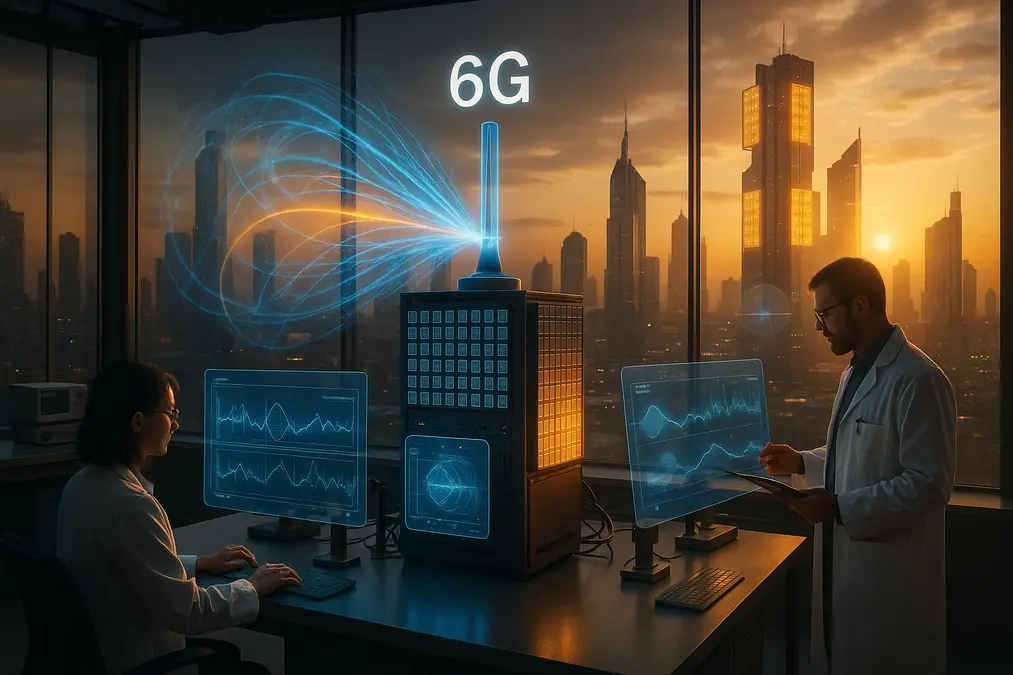
Inside the testbeds running today, 6G does not look like a 5G base station with a bigger antenna. It looks like a coordinated system of small radios, smart surfaces, and GPUs talking to each other over an optical fronthaul:
Sub-Terahertz, In Practice
At 140 GHz, a single carrier can carry 40+ Gbps in 10 GHz of bandwidth — but the wavelength is only about 2 millimeters. Path loss is brutal, atmospheric absorption peaks every few tens of GHz, and a human body completely blocks a link. The fix is dense small cells, hyper-narrow pencil beams from 1,024-element phased arrays, and constant beam tracking with millisecond cadence.
RIS Closes the Coverage Gap
A reconfigurable intelligent surface is essentially a 2-bit phased-mirror — thousands of tiny passive elements that the network controls to bend a sub-THz beam around a corner or off a window. NTT DOCOMO has demonstrated transparent RIS panes integrated into building glass; Greenerwave and Metawave are shipping commercial RIS for early enterprise mmWave today.
ISAC Turns the Network Into a Radar
Because 6G uses wide bandwidths and dense arrays, the reflected signal carries enough information to localize an object to centimeter accuracy, estimate its velocity, and even infer chest motion for vital-sign monitoring. ISAC turns every gNB into a privacy-bounded radar — and forces the industry to confront a brand-new layer of consent and regulation.
The AI-Native Stack
In 6G, the PHY block diagram is partly learned. Neural channel estimators, autoencoder receivers, and reinforcement-learning beam managers replace decades of hand-tuned algorithms. The AI-RAN Alliance — NVIDIA, T-Mobile, SoftBank, Ericsson, Nokia, Samsung — is building the GPU-based reference platform on which most of those models will run, both in the cell site and in the cloud.
The Open Problems
Energy budget. Every previous generation has been more energy-efficient per bit but less efficient per square kilometer of coverage. A naive sub-THz rollout would multiply RAN energy consumption by 4-6x. ITU-R IMT-2030 explicitly elevates sustainability to a first-class KPI, and the industry response is sleep-mode AI, cell-zooming, and offloading more compute to centralized GPU pools.
Spectrum politics. WRC-27 will allocate the IMT identification for the 7-24 GHz upper midband and frame the rules above 100 GHz. The US (FCC), EU (CEPT), and China (MIIT) are circling slightly different bands, and ITU consensus is no longer a foregone conclusion. The first 6G phone may need region-specific spectrum support, complicating roaming.
Security and post-quantum readiness. A 6G network with native sensing collects data 5G never did. The 3GPP SA3 group is folding post-quantum cryptography (PQC) into the baseline security architecture, and zero-trust principles are being baked into the service-based architecture rather than bolted on later.
The handset problem. No one yet has a 140 GHz front-end that fits in a phone, draws less than a watt, and survives a coat pocket. Apple C2, Qualcomm Snapdragon X, and MediaTek roadmaps put sub-THz transceivers somewhere in 2028-2029. Before then, 6G "phones" are likely to be enterprise CPE, AR glasses, and vehicles with rooftop arrays.
What 6G Means for the Networking, AI, and Industrial Stack
- The RAN becomes a GPU workload. AI-native PHY and cell-free MIMO push enormous compute into the base station. The line between data center silicon and base-station silicon blurs — NVIDIA Aerial, Marvell, and AMD all compete for the same socket.
- Sensing-as-a-service is a new revenue line. Operators can monetize traffic counting, occupancy detection, fall detection for elder care, and high-precision indoor positioning, layered on top of connectivity.
- Open RAN finally matters at scale. The O-RAN Alliance interfaces are the natural integration point for cell-free architectures and AI-RAN. Vendors that resist disaggregation lose access to the most exciting layer of 6G innovation.
- Industrial 6G arrives before consumer 6G. Factories, ports, and mines need URLLC, ISAC, and centimeter-class positioning years before phone users do. The first paying customers of 6G will look like Audi Ingolstadt, Hamburg Port, and Rio Tinto autonomous haul fleets.
- Sovereign 6G strategy is now policy. The EU Smart Networks & Services JU, the US NextG Alliance, China's IMT-2030 group, and Japan's Beyond 5G program are each spending billions to ensure their vendors set the standard.
The Road From Lab to Launch
The 3GPP timetable now in motion is concrete: Release 21 (2026-2027) for 6G study items, Release 22 (2028) for the first normative specifications, with the first commercial deployments lighting up around 2030. By 2032-2033, 6G will look like 5G does today — a globally interoperable standard rolling out in waves, with handsets, RAN, and core all simultaneously upgrading. By the late 2030s, sensing, AI, and connectivity will be a single fabric the rest of the digital economy assumes is there.
For business and IT leaders the takeaway is not "wait until 2030." The capabilities 6G assumes — Open RAN, GPU-accelerated networking, edge AI, post-quantum security, and high-precision positioning — are being built into 5G-Advanced deployments today. The organizations that pilot ISAC, RIS, and AI-RAN inside their 5G estates over the next 24 months will be the ones running the 6G transition. The rest will spend the early 2030s buying capacity from the operators who did. The 6G race in 2026 looks calm and academic from the outside; inside the labs in Yokosuka, Suwon, Murray Hill, and Stuttgart, the system that will carry the AI economy of the 2030s is already being soldered together.