Space Debris Removal in 2026: How Astroscale, ClearSpace, and the New Deorbit Rules Are Cleaning Up the Junkyard in Earth Orbit
- Internet Pros Team
- July 8, 2026
- AI & Technology
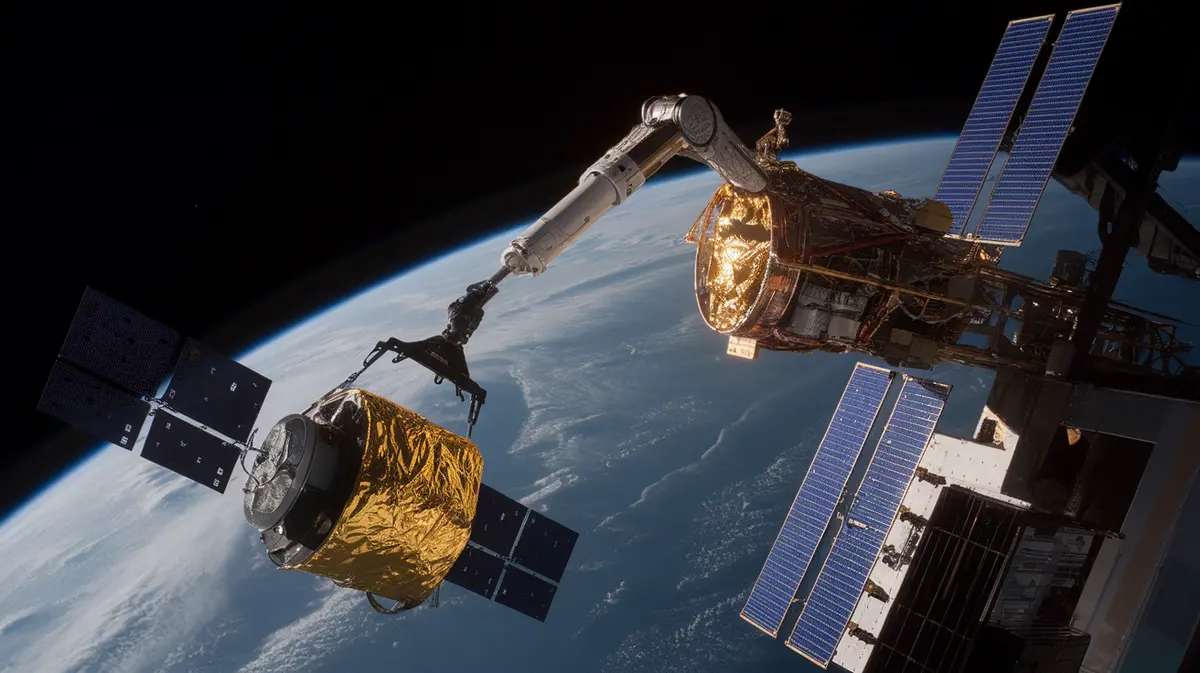
Every satellite that powers your GPS, your weather forecast, your satellite internet, and a growing share of your phone calls shares a thin shell of space just a few hundred kilometers up - and that shell is filling with garbage. Spent rocket stages, dead satellites, and millions of shards from old collisions are racing around Earth at more than 25,000 km/h, fast enough to turn a fleck of paint into a bullet. In 2026, a brand-new industry is finally doing something about it: active space debris removal - robotic spacecraft that chase down dead objects and drag them out of the sky before they can smash into something that still works.
What Space Debris Actually Is
Space debris - or orbital debris, or plain "space junk" - is any human-made object in orbit that no longer serves a purpose. It ranges from whole defunct satellites the size of a bus and abandoned upper rocket stages, down through bolts, lens caps, and frozen coolant, to millions of paint flecks and metal shards too small to track. There are now tens of thousands of tracked objects bigger than a softball and an estimated hundreds of millions of smaller pieces nobody can see coming. The problem is speed: at orbital velocity, even a one-centimeter fragment carries the energy of a hand grenade. A working satellite does not need to be hit by another satellite to be destroyed - a single lost bolt will do.
The Nightmare Scenario: Kessler Syndrome
In 1978, NASA scientist Donald Kessler described a chilling feedback loop. Once orbit gets crowded enough, a single collision creates a cloud of thousands of new fragments - and each of those fragments can cause the next collision, which creates thousands more. Left unchecked, this cascade could make entire orbital bands so full of shrapnel that no satellite can survive there for decades. This is the Kessler syndrome, and with mega-constellations pushing the number of active satellites past tens of thousands, it has gone from a thought experiment to a live risk that space agencies plan around. The grim punchline is that even if every launch stopped tomorrow, the debris already up there would keep colliding and multiplying on its own.
"We spent sixty years treating orbit as an infinite dumping ground. It is not. Low Earth orbit is a shared, finite resource - like a fishery or a highway - and if we do not actively clean it, the most valuable region of space could become a no-go zone for a generation. Removal is no longer optional; it is infrastructure."
The Hard Part: Catching a Tumbling Object That Does Not Want to Be Caught
Removing a dead satellite sounds simple until you remember it is uncooperative. It has no working thrusters, no docking port, no lights, and it is almost always tumbling - slowly cartwheeling end over end from years of tiny nudges. To grab it, a hunter spacecraft must perform rendezvous and proximity operations (RPO): it launches into a similar orbit, spends days carefully closing the distance, uses cameras and lidar to map the target in 3D, matches its tumble exactly, and only then reaches out to make contact. Get the approach wrong by a hair and you create more debris instead of removing it. Solving this dance reliably, safely, and cheaply is the entire engineering story that took debris removal from PowerPoint to real flight demonstrations.
How You Actually Grab It
- Robotic arm. A servicer flies up and a dexterous arm grabs a fixture or the ring left over from the satellite's launch adapter - the most controlled and precise method.
- Magnetic docking plate. Newer satellites launch with a small ferromagnetic plate bolted on, so a future servicer can simply latch onto it magnetically - designing cleanup in from the start.
- Capture net. A wide net is fired to wrap around an irregular, spinning target that has nothing convenient to grab, then reeled in.
- Harpoon. A tethered barb is fired into the body of large debris like a spent rocket stage, tethering it to the hunter for disposal.
- Drag sail. Rather than being hauled away, a satellite unfurls a large sail at end of life to catch the wisps of upper atmosphere and drag itself down faster.
Once a target is captured, the endgame is the same: fire thrusters to lower the orbit until the object dips into the atmosphere and burns up on reentry, or is steered into a remote stretch of the South Pacific known as the spacecraft cemetery.
Passive Mitigation
Design satellites to deorbit themselves at end of life - reserve fuel, add a drag sail, follow the "leave orbit within five years" rules. Cheap and preventive, but does nothing about the junk already up there.
Active Removal (ADR)
Launch a dedicated servicer to chase down and remove existing dead objects. The only way to clean up the legacy debris and the big, dangerous derelicts - at the cost of a whole mission per target.
Prevention vs. Removal at a Glance
| Property | Passive Mitigation | Active Debris Removal |
|---|---|---|
| What it does | Stops new junk | Removes existing junk |
| Cost per object | Very low | Whole mission each |
| Handles legacy debris | No | Yes |
| Technical difficulty | Modest | Very high |
| Maturity in 2026 | Now mandated | Flight demonstrations |
Who Is Building It
The clear pioneer is Japan's Astroscale, whose ADRAS-J mission flew right up alongside a discarded rocket upper stage and photographed it from just meters away - the first close inspection of a real piece of large debris - and whose ELSA line is designed to magnetically dock with and deorbit dead satellites. The European Space Agency is backing ClearSpace, whose ClearSpace-1 mission aims to wrap robotic arms around a leftover payload adapter and drag it down in one of the first true captures of an uncooperative object. The U.S. Space Force and NASA are funding servicing and inspection demonstrations, while a growing roster of startups builds the drag sails, docking plates, and space-situational-awareness tracking that make the whole enterprise possible. What was a single national experiment a few years ago is now a small but real commercial market.
The Rules Are Finally Forcing the Issue
Technology alone would not have moved fast enough - regulation is the accelerant. For years the guideline was to clear your satellite out of low Earth orbit within 25 years of retirement, a limit widely ignored. In 2024 the U.S. FCC slashed that to a five-year deorbit rule with real enforcement teeth, and space agencies worldwide are tightening their own standards. Suddenly, planning for a satellite's death is a legal requirement, not a courtesy - and that has created genuine demand for the removal services, drag sails, and standardized docking fixtures the cleanup industry sells.
The Honest Trade-Offs
Debris removal is essential, but nobody in the field pretends it is easy or cheap. Each active-removal mission today can only capture one object at a time, and it costs about as much as a small satellite to build and launch - so the economics of removing thousands of derelicts are daunting. The same rendezvous technology that can gently capture a dead satellite could, in the wrong hands, grab a live one, so debris servicers raise thorny questions of trust and dual-use in space. And there is a simple race against arithmetic: we are still launching far more objects than we are removing, so prevention through better design and honest deorbit planning matters just as much as the dramatic capture missions.
What It Means for Business
This is not a niche space-agency concern - it is about protecting the invisible utility layer that modern business runs on. GPS timing, weather data, logistics tracking, satellite internet, and emergency communications all depend on hardware in exactly the orbits that are getting crowded, and a Kessler cascade in the wrong band would degrade services companies now take for granted. A cleaner, actively managed orbit is becoming part of the resilience of the entire digital economy. For most businesses the practical takeaway is awareness: the connectivity and data you buy from space are only as reliable as the orbit they live in, and 2026 is the year that keeping that orbit usable finally became a real, funded, and fast-growing industry.
At Internet Pros, we help businesses make sense of fast-moving technology and turn it into a practical roadmap - from strategy to the software and automation that tie new systems together. Get in touch to talk through what emerging technology could mean for your operation, or explore more technology insights on our blog.