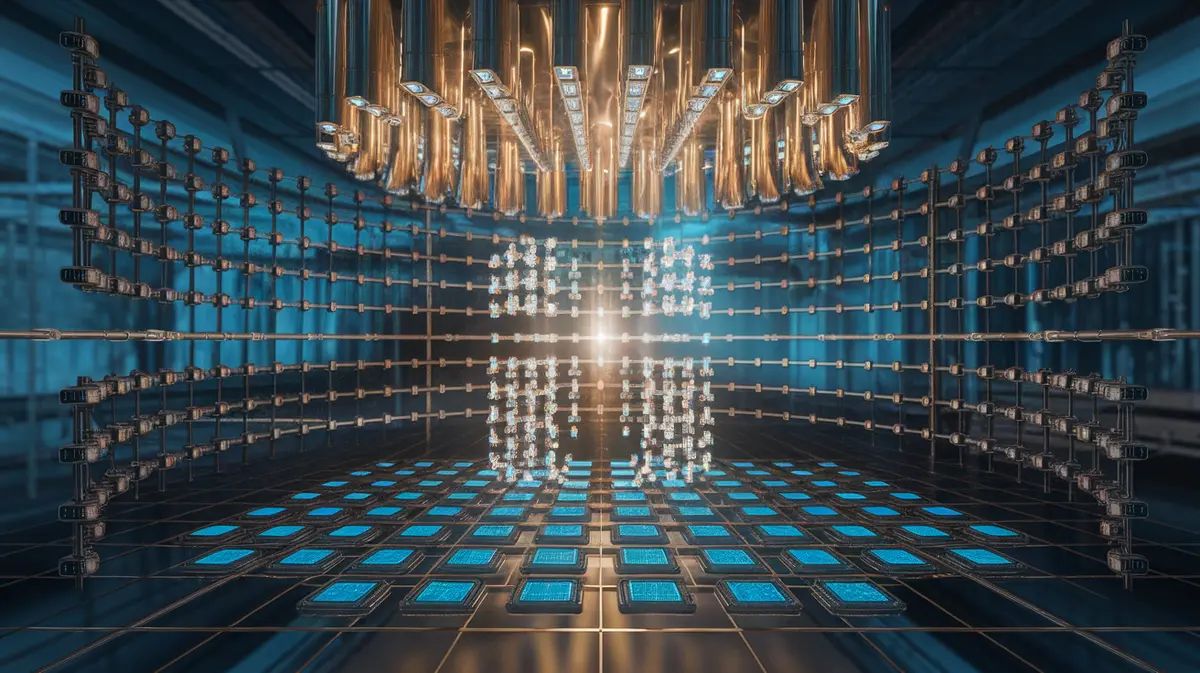
Quantum Error Correction in 2026: How Google, IBM, Quantinuum, and QuEra Are Building Logical Qubits That Finally Fix Their Own Mistakes
- Internet Pros Team
- July 9, 2026
- AI & Technology
For thirty years, quantum computing has carried an embarrassing secret: the machines make mistakes almost as fast as they can compute. A quantum bit is so delicate that a stray vibration, a flicker of heat, or a passing cosmic ray can scramble it in a fraction of a second - and until recently, adding more qubits mostly meant adding more errors. In 2026, that story is finally flipping. Quantum error correction (QEC) - the art of bundling many noisy qubits into a few reliable ones that catch and fix their own mistakes - has crossed the threshold from theory into working hardware, and it is the single development that turns quantum computing from a science experiment into a technology you can eventually trust.
Why Qubits Are So Fragile
A classical bit is a rugged thing - a voltage that is clearly high or low, easy to read and hard to accidentally flip. A qubit is the opposite. It holds a delicate blend of 0 and 1 at the same time (a superposition), and that state lives in something as fragile as the spin of an electron, the charge in a superconducting loop, or the energy level of a single trapped atom. The tiniest disturbance from the outside world - heat, electromagnetic noise, mechanical vibration - nudges the qubit and destroys the information, a process called decoherence. Worse, you cannot simply peek at a qubit to check on it: measuring a quantum state collapses it. So the classical trick of "read the value and make three copies" is off the table, and for decades that made error correction look impossible.
The Big Idea: Logical Qubits
The breakthrough is to stop trusting any single qubit. Instead of storing one bit of quantum information in one physical qubit, you spread it across many physical qubits working together as one - a logical qubit. The individual physical qubits still make errors constantly, but the information is encoded in the relationships between them, so no single failure destroys it. A cluster of extra "helper" qubits is measured continuously to reveal where an error happened without ever reading the protected data itself. It is a bit like a group of people memorizing a message together: any one person might misremember a word, but by comparing notes the group can reconstruct the original perfectly.
"A physical qubit is a promise the hardware keeps for a few microseconds. A logical qubit is a promise you can actually build a business on. Everything that makes quantum computing useful - breaking encryption, designing drugs, modeling materials - lives on the far side of error correction, not before it."
How the Surface Code Works
The leading recipe for building a logical qubit is the surface code. Picture a checkerboard grid of qubits: the "data" qubits that hold the information sit on one set of squares, and "measurement" qubits sit between them. Those measurement qubits are read over and over, each one reporting whether its neighbors have quietly slipped out of alignment. The pattern of these readings - called the error syndrome - does not reveal the secret data, but it acts like a fingerprint that a classical computer can use to deduce exactly which errors occurred and undo them. The bigger the grid (its code distance), the more simultaneous errors it can survive.
Physical Qubit
A single real device - a superconducting circuit, trapped ion, or neutral atom. Fast and small, but noisy and short-lived, with an error every few hundred to few thousand operations.
Logical Qubit
Dozens to thousands of physical qubits acting as one error-corrected unit. Slower and expensive, but stable enough to run the long algorithms that actually matter.
Crossing the Threshold - The Milestone That Changed Everything
For years, error correction had a chicken-and-egg problem: the extra qubits and operations needed to fix errors introduced new errors, and if your hardware was too noisy, a bigger code made things worse, not better. The turning point is the error-correction threshold - the point where your physical qubits become just good enough that making the logical qubit bigger finally makes it more reliable, not less. In late 2024, Google's Willow chip became the first to convincingly cross that line: each time they scaled the surface code up by one step, the logical error rate was cut roughly in half. That "below threshold" result was the proof-of-principle the whole field had waited on for 30 years, and 2026 is the year the industry is racing to scale it.
Physical vs. Logical Qubits at a Glance
| Property | Physical Qubit | Logical Qubit |
|---|---|---|
| What it is | One real device | Many devices as one |
| Error rate | High, constant | Low, suppressed |
| Lifetime | Microseconds | Effectively extended |
| Cost per logical unit | N/A | Hundreds to thousands of physical |
| Runs real algorithms | No | Yes, eventually |
Who Is Building It
Google Quantum AI set the pace with Willow and its below-threshold demonstration, and has published a roadmap toward a large-scale error-corrected machine. IBM is pursuing a different, hardware-efficient code (the "qLDPC" or Bivariate Bicycle code) that promises to need far fewer physical qubits per logical qubit, aiming for a fault-tolerant system it calls Starling by the end of the decade. Quantinuum, using trapped ions with famously low error rates, has demonstrated some of the highest-fidelity logical qubits to date, while QuEra and Atom Computing use neutral atoms held in laser tweezers to run circuits on dozens of logical qubits at once. PsiQuantum is betting on photons and silicon-photonics manufacturing to leap straight to a million-qubit machine. Different hardware, same destination: reliable logical qubits at scale.
The Hard Part That Remains
Error correction is working, but it is not cheap. Today it can take hundreds or even a thousand physical qubits to make a single good logical qubit, and a genuinely useful machine may need thousands of logical qubits - putting the physical-qubit count in the millions. There is also a brutal speed requirement: the classical computer that reads the error syndrome and decides how to fix it must keep up in real time, decoding a firehose of measurements faster than new errors accumulate, all while the quantum chip sits near absolute zero. And certain operations still require an expensive process called magic state distillation to perform safely. None of these are dealbreakers - they are engineering problems the whole industry is now attacking at once.
What It Means for Business
Here is the honest timeline: error-corrected quantum computers will not be on your desk next year, and anyone selling you a quantum solution for everyday IT today is overpromising. But the reason QEC matters now is that it converts quantum computing from "maybe someday" into "a countdown." The applications waiting on the far side are enormous - simulating molecules for drug discovery and battery chemistry, optimizing logistics and portfolios, and cracking today's public-key encryption. That last point is why error correction should already be on every leader's radar: a future fault-tolerant machine could break the encryption protecting data you send today, which is exactly why the world is migrating to post-quantum cryptography right now. The smart move in 2026 is not to buy a quantum computer - it is to understand which of your problems are quantum-shaped and to make sure your security is quantum-ready.
At Internet Pros, we help businesses make sense of fast-moving technology and turn it into a practical roadmap - from strategy to the software and automation that tie new systems together. Get in touch to talk through what emerging technology could mean for your operation, or explore more technology insights on our blog.