AI-Powered Wearables and Digital Health: How Smart Devices Are Revolutionizing Healthcare in 2026
- Internet Pros Team
- March 19, 2026
- AI & Technology
In January 2026, a 52-year-old marathon runner in Austin, Texas received an alert from his Apple Watch Ultra 3 that detected an irregular heart rhythm pattern consistent with early-stage atrial fibrillation — a condition he had no symptoms of and would not have discovered for months or years through routine checkups. His cardiologist confirmed the diagnosis within 48 hours, and early intervention prevented what could have become a stroke. He is one of an estimated 400,000 people worldwide whose wearable devices detected life-threatening conditions before symptoms appeared in the past year alone. In 2026, AI-powered wearables have crossed a critical threshold: they are no longer fitness trackers that count steps — they are medical-grade diagnostic platforms that continuously monitor vital signs, detect disease patterns, and deliver actionable health intelligence directly to users and their physicians, fundamentally shifting healthcare from reactive treatment to proactive prevention.
The Wearable Health Technology Stack in 2026
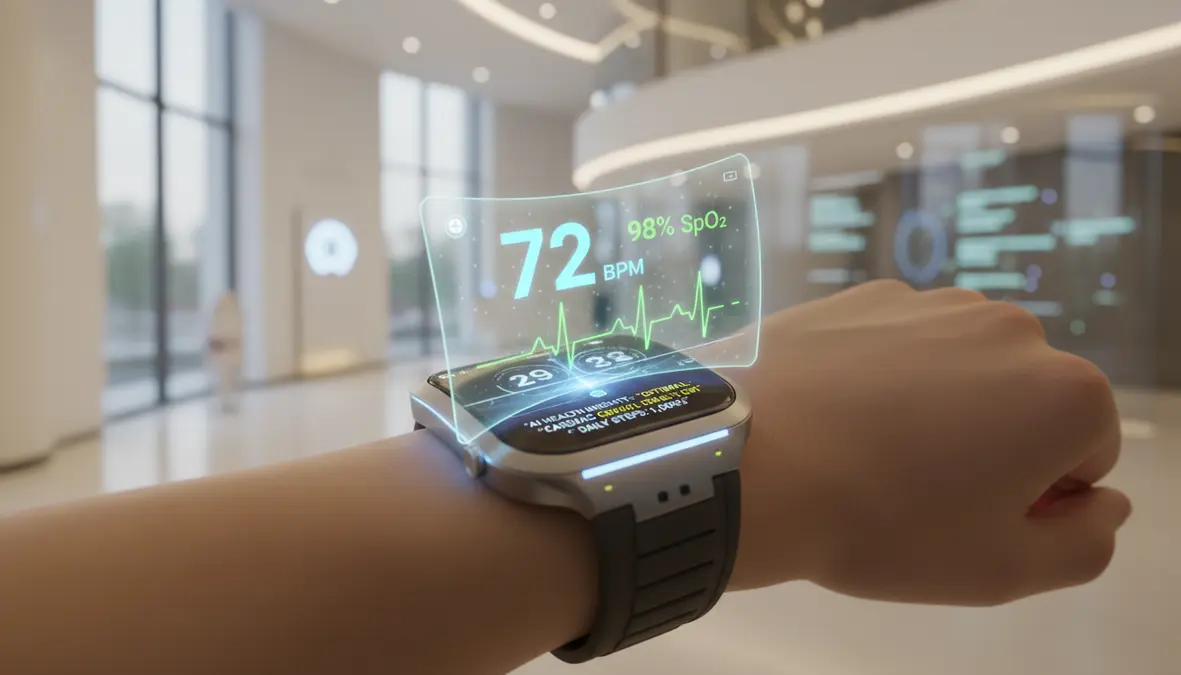
Modern health wearables are built on a sophisticated stack of miniaturized sensors, edge AI processors, and cloud-based analytics that work together to transform raw biometric signals into clinical-grade health insights. The Apple Watch Series 11, Samsung Galaxy Watch 7, and Google Pixel Watch 4 now pack photoplethysmography (PPG) sensors for continuous heart rate and blood oxygen monitoring, single-lead ECG electrodes for cardiac rhythm analysis, skin temperature thermistors for fever and ovulation tracking, accelerometers and gyroscopes for fall detection and movement analysis, and — as of 2026 — non-invasive blood pressure estimation using optical pulse transit time algorithms validated against clinical cuff measurements.
| Sensor Type | What It Measures | Clinical Application | Key Devices (2026) |
|---|---|---|---|
| PPG Optical | Heart rate, SpO2, HRV, blood pressure | Arrhythmia detection, sleep apnea screening, hypertension monitoring | Apple Watch S11, Samsung Galaxy Watch 7, Oura Ring 4 |
| ECG Electrode | Cardiac electrical activity | Atrial fibrillation detection, QT interval monitoring | Apple Watch S11, Withings ScanWatch Nova, Samsung Galaxy Watch 7 |
| Bioimpedance | Body composition, hydration, respiratory rate | Heart failure monitoring, fluid retention alerts, body fat analysis | Samsung Galaxy Ring 2, Whoop 5.0, Amazfit Balance |
| Continuous Glucose | Interstitial glucose levels | Diabetes management, metabolic health optimization | Dexcom Stelo, Abbott Lingo, Dexcom G8 |
| Skin Temperature | Peripheral temperature variations | Fever detection, menstrual cycle tracking, illness onset prediction | Oura Ring 4, Apple Watch S11, Fitbit Sense 4 |
The critical advancement in 2026 is not the sensors themselves — it is the AI running on them. Apple's Health Neural Engine, Google's Health AI chip, and Qualcomm's Snapdragon W7 health coprocessor run lightweight machine learning models directly on the wearable device, analyzing raw sensor data in real time without requiring cloud connectivity. These on-device models detect subtle patterns across multiple sensor streams simultaneously — correlating heart rate variability changes with skin temperature shifts and sleep disruptions to identify early signs of illness up to 48 hours before symptoms appear.
"We are witnessing the emergence of the 'always-on physician' — a device on your wrist that monitors your health continuously, understands your personal baseline, and alerts you to meaningful deviations before they become emergencies. This is the most significant shift in preventive medicine since the invention of the stethoscope."
AI-Driven Early Disease Detection
The most impactful application of AI-powered wearables is early disease detection — identifying health conditions days, weeks, or even months before traditional diagnosis. Clinical studies published in 2025 and early 2026 have validated wearable AI algorithms for detecting atrial fibrillation with 97.5 percent sensitivity and 99.3 percent specificity using continuous PPG monitoring combined with on-demand ECG confirmation. The Apple Heart and Movement Study, involving over 500,000 participants, has demonstrated that wearable-detected irregular rhythms lead to clinical diagnosis of previously unknown AFib in approximately 34 percent of cases flagged.
Cardiovascular Monitoring
Beyond AFib, AI models now analyze ECG morphology to detect prolonged QT intervals associated with sudden cardiac death risk, left ventricular dysfunction through subtle heart rate patterns, and hypertension through continuous blood pressure trending. The FDA cleared Samsung's blood pressure monitoring feature for the Galaxy Watch 7 in late 2025, making it the first cuffless, calibration-free blood pressure monitor approved for consumer use in the United States.
Respiratory and Sleep Analysis
Wearable AI algorithms detect sleep apnea by analyzing blood oxygen desaturation patterns, respiratory rate, and body movement during sleep. The Withings ScanWatch Nova received FDA clearance for moderate-to-severe sleep apnea detection with 92 percent accuracy, eliminating the need for expensive overnight sleep lab studies for initial screening. Google's sleep AI on the Pixel Watch 4 additionally tracks sleep stages, snoring, and sleep environment quality.
Continuous Glucose Monitoring Goes Mainstream
Perhaps the most transformative development in wearable health technology in 2026 is the mainstreaming of continuous glucose monitoring (CGM) for non-diabetic users. Devices like the Dexcom Stelo and Abbott Lingo — both available over the counter without a prescription since 2025 — allow anyone to track how their body responds to food, exercise, stress, and sleep in real time. The data has proven revelatory: studies show that approximately 80 percent of non-diabetic CGM users make measurable dietary changes within the first two weeks, and a Stanford study found that 12 percent of apparently healthy CGM users discovered they had prediabetic glucose patterns they were previously unaware of.
AI-powered CGM platforms go beyond raw glucose readings by learning each user's individual metabolic patterns and providing personalized recommendations. Levels Health and January AI use machine learning to predict how specific meals will affect a user's glucose based on their historical response patterns, microbiome data, and activity levels — enabling truly personalized nutrition guidance that replaces one-size-fits-all dietary advice.
Remote Patient Monitoring and Clinical Integration
The clinical impact of wearable health data extends far beyond individual consumer use. Remote patient monitoring (RPM) powered by AI wearables has become a standard component of chronic disease management, with the Centers for Medicare and Medicaid Services (CMS) expanding reimbursement codes for RPM in 2025 to cover 42 million Medicare beneficiaries. Hospitals and health systems are integrating wearable data streams into electronic health records (EHRs), enabling physicians to monitor patients' vital signs continuously between visits rather than relying on single-point-in-time measurements during office appointments.
- Heart Failure Management: Wearable bioimpedance sensors detect fluid retention 3 to 5 days before patients experience symptoms, enabling medication adjustments that prevent costly emergency hospitalizations — reducing 30-day readmission rates by 38 percent in Cleveland Clinic pilot programs
- Post-Surgical Recovery: AI algorithms analyzing wearable activity, heart rate, and sleep data predict post-operative complications with 89 percent accuracy, alerting surgical teams to intervene before patients deteriorate
- Mental Health Monitoring: Patterns in heart rate variability, sleep quality, activity levels, and voice biomarkers captured by wearables correlate with depression and anxiety episodes, enabling proactive outreach from mental health providers
- Elderly Care: Fall detection, gait analysis, and activity monitoring through smartwatches and smart rings provide continuous safety monitoring for aging-in-place seniors, reducing emergency response times by an average of 8 minutes
The Smart Ring Revolution
While smartwatches remain the dominant wearable health platform, 2026 has seen the rapid rise of smart rings as a compelling alternative for users who want continuous health monitoring without a screen on their wrist. The Oura Ring 4, Samsung Galaxy Ring 2, and Ultrahuman Ring AIR pack PPG sensors, skin temperature monitors, accelerometers, and bioimpedance sensors into a titanium band weighing under 5 grams. Smart rings offer advantages in sleep tracking — users report higher compliance wearing a lightweight ring to bed versus a bulky watch — and their close contact with finger arteries provides exceptionally clean PPG signals for heart rate and HRV measurement.
Oura Ring 4
Industry-leading sleep analysis with new daytime stress tracking, SpO2 monitoring, and cycle prediction. Battery life of 7 days. Oura's AI delivers a daily Readiness Score used by over 3 million users to optimize training and recovery.
Samsung Galaxy Ring 2
Deep integration with Samsung Health and Galaxy Watch ecosystem. Features bioimpedance body composition, snore detection, and automatic workout tracking. FDA-cleared AFib detection — a first for smart rings.
Ultrahuman Ring AIR
Combines ring-based health tracking with optional CGM integration through Ultrahuman M1, providing unified metabolic and cardiovascular health insights with personalized AI coaching and movement scores.
Privacy, Regulation, and the Data Challenge
The explosion of wearable health data raises profound privacy and regulatory questions. A single smartwatch generates approximately 500 megabytes of health data per month — heart rate sampled every second, movement tracked continuously, sleep analyzed nightly. For the estimated 600 million health wearable users worldwide in 2026, this represents an unprecedented volume of intimate personal health information flowing through cloud platforms operated by technology companies that are not traditional healthcare entities.
The regulatory landscape is evolving rapidly. The FDA's Digital Health Center of Excellence has cleared over 200 software-as-a-medical-device (SaMD) algorithms for wearable platforms as of early 2026, including AFib detection, sleep apnea screening, and blood pressure monitoring. The EU's Medical Device Regulation (MDR) applies strict clinical evidence requirements to health-related wearable features marketed in Europe. Meanwhile, HIPAA in the United States does not automatically cover consumer wearable data — a regulatory gap that consumer advocates are pushing Congress to close. Apple, Google, and Samsung have adopted health data minimization principles and on-device processing to reduce cloud exposure, but the fundamental tension between AI model improvement (which benefits from large datasets) and individual privacy remains unresolved.
What This Means for Your Business
The AI-powered wearable health revolution creates opportunities across industries. Healthcare providers must build infrastructure to ingest and act on continuous wearable data streams, transforming care models from episodic visits to continuous monitoring. Employers are integrating wearable wellness programs that improve workforce health outcomes and reduce insurance costs — companies offering voluntary wearable health programs report 18 percent lower healthcare claims and 12 percent improvement in employee productivity metrics. Insurance companies are developing dynamic pricing models based on real-time health data from wearables, rewarding healthy behaviors with lower premiums.
At Internet Pros, we help healthcare organizations and businesses build the digital infrastructure needed to leverage wearable health data — from secure API integrations with wearable platforms and EHR systems to custom health analytics dashboards, HIPAA-compliant data pipelines, and AI-powered alert systems that transform raw sensor data into actionable clinical and business intelligence. Contact us today to discuss how we can help your organization harness the power of AI-powered wearable health technology.