AI-Native Smart Glasses in 2026: How Meta Ray-Ban Display, Snap Spectacles, Samsung Galaxy XR, and Google Android XR Are Replacing the Smartphone Screen
- Internet Pros Team
- May 16, 2026
- AI & Technology
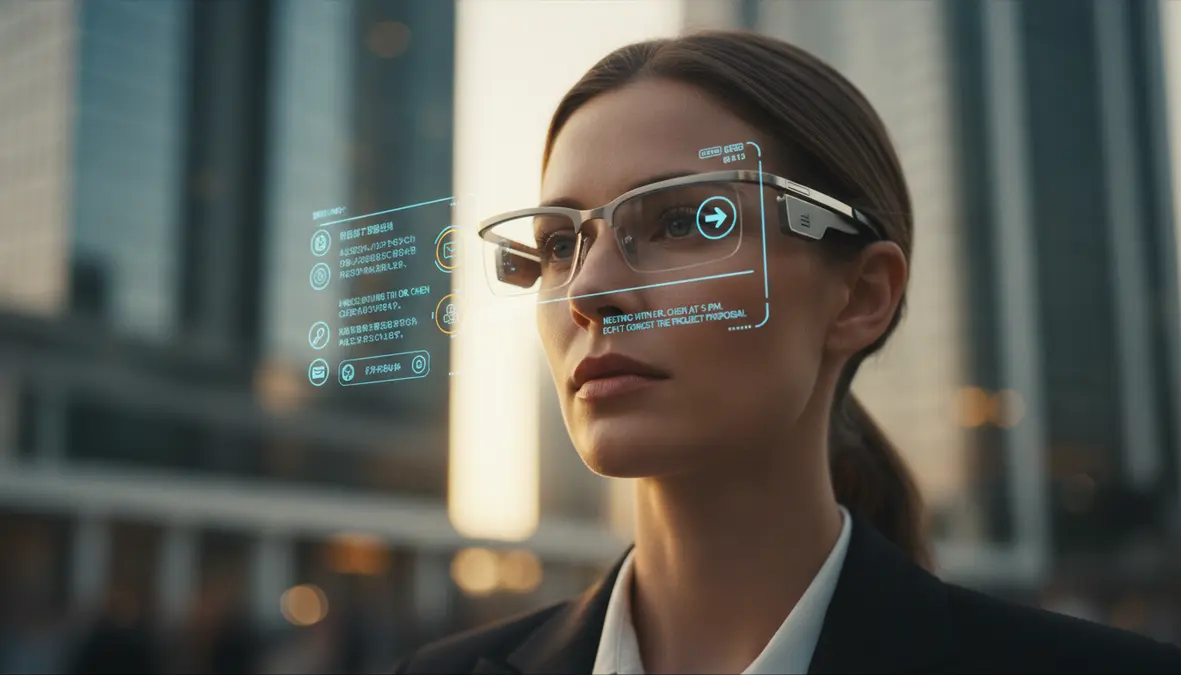
For fifteen years, the smartphone has been the single piece of glass through which most of the world reaches the internet. In 2026, that monopoly is finally being challenged — not by a bigger screen, but by a smaller one strapped to your face. AI-native smart glasses have crossed the line from gadget novelty to mainstream consumer product. Meta Ray-Ban Display ships with a 600 nit waveguide and a discreet sEMG wristband for silent input. Samsung Galaxy XR glasses run Google Android XR with Gemini Live always listening. Snap Spectacles 5 brings full binocular AR to creators. And Apple Vision Air — the long-rumored lightweight follow-up to Vision Pro — is reportedly on track for a late-2026 reveal. After a decade of stutter-stepping (Google Glass, North Focals, the original Magic Leap), the combination of micro-LED brightness, slim diffractive waveguides, on-device multimodal LLMs, and EssilorLuxottica fashion distribution has produced something genuinely new: a pair of normal-looking glasses that quietly replaces about 60 percent of what you used to pull a phone out for.
Why 2026 Is the Year — and 2014 Wasn't
Google Glass failed in 2014 because it solved no specific problem well, looked like a piece of test equipment, and demanded the cloud round-trip a 4G modem could not reliably deliver. Twelve years later, every one of those bottlenecks has independently collapsed. Micro-LED displays from JBD and Sony hit 5,000+ nits in a 0.13-inch panel — bright enough to read in direct sunlight from inside a waveguide. Diffractive surface-relief gratings from Lumus, DigiLens, and Snap have shrunk to lens-thickness while pushing field of view past 50 degrees. Vision-language models like Gemini 2.5 Pro, GPT-4o, and Llama 4 Vision can answer "what am I looking at?" in 600 milliseconds. On-device NPUs — Qualcomm AR2 Gen 1, Apple R1, Samsung Exynos XR1 — run small multimodal models locally so the glasses still work when the cloud does not. And EssilorLuxottica, the world's largest eyewear company, finally figured out how to put computers inside frames people actually want to wear. The Ray-Ban Meta line crossed two million units in 2024, four million in 2025, and is on pace to ship more than eight million in 2026.
"The phone was the answer when the computer had to live somewhere away from your face. Once the computer is in front of your eyes — and the model is good enough to actually understand what is in front of you — the phone is just the battery."
The Four Things AI Glasses Actually Do Better Than a Phone
The 2026 generation of smart glasses is not a phone replacement in every dimension — typing, gaming, and long-form reading still belong on a screen you can hold. But four use cases are genuinely better on glasses than on glass:
Always-On Translation and Captions
Real-time subtitles for conversation float at the bottom of the wearer's field of view. Meta Ray-Ban Display ships live translation in 18 languages with sub-second latency, and accessibility groups have called wearable live captions the most significant assistive technology shipped this decade for the deaf and hard of hearing.
Hands-Free Look-and-Ask AI
Tap the temple, ask "what is this?" — and a multimodal model answers based on what the outward camera sees. Identify a plant, translate a sign, decode a menu, parse a wiring diagram, or compare two products on a shelf without ever pulling out a phone. The latency feels like talking to a knowledgeable friend, not querying a database.
Turn-by-Turn Navigation in Your Eyeline
A floating arrow at the next intersection beats glancing at a phone every fifteen seconds. Google Maps on Android XR and Apple Maps on the rumored Vision Air both stream directional overlays through the waveguide, and city-scale visual positioning systems (Niantic Lightship, Google VPS) anchor them to real-world geometry with sub-meter accuracy.
First-Person Capture
A discrete camera at brow height records what the wearer actually sees — birthday-cake-blow-out, kid scoring a goal, surgeon's view of a procedure, mechanic's view inside an engine bay. The aesthetic difference between "phone held up" and "actually present" turns out to matter enormously, especially for parents, athletes, and field workers.
Who Ships What in 2026
| Product | Display & Form Factor | What It Wins On |
|---|---|---|
| Meta Ray-Ban Display | Monocular 600-nit micro-LED waveguide in the right lens, paired with a neural sEMG wristband for silent finger-twitch input. ~50 grams. | Distribution and fashion. EssilorLuxottica's Ray-Ban, Oakley HSTN, and rumored Prada SKUs mean the glasses already look like glasses people wear. Meta AI multimodal is genuinely best-in-class for the look-and-ask use case. |
| Samsung Galaxy XR Glasses | Binocular waveguide, full-color microLED, Snapdragon XR2 Plus Gen 2 + Exynos XR1. Designed as a companion to Galaxy phones and the Galaxy XR headset. | Tight Android XR + Gemini Live integration. Galaxy AI features, Circle-to-Search, and real-time translation are available without context-switching. Strong enterprise and Samsung-ecosystem story. |
| Snap Spectacles 5 | Binocular dual-waveguide, 46° FOV, on-device Snap OS with 800,000+ Lens creators. Standalone, no phone tether required. | The creator AR platform. Spectacles 5 is the only consumer smart glass that takes full binocular AR seriously today — anchored Lenses, multi-user co-presence, and the most mature first-party AR SDK in the industry. |
| Google Android XR Reference Glasses | Project Astra in a glasses form factor, codeveloped with Samsung and Magic Leap. Gemini Live, Maps AR, and Lens are first-class apps. | The Android-of-glasses platform play. Android XR is the open OS that non-Meta, non-Apple OEMs (Xreal, Rokid, TCL RayNeo, Viture) are coalescing around for their 2026 hardware. |
| Apple Vision Air (rumored) | Lightweight Vision Pro successor — reportedly under 200 grams with optical see-through waveguides and an R1-class sensor processor. Late-2026 reveal expected. | The Apple ecosystem premium. Tight integration with iPhone, AirPods, and Apple Intelligence; the Vision Pro app catalog rebased onto a wearable that does not look like ski goggles. |
| Xreal One Pro / Rokid AR Lite / TCL RayNeo X3 Pro | Tethered or hybrid binocular waveguide glasses on Android XR or Snapdragon Spaces. Often paired with a pocket compute puck. | Price and openness. The fast-follower cluster targets $499–$899, undercuts Meta on raw display specs, and ships unlocked Android XR — the prosumer and developer's choice. |
The Three Hard Problems Still Left
Smart glasses have crossed the line of "good enough for the early majority," but the engineering frontier in 2026 is brutal. Three problems dominate every product roadmap discussion in the category.
Battery life. A normal pair of glasses weighs 25 grams and lasts forever. A smart pair weighs 50 grams, runs 6 hours of mixed use, and dies in 90 minutes with the camera and display going hard. Every gram of battery is a gram on the bridge of the wearer's nose, and physics has not gotten kinder. Charging cases — borrowed straight from the AirPods playbook — are now the universal answer, but all-day display-on glasses are still a 2027 problem.
Display fidelity at slim form factor. A wide-FOV, full-color, sunlight-readable binocular waveguide that fits inside a 2.5mm lens does not exist outside of research demos. Today's shipping products trade off field of view (Meta Ray-Ban Display, ~20°), brightness, color uniformity, or thickness. Lumus and DigiLens are the names to watch on geometric and surface-relief waveguides; JBD and Mojo Vision dominate micro-LED panel supply. The first product to credibly ship 50°+ FOV in a normal-glasses form factor wins the next platform cycle.
The privacy conversation. A camera on every face is a category of social and regulatory problem the smartphone never had to answer. EU GDPR enforcers and U.S. state legislatures are actively debating biometric-capture restrictions; the original "Glasshole" backlash never quite went away. Every credible 2026 product ships a hard-wired privacy LED that lights when the camera is active, plus on-device face blurring for bystanders. Whether that proves enough — socially or legally — is the open question that hangs over the entire category.
What Smart Glasses Mean for Businesses in 2026
- The next mobile platform is being chosen now. Whoever owns the OS that ships on hundreds of millions of pairs of glasses by 2028 owns the next decade of attention. Android XR, Meta Horizon OS, and Apple's visionOS derivatives are the three real contenders.
- Field workers go first. RealWear, Vuzix, Iristick, and the IVAS-style military platforms have been quietly proving the model for years — warehouse pick-and-pack, frontline repair, surgical guidance, and remote expert see-what-I-see. Enterprise AR is where the ROI is already obvious.
- Build for voice and glance, not for tap. Smart-glasses UX is push-to-talk, look-and-ask, and silent micro-gestures via wristbands or eye tracking. Designs that port mobile UI conventions directly will feel wrong on the head. Treat glasses as a new modality, not a smaller screen.
- Multimodal capture changes the marketing funnel. If the camera on the customer's face can identify your product on a shelf and pull up reviews in 600ms, "Generative Engine Optimization" extends from the chatbot into the lens. Optimize for vision models, not just text models.
- Bring-your-own-glasses is coming. Within 18 months, the same MDM conversations that happened around BYOD smartphones in 2012 will reopen for smart glasses — with sharper teeth because of the always-on camera. Plan the policy now.
Where the Stack Goes Next
The 2027 horizon is dominated by two convergences. First, smart glasses and vision-language-action (VLA) robotics models are converging on the same multimodal foundation models. The same Gemini Robotics or Physical Intelligence model that drives a humanoid in a warehouse will sit behind the glasses on the warehouse worker's face — same context, same scene understanding, two embodiments. Second, the neural input story is finally credible. Meta's sEMG wristband (acquired from CTRL-Labs in 2019) ships in volume with Ray-Ban Display, and silent text input from finger micro-twitches is good enough to send a message without speaking. Combined with eye tracking and ambient voice, glasses become genuinely hands-free — the keyboard-and-mouse problem solved without subjecting anyone to invasive brain-computer interfaces.
In 2014, smart glasses were a product looking for a problem. In 2026, the problems — translation, captioning, navigation, look-and-ask AI, hands-free capture — are obvious, the hardware finally fits, and the models are finally smart enough. The question is no longer whether smart glasses are a real category. It is which of the three platform contenders ends up owning the next decade of personal computing — and how soon the phone in your pocket starts feeling like an extra step.