Quantum Sensing in 2026: How NV-Diamond Magnetometers, Atomic Interferometers, and Cold Atom Clocks Are Powering GPS-Denied Navigation, Brain Imaging, and Mineral Exploration
- Internet Pros Team
- May 15, 2026
- AI & Technology
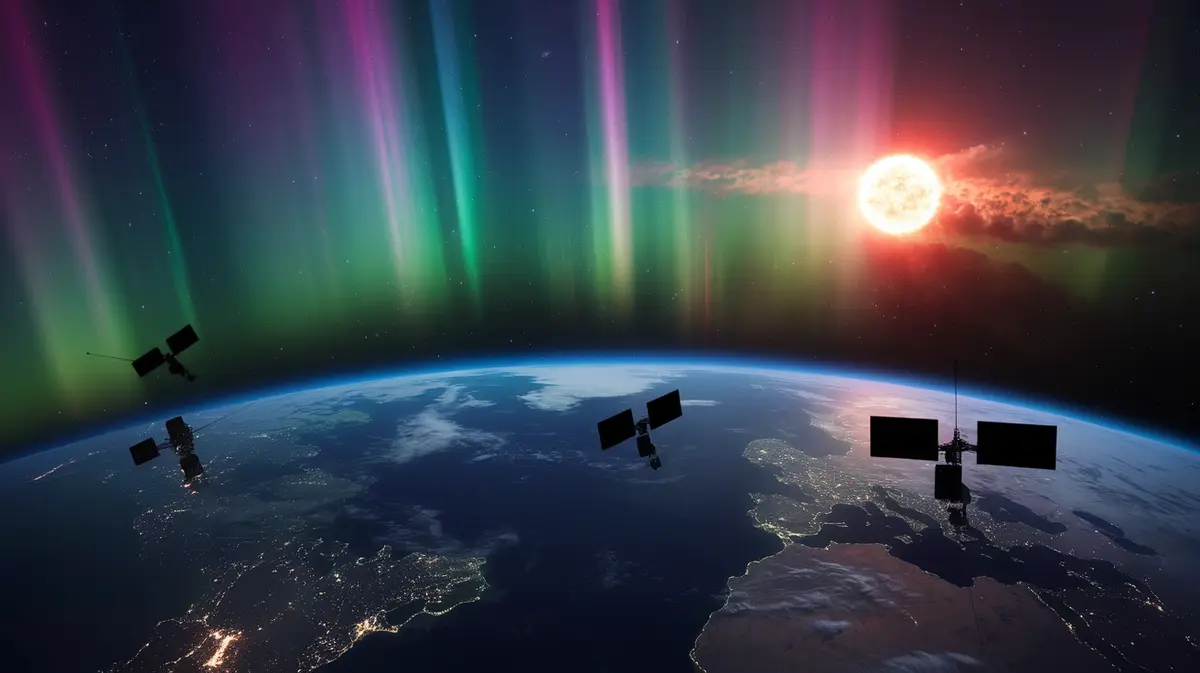
While the world's attention has fixated on quantum computing — Google, IBM, and Microsoft racing to a useful logical qubit — a quieter and arguably more commercially mature quantum revolution has been quietly shipping hardware. Quantum sensing turns the most uncomfortable property of a quantum system — its almost neurotic sensitivity to the outside world — into the basis for instruments that measure magnetic fields, gravity, acceleration, time, and electric fields with precision that classical sensors physically cannot match. The same nitrogen-vacancy (NV) centers, laser-cooled atom clouds, and matter-wave interferometers that make quantum computers so fragile make quantum sensors extraordinarily good. In 2026, the field has moved from physics journals to procurement orders. SBQuantum's NV-diamond magnetometers are flying on a Royal Canadian Air Force project to map Earth's magnetic field for GPS-denied navigation. AOSense and Vector Atomic atom-interferometer accelerometers are aboard U.S. Navy ships. Cerca Magnetics, FieldLine, and QuSpin sell optically-pumped magnetometers (OPMs) that have replaced cryogenic SQUIDs in next-generation wearable MEG brain scanners. And Q-CTRL just signed contracts with mineral-exploration majors to map subsurface geology from drone-borne quantum magnetometers. The era of the quantum sensor is here — and unlike quantum computing, it is already making money.
What "Quantum Sensing" Actually Means
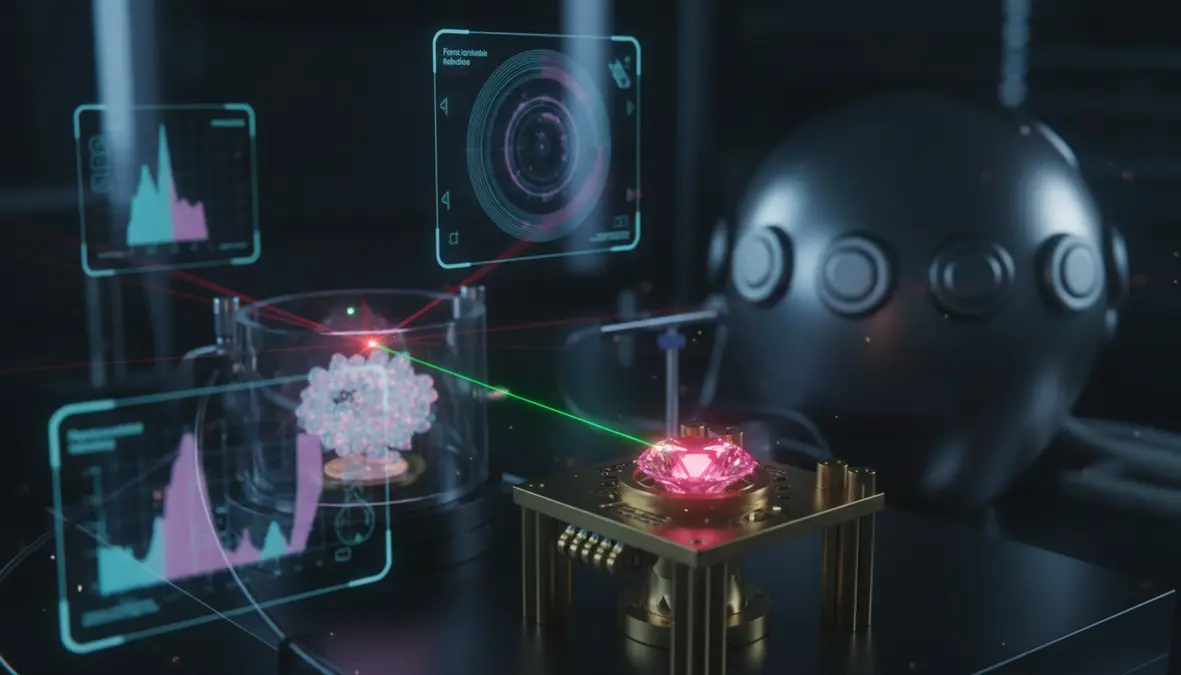
A working definition: a quantum sensor measures a classical signal by reading out a property of a quantum system whose evolution depends on that signal. An NV center in diamond has an electronic spin whose magnetic resonance frequency shifts in exact proportion to the local magnetic field — read out the frequency optically, and you have measured the field with no calibration step. A cloud of laser-cooled rubidium atoms held in a vacuum cell falls under gravity, and the resulting matter-wave interference fringes encode the local gravity gradient. A cesium atomic transition produces a frequency stable to one part in 1016 — far beyond any quartz crystal — and that is the definition of the SI second. Three properties make quantum sensors different from anything classical: they can approach the Heisenberg limit of precision; they are intrinsically calibration-free (the unit is baked into atomic physics); and they are immune to most forms of long-term drift.
"A quantum computer is trying to protect a qubit from the world. A quantum sensor is trying to expose one to it. Same physics, opposite goal — and the sensor side is shipping today."
The Four Flagship Modalities in 2026
Quantum sensing is not one technology — it is a family of techniques sharing a single principle. Four modalities account for almost every commercial shipment in 2026.
NV-Diamond Magnetometry
Nitrogen-vacancy defects in synthetic diamond act as room-temperature, chip-scale magnetic field sensors with vector sensitivity. SBQuantum, QDTI, and Lockheed Martin's Dark Ice program target airborne magnetic-anomaly navigation, IC failure analysis, and battery diagnostics. Sensitivity into the femtotesla range — and no cryogenics.
Optically-Pumped Magnetometers
Alkali-vapor cells (rubidium, cesium) pumped by a laser become exquisitely sensitive magnetometers — sensitive enough to detect the magnetic field of a single neuron. Cerca, FieldLine, and QuSpin are replacing $3 million cryogenic SQUID MEG scanners with wearable, room-temperature helmets in epilepsy and dementia clinics.
Cold-Atom Interferometry
Laser-cooled atoms in free fall behave as matter waves. Split them, let gravity or acceleration shift their phase, and recombine. AOSense, Vector Atomic, and Muquans build gravimeters, gyroscopes, and accelerometers for submarine and ship navigation that drifts millimeters per hour — orders of magnitude better than ring-laser gyros.
Optical Atomic Clocks
Strontium and ytterbium optical lattice clocks reach 10-18 fractional stability — losing one second in 30 billion years. Infleqtion (ColdQuanta), Vescent, and Microchip are productizing transportable optical clocks and chip-scale atomic clocks (CSAC) for 5G sync, financial timestamping, and GPS holdover.
Who Is Shipping Quantum Sensors in 2026
| Company | Technology | Where They Win |
|---|---|---|
| SBQuantum | NV-diamond vector magnetometer | Sherbrooke spin-out flying with the Royal Canadian Air Force on MagQuest — mapping the World Magnetic Model from light aircraft for backup PNT. The first NV-diamond magnetometer in regular flight operations. |
| AOSense & Vector Atomic | Cold-atom interferometer gyroscopes and accelerometers | Two of the only firms in the world that have demonstrated a transportable atom-interferometer IMU at sea. Their navigation-grade hardware is the leading candidate to replace ring-laser gyros aboard U.S. Navy ships and submarines. |
| Cerca Magnetics, FieldLine, QuSpin | Optically-pumped magnetometer arrays for MEG | The clinical wearable-MEG cluster. Wearable OPM-MEG helmets allow patients — including infants — to move freely during recording, opening pediatric epilepsy and dementia indications that cryogenic SQUID systems physically cannot. |
| Infleqtion (ColdQuanta) | Cold-atom clocks, sensors, and Rydberg RF receivers | The broadest commercial portfolio. Tiqker transportable atomic clock, Albert quantum gravimeter, and the SqyDuck Rydberg-atom RF receiver — the latter capable of detecting radio signals from DC to ~100 GHz with a single atom-based head. |
| Q-CTRL | Quantum control + magnetic navigation software | The Sydney/LA firm bundles control-engineering software with magnetometer hardware. Q-CTRL Dragonfly does AI-assisted magnetic-anomaly navigation; mineral-exploration majors are flying it on drones over Western Australia. |
| Microchip / Vescent / Stable Laser | Chip-scale atomic clocks and lasers | The Microsemi/Microchip CSAC is the workhorse defense atomic clock; Vescent and Stable Laser supply the ultra-stable lasers that lock optical clocks. Unsexy plumbing — but every quantum-sensor company is a customer. |
Why the Applications Are More Interesting Than the Physics
The physics is a half-century old. What changed in 2026 is the engineering — and the buyer. GPS-denied navigation is the single largest market: a submarine that cannot surface, a hypersonic vehicle outrunning satellite uplinks, or a deep-strike drone in a contested environment all need to know where they are without GPS. A quantum-inertial sensor that drifts a meter per day rather than per minute changes the entire mission profile. Wearable MEG is the largest healthcare opportunity: OPM-helmets fit on a moving child's head, do not need a liquid-helium room, and cost a fraction of the SQUID system they replace — opening pediatric epilepsy, language mapping, and dementia screening as routine clinical procedures rather than research curiosities. Mineral and energy exploration pays for drone-borne magnetometers because the alternative is months of seismic survey crews. 5G and finance pay for CSACs and optical clocks because timing matters: a microsecond of GPS holdover keeps a tower locked; a nanosecond of timestamp accuracy is a MiFID II compliance line. And geophysics — gravity surveys for groundwater, earthquake early warning, and CO2 sequestration verification — increasingly buys transportable quantum gravimeters whose absolute accuracy obsoletes a generation of relative-gravity instruments.
What Quantum Sensing Means for Buyers in 2026
- Sensitivity is no longer the bottleneck — size, weight, and power (SWaP) is. Lab-grade quantum sensors have existed for decades. The 2026 race is to fit them in a backpack, a drone payload, or a chip-scale module.
- Calibration disappears. Atomic transitions and NV centers are intrinsic standards. A quantum sensor that ships from the factory is, by physics, a primary reference — no field calibration drift to manage.
- GPS is not assumed. Defense, aviation, and critical infrastructure buyers increasingly assume GPS will be jammed or spoofed during a crisis. Quantum-PNT is now a line item, not a research project.
- The software stack matters as much as the head. Q-CTRL, Quantum Machines OPX, and dynamical-decoupling pulse protocols are what convert a noisy quantum probe into a useful sensor. Treat any quantum-sensor vendor as a control-software company first.
- The supply chain is shallow. Element Six dominates electronic-grade CVD diamond; a handful of firms make the ultra-stable lasers and frequency combs. Lock down sourcing before you commit to a deployment.
Where Quantum Sensing Goes Next
The 2028 horizon is dominated by two ideas. First, Rydberg-atom RF receivers — vapor-cell sensors that detect electric fields rather than magnetic ones — are on track to replace classical antennas in some defense communications and electronic-warfare roles. A Rydberg atom does not care what frequency it is tuned to in the way a metal antenna does; a single sensor head can cover DC to 100 GHz. Second, entanglement-enhanced metrology — using spin-squeezing and entangled atomic states to push past the standard quantum limit — is moving out of the AMO physics community and into prototype gravimeters and optical clocks. If it works at scale, it would buy another order of magnitude of sensitivity for the same atom count and integration time. Both are real, both are funded, and both are likely to ship before any fault-tolerant quantum computer becomes commercially relevant.
The lesson of 2026 is that quantum technology does not require qubits, error correction, or millions of logical operations to change an industry. Sometimes it just requires a single, exquisitely well-controlled atom — and the willingness to ask it a question about the world.