Betavoltaic Nuclear Batteries in 2026: How Betavolt, City Labs, and Infinity Power Are Building Diamond Batteries That Run for Decades Without a Single Charge
- Internet Pros Team
- July 14, 2026
- AI & Technology
Every battery you have ever owned runs down. Your phone dies overnight, your smoke detector chirps for a fresh cell, the pacemaker in a patient must eventually be swapped out in surgery. Now imagine a battery the size of a coin that quietly delivers power for fifty years - no charging cable, no replacement, no maintenance. That is the promise of the betavoltaic battery, often called a nuclear diamond battery, and in 2026 it is moving out of the lab and into real products. It does not store energy in a chemical reaction that empties; it harvests the endless trickle of electrons streaming out of a decaying radioactive isotope, turning the steady clockwork of physics itself into electricity.
The Problem: Chemistry Runs Out
Lithium-ion has conquered the world, but it has a hard limit: it stores a fixed amount of chemical energy, and once that is spent, the device is dead until you recharge it. For most gadgets that is fine. But a whole class of applications needs power that simply never stops - a sensor buried in a bridge for its entire service life, a cardiac implant deep inside the body, a probe drifting toward the outer solar system where sunlight is too faint for solar panels. For these jobs, swapping a battery is expensive, dangerous, or flatly impossible. Betavoltaics attack exactly this gap by trading raw power for extraordinary endurance.
"We are not trying to replace the battery in your laptop. We are trying to build a power source you install once and forget about for the rest of your life - or the life of the device. When you measure a battery in decades instead of hours, everything about how you design electronics changes."
How a Betavoltaic Battery Actually Works
The physics is elegant. Certain isotopes - such as nickel-63, tritium, or carbon-14 - are unstable, and as they decay they emit beta particles, which are simply high-speed electrons. Place a thin layer of that isotope next to a semiconductor, and each emitted electron knocks loose a cascade of charge carriers inside the material - the same effect a photon of sunlight has in a solar cell. Collect that charge and you have a steady electric current. In effect, a betavoltaic cell is a solar panel that runs on radioactive glow instead of sunlight, and because the isotope keeps decaying at a fixed, predictable rate, the current flows day and night for the isotope’s entire half-life.
The Fuel
A safe, low-energy beta emitter - nickel-63, tritium, or carbon-14 - releases a steady stream of electrons as it slowly decays over years to decades.
The Converter
A wide-bandgap semiconductor - increasingly synthetic diamond or silicon carbide - absorbs each beta particle and turns it into usable electric charge.
The Shield
The whole cell is sealed inside a solid casing. Beta particles are so weak they are stopped by a sheet of paper or the casing itself - no radiation escapes.
The Output
The result is a trickle of microwatts to milliwatts - tiny, but utterly constant and maintenance-free for the life of the device.
The Diamond Battery Twist
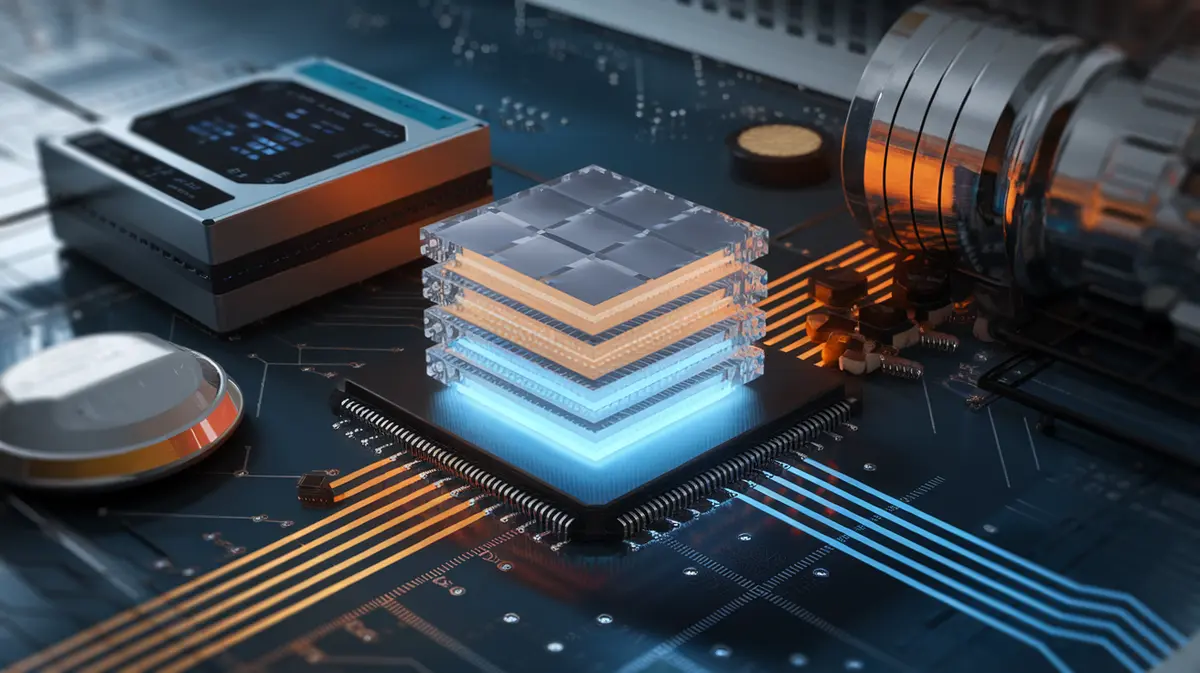
The most futuristic version uses diamond as the semiconductor - hence the name "diamond battery." Synthetic diamond is not just a gimmick: it is the toughest, most radiation-hardened converter material known, and it can be grown directly around a radioactive carbon-14 source so the fuel and the collector become one solid, inert crystal. A striking side benefit is that carbon-14 is a waste product of graphite nuclear reactors, so these batteries can recycle nuclear waste into power. Encased in ordinary non-radioactive diamond, the finished cell is chemically inert, non-flammable, and effectively tamper-proof - it cannot leak, catch fire, or explode the way a lithium cell can.
Who Is Building It
A small but fast-moving cluster of companies is racing to commercialize different flavors of the idea:
- Betavolt made headlines with its BV100, a nickel-63 betavoltaic module smaller than a coin that it says delivers steady microwatt power for up to 50 years, with plans to stack cells into higher-output modules for phones and drones.
- City Labs builds tritium-powered betavoltaic cells already used in medical and aerospace applications, and has partnered on batteries designed to run implanted medical devices for decades.
- Infinity Power takes a different route with radioisotope electrochemical cells, aiming for far higher efficiency to power remote sensors, undersea equipment, and defense electronics.
- Arkenlight and university spinouts are commercializing carbon-14 diamond batteries built from reactor waste, targeting ultra-long-life sensors and identification tags.
- Kronos, NDB, and others are pursuing nano-diamond and layered designs that promise to squeeze more power out of the same tiny sliver of isotope.
Betavoltaic vs. Lithium: Different Jobs
It is crucial to understand that a betavoltaic battery is not a lithium replacement. They solve opposite problems - one delivers a lot of power for a short time, the other a tiny amount of power for a very long time.
| Factor | Betavoltaic (Nuclear) | Lithium-Ion |
|---|---|---|
| Power output | Microwatts to milliwatts | Watts to kilowatts |
| Lifespan | Years to decades (no recharge) | Hours per charge; a few years total |
| Maintenance | None - install and forget | Regular charging and eventual replacement |
| Best use | Implants, remote sensors, space, IoT | Phones, laptops, EVs, power tools |
| Safety risk | Sealed, non-flammable, no thermal runaway | Can overheat, swell, or catch fire |
Where Near-Eternal Power Changes Everything
The magic of betavoltaics is not raw wattage - it is what becomes possible when a device never needs a new battery. Consider where that matters most:
- Medical implants: Pacemakers and neurostimulators could outlast the patient, eliminating repeat surgeries just to swap a dying battery.
- The Internet of Things: Billions of tiny sensors in bridges, pipelines, and farmland could run for their entire service life with no battery changes and no wiring.
- Space and defense: Deep-space probes, remote weather stations, and undersea monitors can operate for decades where sunlight is absent and human access is impossible.
- Always-on memory and clocks: Betavoltaics can keep a real-time clock or secure memory alive for the life of a product without a single maintenance visit.
"The word ‘nuclear’ scares people, but the beta particles from these isotopes are stopped by your skin, let alone the casing. The real breakthrough is boring in the best way: a power source so reliable and so long-lived that you never have to think about it again."
The Honest Trade-Offs
Betavoltaics are not magic, and the hype needs a reality check. The output is genuinely tiny - a single cell produces roughly a millionth of what a smartphone draws, so claims of "nuclear-powered phones" are, for now, marketing that requires stacking many cells or pairing them with a supercapacitor that stores the slow trickle until a burst is needed. Efficiency is still low, isotopes like tritium and carbon-14 are costly and tightly regulated, and manufacturing at scale is unproven. Public perception of anything labeled "nuclear" remains a hurdle even though the safety case is strong. These are precision power sources for niche, high-value jobs - not a general-purpose battery for your garage.
What It Means for Your Business
You will not be buying a nuclear-powered laptop in 2026, but the ripple effects are real for anyone building connected products. As betavoltaic cells become available, entire categories of "install-once" hardware become viable - maintenance-free sensor networks, lifetime-powered asset trackers, and medical or industrial devices freed from the cost and logistics of battery replacement. The strategic lesson is to think about total lifetime cost, not just the price of a cell: a battery you never replace can be worth far more than a cheap one you swap every year.
Betavoltaic nuclear batteries are a reminder that not every energy breakthrough is about storing more - sometimes it is about lasting longer. By quietly converting the steady drumbeat of radioactive decay into decades of trickle power, diamond batteries could become the invisible, everlasting heartbeat behind the sensors, implants, and spacecraft of the coming decades.
Key Takeaways
- Betavoltaic batteries turn the electrons released by radioactive decay into a steady trickle of electricity for years to decades - no recharging.
- "Diamond batteries" use synthetic diamond as the converter and can be built from carbon-14 nuclear waste, sealing the fuel inside an inert crystal.
- They are extremely safe - the beta radiation is stopped by the casing - but produce only microwatts, so they complement rather than replace lithium.
- The killer applications are implants, IoT sensors, space, and defense - anywhere replacing a battery is costly or impossible.
- Betavolt, City Labs, Infinity Power, and Arkenlight are leading the race to commercialize near-eternal micro-power in 2026.