Smart Cities: How AI, IoT, and Digital Infrastructure Are Building the Cities of Tomorrow in 2026
- Internet Pros Team
- March 18, 2026
- AI & Technology
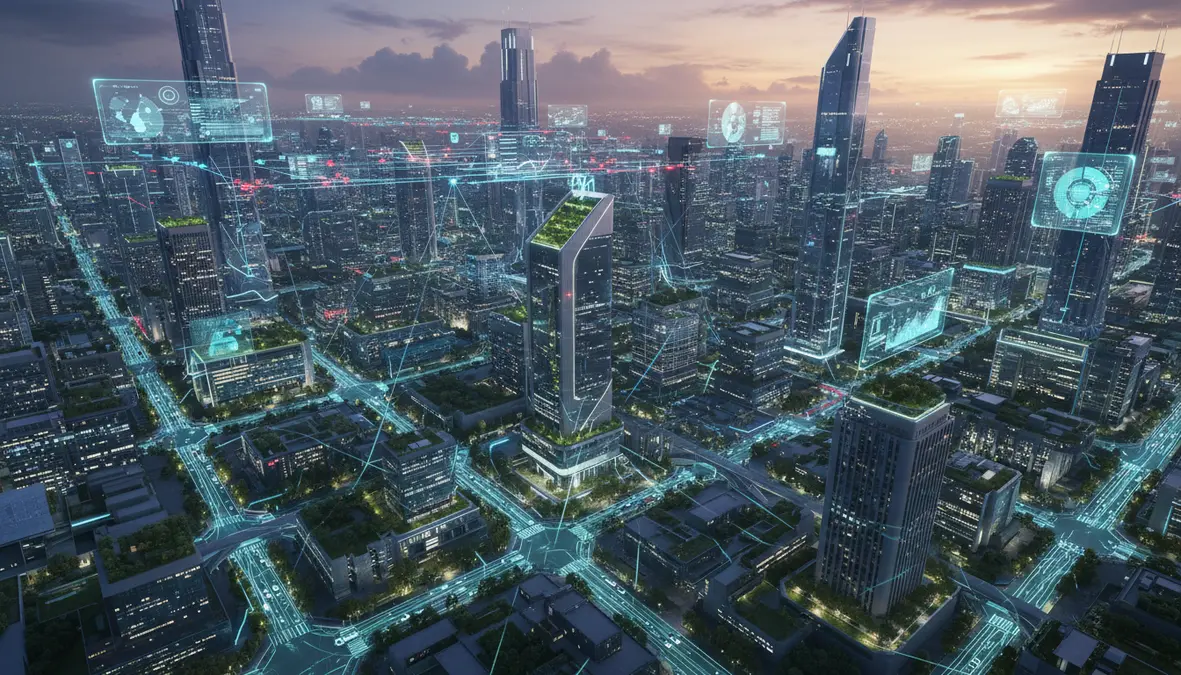
In January 2026, the city of Barcelona announced that its AI-powered urban management platform had reduced traffic congestion by 22 percent, cut water waste by 18 percent, and saved the city 47 million euros in infrastructure maintenance costs — all within its first full year of operation. Across the Atlantic, Columbus, Ohio completed the deployment of 12,000 IoT sensors across its road network, enabling real-time adaptive traffic signals that have slashed average commute times by 14 minutes. Meanwhile, Singapore's Virtual Singapore platform — the most advanced urban digital twin on Earth — predicted and prevented a catastrophic flooding event in February 2026 by simulating storm drainage patterns 72 hours in advance and automatically adjusting pump stations across the island. These are not isolated experiments. In 2026, the smart city has evolved from a buzzword into measurable urban reality, driven by converging advances in AI, IoT, 5G connectivity, and digital twin technology that are fundamentally reshaping how cities operate, grow, and serve their residents.
The Smart City Technology Stack: From Sensors to Intelligence
A modern smart city is built on a layered technology architecture that transforms raw urban data into actionable intelligence. At the foundation lies a dense network of IoT sensors — embedded in roads, bridges, water pipes, streetlights, waste bins, and air quality monitors — that generate continuous streams of data about every measurable aspect of city life. In 2026, the average smart city deployment includes 20 to 50 sensors per 1,000 residents, connected through a combination of 5G cellular, LoRaWAN, and fiber optic networks that transmit data in real time to centralized and edge computing platforms.
| Layer | Technology | Function | Examples |
|---|---|---|---|
| Sensing | IoT sensors, cameras, LiDAR | Data collection from physical infrastructure | Traffic counters, air quality monitors, water pressure sensors |
| Connectivity | 5G, LoRaWAN, fiber, satellite | Real-time data transmission | Private 5G networks, LPWAN for low-power devices |
| Platform | Cloud, edge computing, data lakes | Data aggregation, storage, and processing | AWS IoT, Microsoft Azure Digital Twins, Google Urban Computing |
| Intelligence | AI/ML models, digital twins | Pattern recognition, prediction, optimization | Predictive maintenance, traffic flow optimization, energy balancing |
| Action | Automated controls, dashboards, APIs | Real-time response and decision support | Adaptive traffic signals, smart grid switching, emergency dispatch |
Above the connectivity layer sits the urban data platform — the operating system of the smart city. Platforms like Cisco Kinetic, Siemens MindSphere, and custom municipal systems ingest, normalize, and correlate data from thousands of heterogeneous sources. AI and machine learning models running on these platforms detect anomalies, forecast demand, optimize resource allocation, and trigger automated responses. The critical innovation in 2026 is that these systems no longer operate in silos — traffic, energy, water, waste, and emergency services share a unified data environment, enabling cross-domain optimization that was impossible when each department ran its own isolated technology stack.
"The smart city is not about putting sensors everywhere. It is about connecting systems that were never designed to talk to each other — traffic lights that know about air quality, water networks that respond to weather forecasts, and energy grids that anticipate demand before it materializes. The intelligence is in the integration."
AI-Powered Traffic and Mobility
Traffic management has emerged as the highest-impact application of smart city technology, driven by the staggering economic cost of congestion — estimated at 87 billion dollars annually in the United States alone. In 2026, AI-powered adaptive traffic systems have moved far beyond simple signal timing optimization. Modern systems like Siemens Yutraffic, Google's Project Green Light, and Alibaba's City Brain process live feeds from cameras, inductive loops, connected vehicles, and mobile phone signals to create a real-time digital model of traffic flow across an entire metropolitan area.
Adaptive Signal Control
AI systems continuously adjust green light duration, phase sequencing, and signal coordination across corridors based on real-time demand. Pittsburgh's Surtrac system, one of the earliest deployments, reduced travel times by 25 percent and idling by 40 percent. In 2026, next-generation systems incorporate vehicle-to-infrastructure (V2I) communication, receiving intent data from connected and autonomous vehicles to pre-emptively adjust signals before vehicles arrive at intersections.
Multimodal Transit Integration
Smart city platforms now integrate buses, trains, ride-shares, bike-shares, scooters, and autonomous shuttles into unified mobility-as-a-service (MaaS) platforms. Helsinki's Whim app and Singapore's SimplyGo system allow residents to plan, book, and pay for multimodal journeys through a single interface, with AI optimizing routes across all available transport modes based on real-time conditions, user preferences, and carbon impact.
Digital Twins: The City in a Computer
Perhaps the most transformative smart city technology in 2026 is the urban digital twin — a real-time, physics-accurate virtual replica of an entire city that enables simulation, prediction, and what-if analysis at unprecedented scale. Singapore's Virtual Singapore, built on a partnership between the National Research Foundation and Dassault Systemes, models every building, road, utility network, and transit system on the island with centimeter-level accuracy, updated continuously from sensor feeds and satellite imagery.
Urban digital twins enable planners to simulate the impact of new construction on wind patterns and pedestrian comfort, model how a proposed transit line would redistribute traffic across the city, predict the cascading effects of infrastructure failures — what happens to traffic, emergency response times, and power distribution if a major bridge closes for repair, and test disaster response scenarios including flooding, earthquakes, and pandemic containment measures without any real-world disruption.
- Singapore's Virtual Singapore: The gold standard for urban digital twins, used by 40 government agencies for planning, simulation, and real-time monitoring of the entire island
- Helsinki's Kalasatama Digital Twin: Models an entire new urban district with building energy performance, solar exposure, and noise mapping that informed zoning decisions
- Shanghai's Urban Digital Twin: Covers all 6,340 square kilometers of the municipality, integrating transportation, energy, and environmental monitoring with AI-powered anomaly detection
- Las Vegas Innovation District: Uses NVIDIA Omniverse-powered digital twin to simulate autonomous vehicle routing, pedestrian flow, and event crowd management on the Strip
Smart Infrastructure: Predictive Maintenance and Resilience
Aging infrastructure is one of the most expensive challenges facing cities worldwide. The American Society of Civil Engineers estimates that the US faces a 2.6 trillion dollar infrastructure investment gap, with 43 percent of public roads in poor or mediocre condition and 7.5 percent of bridges classified as structurally deficient. Smart city technology is addressing this crisis through predictive maintenance — using IoT sensors and AI to detect deterioration before it becomes failure.
In 2026, smart water networks equipped with acoustic sensors, pressure monitors, and flow meters can detect pipe leaks as small as 0.5 gallons per minute, enabling repairs before small leaks become catastrophic main breaks. London's Thames Water deployed over 10,000 acoustic sensors across its pipe network, reducing burst incidents by 35 percent and water loss by 15 percent in the first year. Smart bridge monitoring systems using strain gauges, accelerometers, and fiber optic sensors provide continuous structural health assessments, replacing the traditional two-year manual inspection cycle with real-time condition monitoring that catches problems months or years earlier.
Smart Energy Grids
AI-optimized microgrids balance distributed solar, battery storage, and EV charging loads across city districts, reducing peak demand by up to 20 percent and enabling automatic islanding during grid outages to keep critical facilities powered.
Smart Waste Management
Sensor-equipped waste bins report fill levels in real time, enabling AI-optimized collection routes that reduce truck mileage by 30 to 40 percent and cut collection costs by 25 percent while preventing overflowing bins in high-traffic areas.
Environmental Monitoring
Dense networks of air quality, noise, and temperature sensors feed AI models that predict pollution events, trigger traffic rerouting to reduce emissions in affected areas, and provide hyperlocal environmental data to residents through mobile apps.
Privacy, Security, and Governance Challenges
The smart city's greatest strength — its ability to sense and analyze everything — is also its greatest risk. A city blanketed in cameras, sensors, and connectivity creates an unprecedented surveillance infrastructure. In 2026, cities are grappling with how to deliver the benefits of urban intelligence without creating Orwellian monitoring systems that erode civil liberties.
Leading smart city programs have adopted privacy-by-design frameworks that anonymize and aggregate sensor data at the edge before transmission, preventing individual tracking. Barcelona's DECODE project pioneered the use of data sovereignty tools that give citizens control over what urban data about them is collected and how it is used. Toronto's Quayside project, controversially cancelled in 2020 over privacy concerns, has become a cautionary tale that shapes governance frameworks worldwide. Meanwhile, cybersecurity for smart city infrastructure has become critical — a compromised traffic management system or water treatment facility represents a direct threat to public safety. The US Cybersecurity and Infrastructure Security Agency (CISA) published dedicated smart city security guidelines in 2025, and the EU's NIS2 directive now explicitly covers urban infrastructure platforms.
What This Means for Your Business
The smart city transformation creates opportunities and requirements for businesses of every size. Companies with physical operations in smart city zones can leverage municipal data platforms for logistics optimization, location intelligence, and customer insights. Technology providers can build applications on open urban data APIs now offered by over 200 cities worldwide. Meanwhile, businesses must prepare for smart city regulations that increasingly mandate environmental monitoring, energy reporting, and digital infrastructure integration for commercial properties.
At Internet Pros, we help businesses navigate the smart city ecosystem — integrating IoT sensors and data platforms for commercial properties, building applications on urban data APIs, implementing cybersecurity frameworks for connected infrastructure, and developing digital twin solutions for facility management and operational optimization. Contact us today to discuss how we can help your organization leverage smart city technology for competitive advantage and operational efficiency.