Subsea Cables in 2026: The Fiber on the Ocean Floor That Carries Almost Everything, Why It Keeps Getting Cut, and How Repairs Actually Work
- Internet Pros Team
- August 25, 2026
- Networking & Security
Almost everything you did online today left the country through a garden hose. That is roughly the diameter of the cables that carry international internet traffic across ocean floors, and there are only a few hundred of them. Satellites, for all the attention they get, handle a rounding error of global data. The real internet is a sparse mesh of glass laid on seabed mud, and in 2026 it is under more strain, and more scrutiny, than at any point since it was built.
What Is Actually Down There
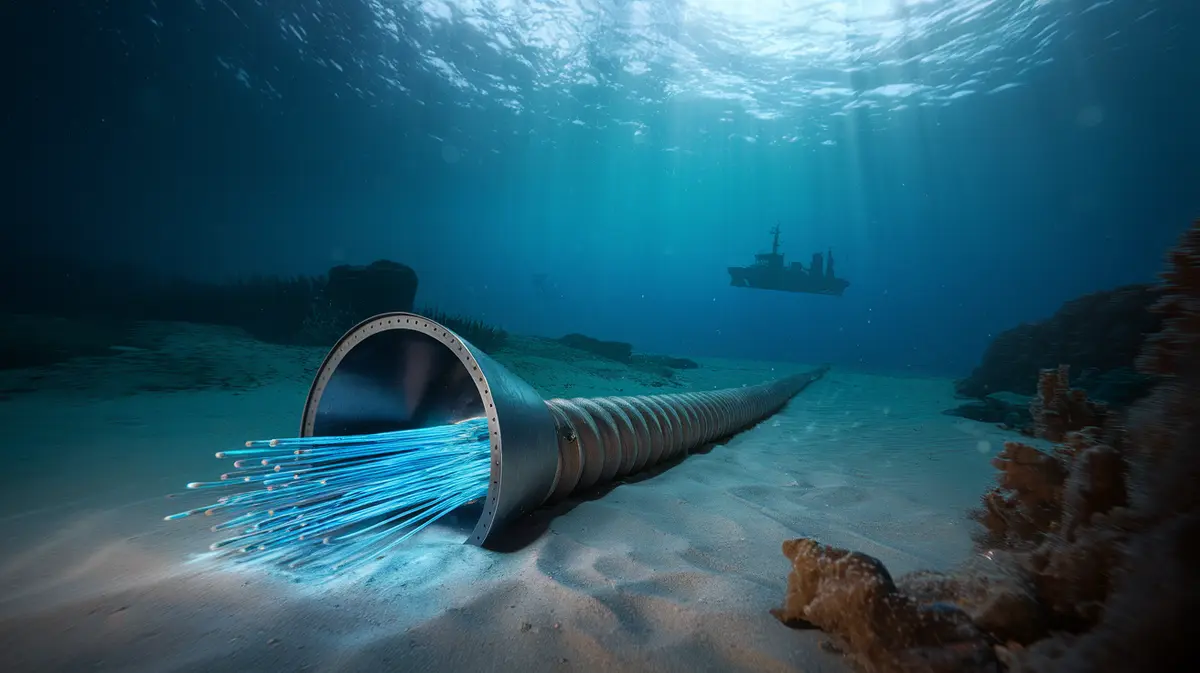
A modern submarine cable is smaller than most people expect. At its core sit a handful of optical fiber pairs, each thinner than a human hair, wrapped in a steel tube, a copper conductor, insulation, and - in shallow water - layers of steel armor. In the deep ocean, where nothing much can reach it, the armor comes off and the cable is barely thicker than a marker pen. Total global length runs past 1.4 million kilometers across roughly 550 active systems.
The copper matters as much as the glass. Light weakens as it travels, so every 50 to 100 kilometers the signal passes through a repeater, an amplifier sealed in a beryllium copper housing that has to survive decades on the seabed with no maintenance. Those repeaters are powered by a single high-voltage current fed from shore, which is why a cable is an electrical system as well as an optical one, and why cutting one does more than interrupt a beam of light.
Each end terminates at a landing station, an unglamorous building near a beach where the cable meets terrestrial networks. These are the least redundant part of the arrangement: one facility often terminates several cables, so geographic diversity on a map can turn out to be no diversity at all once traffic reaches land.
Buying two carriers is not redundancy if both of them lease capacity on the same cable and land it in the same building.
Why Cables Keep Getting Cut
Between 150 and 200 cable faults are recorded worldwide every year. That number surprises people because most faults never make the news - the traffic reroutes, the operators absorb it, and a repair ship quietly sails out. Faults become visible only where there was nothing to reroute onto.
| Cause | Share of faults | Where it happens |
|---|---|---|
| Fishing gear | Roughly 40 percent | Continental shelves, trawling grounds under 200m |
| Ship anchors | Roughly 15 to 20 percent | Approaches to ports, congested straits |
| Natural events | Roughly 10 percent | Seabed landslides, earthquakes, turbidity currents |
| Equipment and abrasion | Remainder | Aging systems, rock chafe, repeater failure |
The overwhelming majority of damage, in other words, is accidental and boring. What changed recently is not the physics but the interpretation. A cluster of cuts in the Baltic Sea, and a separate cluster in the Red Sea, involved vessels dragging anchors for improbable distances in ways that looked less like carelessness than practice. Attribution at sea is genuinely hard - the seabed keeps no records - and that ambiguity is exactly what makes the tactic attractive. A category of incident once handled as marine maintenance is now handled as a security question, with naval patrols attached.
How a Repair Actually Works
Repairing a cable is a maritime operation, not a networking one, and it runs on a timescale that shocks people used to same-day service. Operators first locate the fault electrically from shore, measuring the resistance and optical return along the line to pin the break within a kilometer or so. Then they wait for a ship.
There are only around 60 cable ships in the world capable of deep-water repair, most of them decades old, and they are shared across regions through consortium agreements. The vessel sails - often for days - locates the cable with a grapnel dragged along the seabed, hauls both ends to the surface one at a time, splices in a fresh length, tests it, and lays the repaired loop back down. Add weather windows and permits to work in foreign territorial waters, and a typical repair runs one to three weeks. In contested waters it has taken months.
Why Some Cuts Barely Register and Others Are Catastrophic
- Route count. The North Atlantic has dozens of parallel systems, so a single fault is absorbed almost invisibly. West Africa and parts of the Pacific have a handful.
- Spare capacity. Rerouting only works if the surviving cables were not already running near their limit at peak.
- Chokepoints. The Red Sea, the Strait of Malacca, and the Luzon Strait concentrate many systems into narrow corridors where one incident can touch several cables at once.
- Landing diversity. Separate cables that share a landing station or a terrestrial backhaul route fail together.
- Repair access. A ship that must wait weeks for a permit turns a technical outage into a political one.
The AI Boom Changed Who Builds Them
For most of their history, submarine cables were financed by consortia of telecom carriers selling capacity to each other. That model is now the minority. Content and cloud companies - the ones running search, video, social platforms, and increasingly AI training and inference - own or lease the clear majority of transoceanic capacity, and build their own systems when existing routes do not go where they need.
The reason is straightforward. Training a large model in one region and serving it from another moves enormous volumes of data between data centers, and that traffic is far more predictable and far more valuable to the owner than retail internet traffic ever was. Newer projects reflect it: multi-continent systems with fiber pair counts that would have been implausible a decade ago, routed deliberately around the chokepoints that keep failing.
This has an upside and a catch. The upside is genuine new capacity and new routes, including the first serious attempts to avoid the Red Sea entirely. The catch is that a private cable serves its owner first. Regional carriers, smaller markets, and public networks do not automatically inherit the resilience, and some routes remain thin precisely because no hyperscaler has a reason to cross them.
What Any of This Means for an Ordinary Business
You will never buy a submarine cable, but you inherit their failure modes through your providers. A few habits make the difference between an outage you read about and one you live through.
Ask your carriers which physical routes they use. Diversity written into a contract is worth checking against a map. Two providers, one cable, is a common and expensive surprise.
Know where your data actually lives. A cloud region on another continent is a subsea dependency whether or not anyone described it that way. For systems that must survive a regional cut, in-region replicas matter more than a second vendor.
Keep a degraded mode. Most international cuts do not sever connectivity outright, they congest it. Applications that stay usable at high latency and reduced bandwidth - queued writes, cached reads, offline-tolerant clients - ride through incidents that break chatty, synchronous ones.
Have a low-bandwidth fallback for the essentials. Satellite and mobile links cannot replace a cable, but they can carry email, messaging, payment authorization, and voice for a distributed team while a ship is still steaming toward the fault.
The Honest Outlook
None of this points to a fragile internet about to snap. The system is resilient in aggregate, and the resilience is improving where money is flowing: more routes, better monitoring, sensing techniques that can detect a disturbance along a cable before a fault develops, and repair capacity that governments have belatedly noticed is strategic.
The fragility is local and unevenly distributed. It sits in the places with three cables instead of thirty, in the straits everything funnels through, in landing stations that quietly undo a diversity plan, and in an aging repair fleet that nobody was building replacements for until recently. For most businesses the takeaway is not alarm but literacy: knowing that international connectivity rests on physical objects with physical failure modes, and designing systems that degrade gracefully when one of them meets an anchor.