Fiber Gets Another Gear in 2026: What XGS-PON and 50G-PON Actually Change for Business Internet, and Where the Real Bottleneck Moves Next
- Internet Pros Team
- September 5, 2026
- Networking & Security
Most businesses discover the limits of their internet connection in the least convenient way possible. The download figure on the invoice looks generous, video calls are fine most of the time, and then a nightly cloud backup collides with a client uploading a batch of high-resolution files and suddenly nobody can hear anybody. The bottleneck was never the download. It was the upload, and the fiber technology that finally fixes it is being rolled out under a name almost no customer has heard: XGS-PON, with 50G-PON behind it.
The Number on the Contract Is the Wrong Number
For twenty years broadband was sold on one figure, because that figure described what people did. They consumed: pages loaded, video streamed, files came down. Upload was an afterthought, and providers sized it accordingly.
A modern business does the opposite roughly half the time. Every video call, cloud backup, file sync, offsite replication, camera feed and remote desktop session pushes traffic outward. A connection advertised at 1000 down and 50 up is not a fast connection with a small caveat. It is a fast connection in one direction and a twenty-year-old connection in the other.
This is why symmetrical service matters more than another zero on the download. Symmetry is not a luxury tier. It is the difference between a backup window that finishes overnight and one still running when staff arrive.
Nobody complains about their download speed during a video call. They complain that they froze, and freezing is almost always an upload problem wearing a disguise.
What a Passive Optical Network Actually Is
Fiber to the premises is rarely a private strand of glass running from a building to the provider. That exists, it is called dedicated internet access, and it is priced accordingly. What most businesses receive is a passive optical network, whose shape explains almost everything about how it behaves.
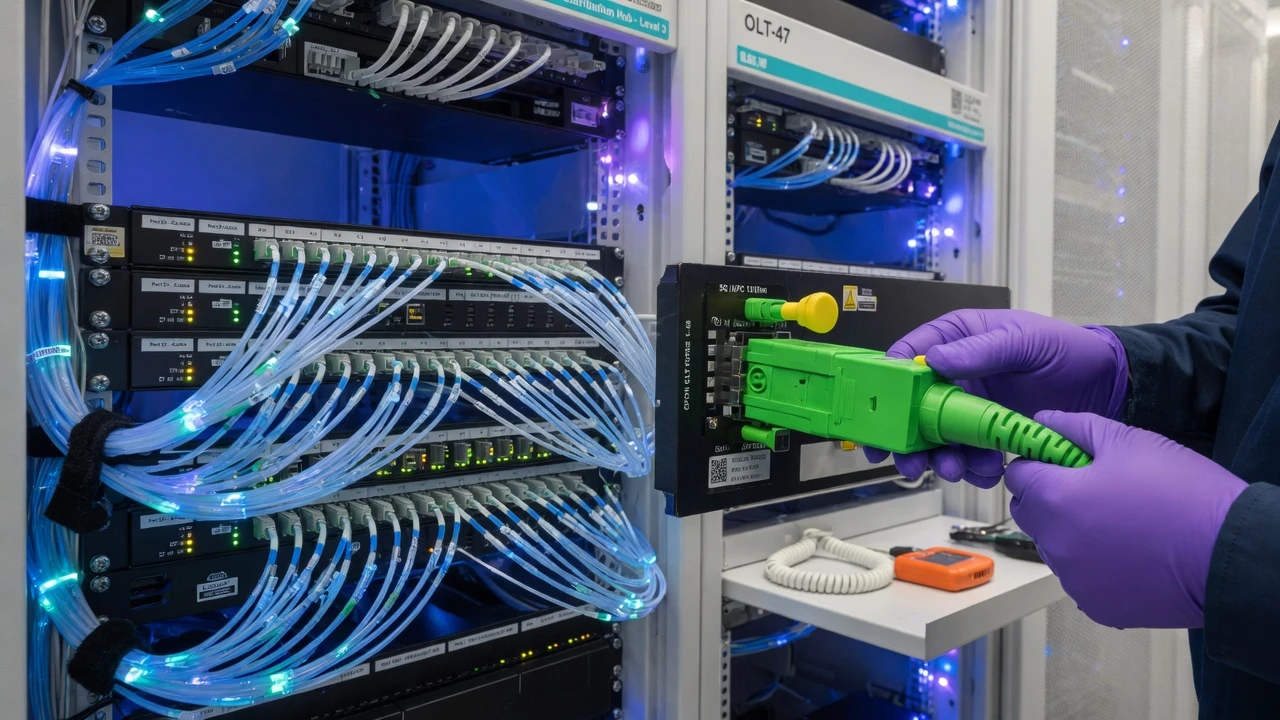
A single fiber leaves the provider equipment, called an optical line terminal, and reaches a splitter in the neighbourhood, which divides the light among many premises, commonly thirty-two or sixty-four, each ending at a small optical network terminal. The splitter is passive in the literal sense: no power, no electronics, nothing to fail. That is why fiber scaled the way it did.
The trade-off is that the capacity of that tree is shared. Downstream, everyone receives everything and their terminal ignores what is not addressed to them. Upstream, each premises gets precise time slots to transmit, so nobody talks over anybody. It is efficient, cheap and reliable. It is also, unavoidably, a shared medium, which is the most useful fact to hold in mind when reading any fiber sales page.
Three Generations on the Same Glass
The upgrade path is generational, and the generations differ far more in upstream capacity than in headline downstream figures.
| Generation | Shared capacity | Symmetry | What it realistically delivers |
|---|---|---|---|
| GPON | 2.5 Gbps down / 1.2 Gbps up | Asymmetric | The installed base. Fine for consumption, thin upstream once a site has cameras, backups and calls |
| XGS-PON | 10 Gbps down / 10 Gbps up | Symmetrical | The current business-grade tier. Real symmetrical gigabit service, widely deployable today |
| 50G-PON | 50 Gbps down, upstream varies by build | Depends on configuration | Early deployment. Matters most for mobile backhaul, dense sites and future headroom |
These generations coexist on the same physical fiber using different wavelengths of light. A provider can add XGS-PON equipment at one end, install a coexistence element, and serve upgraded customers alongside neighbours still on older terminals without trenching anything. That is why the upgrade arrives quietly rather than as a construction project: for most premises it is a new terminal on the wall and a change at the exchange, not a new cable in the ground.
The Questions That Actually Determine What You Get
Two businesses on the same technology at the same speed can have very different experiences, because the variables that decide performance are rarely printed on the offer.
Ask Before Signing
- Is the upload guaranteed or best effort? A symmetrical headline figure means little if the contract quietly permits shaping during business hours.
- What is the contention ratio on this segment? Providers rarely publish it but often answer when asked, and a business tier should carry a materially lower ratio than a residential one.
- Is there an SLA with a repair time? An availability percentage without a stated time to restore is a statistic, not a commitment.
- Static IP address, and is inbound traffic permitted? This decides whether you can host a VPN endpoint or phone system at all.
- Is the terminal capable of multigigabit handoff? A 10 Gbps service delivered into a single 1 Gbps ethernet port is a 1 Gbps service.
- What happens during a fiber cut? Ask whether a backup path exists, and whether failover is automatic or a phone call at eight in the morning.
Where the Bottleneck Moves After the Upgrade
A faster circuit does not make a network faster. It relocates the constraint, usually onto equipment that was perfectly adequate the week before.
The router is the most common casualty. A firewall appliance sized for gigabit will not pass multigigabit traffic with inspection, VPN termination and content filtering enabled, and it will not tell you it has run out of headroom. It simply caps throughput and adds latency under load, which looks like an ISP problem and is not.
Internal cabling is next. Plenty of office infrastructure is aging Category 5e feeding gigabit switches, so the connection can be ten times faster than every port it serves. Where multigigabit matters, that means new switching and often new cable.
And then there is Wi-Fi, where most people actually experience the network. A client on a congested band and an older standard will not perceive a faster circuit at all. If the goal is for staff to feel the upgrade rather than read about it on a speed test, the access points are often a better investment than the next service tier.
What Faster Fiber Does Not Fix
Bandwidth and latency are different properties, and conflating them causes a great deal of disappointed spending. If an application feels slow because its server is on another continent, a larger pipe changes nothing: bandwidth determines how much can travel at once, latency determines how long the first byte takes, and distance sets that floor. Capacity does not fix jitter either, and jitter ruins voice and video far more visibly than raw speed ever does.
Reliability is separate again. A single fiber, however fast, is a single point of failure, and the most common cause of a total outage remains a contractor with an excavator. Any site where downtime carries real cost needs a second path on a different medium.
Who Should Move Now, and Who Should Wait
Move to symmetrical service now if the daily reality includes large uploads: design and video work, engineering files, medical imaging, offsite backup, simultaneous video meetings, on-premises servers reached by remote staff, or cameras recording to the cloud. There the upload constraint is already costing time every day, and the upgrade pays for itself in restored working hours.
Wait if a site is primarily consuming: browsing, email, a handful of calls, cloud applications with modest file traffic. A well-configured symmetrical gigabit connection is plenty, and the money is better spent on the internal network, on a second connection for redundancy, or on the access points that determine what people actually feel.
The useful frame is to stop shopping for the largest number. Ask what the upload is, whether it is guaranteed, what happens when the fiber breaks, and whether the equipment behind the terminal can carry what arrives. Those four answers describe the connection a business will actually have. The headline speed mostly describes the advertisement.