AI-Driven Materials Discovery: How GNoME, MatterGen, and A-Lab Are Compressing Decades of R&D Into Months in 2026
- Internet Pros Team
- May 7, 2026
- AI & Technology
For the entire history of materials science, finding a useful new compound has been a slow, expensive lottery. A graduate student would synthesize a few hundred candidates a year, characterize them painstakingly, and hope one had the right combination of conductivity, stability, or strength to matter. The Materials Genome Initiative tried to industrialize this with high-throughput experimentation a decade ago and made real progress — but it was still a brute-force search through a combinatorial space larger than the number of atoms in the visible universe. In 2026, that workflow has been turned inside out. Foundation models trained on every crystal structure ever published, paired with autonomous robotic labs that synthesize the most promising predictions overnight, are compressing decades of materials R&D into months — and the next generation of batteries, solar cells, catalysts, and superconductors is being discovered on a GPU before it ever touches a beaker.
The Stable-Materials Explosion
The watershed moment came in late 2023, when Google DeepMind published GNoME (Graph Networks for Materials Exploration). GNoME used a graph neural network to predict the formation energy of hypothetical crystals at scale, then bootstrapped its own training data via active learning. The result: 2.2 million stable materials predicted, 380,000 of them at least an order of magnitude more stable than anything in existing public databases — roughly 800 years of conventional human discovery in a single training run. By 2026, GNoME-derived candidates have been independently synthesized hundreds of times, validating the model's predictions in the lab and seeding a new generation of open materials databases that dwarf the original Materials Project, ICSD, and OQMD combined.
The 2026 cohort goes further. Meta released OMat24, the largest open materials training dataset ever assembled — over 100 million DFT calculations — paired with state-of-the-art equivariant neural network potentials that approximate quantum-mechanical accuracy at a million times the speed. Microsoft Research's MatterSim brings universal interatomic potentials to industrial deployments. The Open Catalyst Project, ALIGNN, MACE, M3GNet, and CHGNet form an open ecosystem where any materials lab in the world can run accurate simulations on a single GPU instead of waiting weeks for HPC time.
Generative Models Replace Random Search
Predicting the properties of an existing compound is one problem. Inventing a new one with target properties is the harder one — and the one that most defines 2026. Microsoft's MatterGen, released in early 2025 and now in production use, is a diffusion model that does for crystals what Stable Diffusion did for images: condition it on a desired band gap, magnetic moment, mechanical modulus, or chemical composition, and it generates plausible crystal structures that hit those targets. Validation by DFT and experimental synthesis confirms hit rates over an order of magnitude better than substituting elements into known templates.
Property-Targeted Generation
Tell MatterGen, CDVAE, or DiffCSP "give me a stable oxide with a 1.5 eV band gap and a Curie temperature above 600 K" and it produces hundreds of candidates in minutes — not the millions of failed substitutions of the older era.
Universal Potentials
MACE, CHGNet, M3GNet, and Orb-v2 simulate atomic dynamics across the periodic table at near-DFT accuracy, replacing thousands of CPU-hours of quantum chemistry with a single forward pass on a single GPU.
Inverse Design Loops
Bayesian optimization wraps the generators and potentials into a closed loop: propose, simulate, score, refine. The "design space" is now searched intelligently instead of swept exhaustively.
The Closed Loop: From Prediction to Crystal in 24 Hours
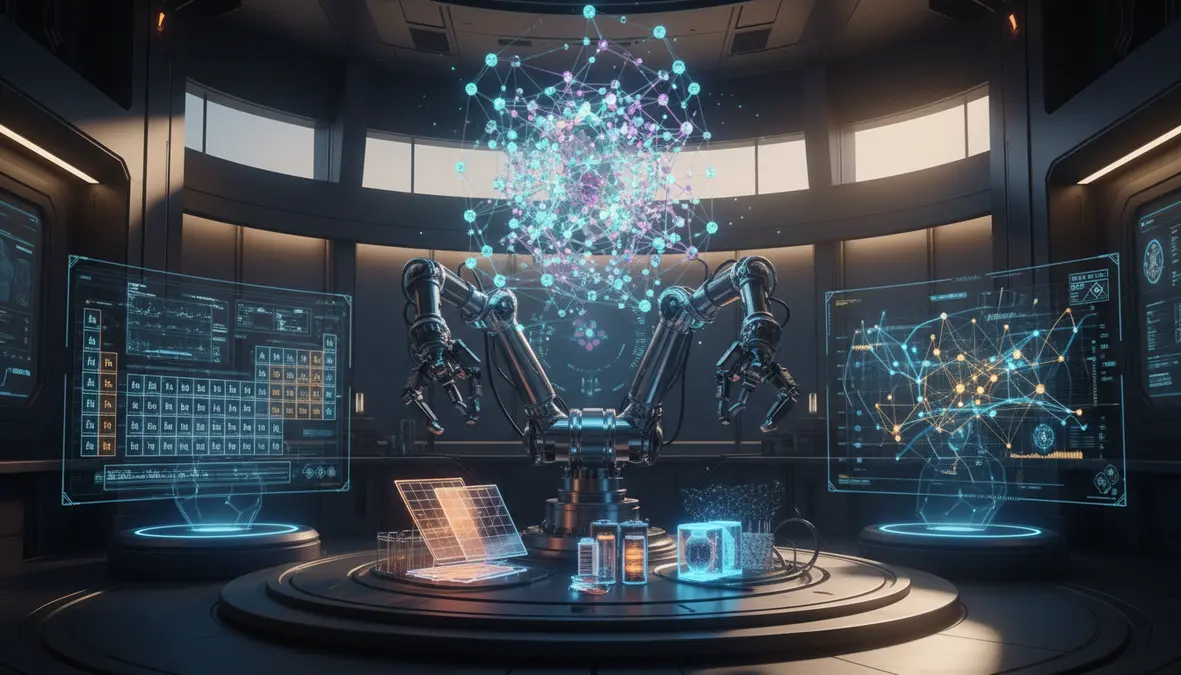
Predictions on a server are nice. Real materials require real synthesis — and that's where the second pillar of the 2026 stack comes in. Lawrence Berkeley National Laboratory's A-Lab stunned the field in 2023 by autonomously synthesizing 41 of 58 GNoME-suggested targets in 17 days with zero human intervention; by 2026 the platform and its descendants — Argonne's Polybot, the University of Toronto's Acceleration Consortium, IBM RoboRXN, the National Renewable Energy Laboratory's autonomous PV cell line, and commercial cloud labs at Strateos and Emerald — run continuous design-build-test-learn cycles around the clock. A model proposes a candidate, the robot synthesizes it, in-situ XRD and Raman characterization measure what came out, and the result feeds back into the model before morning coffee.
"For decades we accepted that finding a new battery cathode took ten years and ten million dollars. The combination of generative models and autonomous synthesis is collapsing that to weeks and a fraction of the cost — and we're only at the beginning."
Where AI Materials Are Already Earning Their Keep
The 2026 production landscape is no longer slideware. Real products and real money are flowing on the back of AI-discovered materials:
| Domain | AI-Discovered Material Class | Where It Shows Up in 2026 |
|---|---|---|
| Batteries | Solid-state lithium and sodium electrolytes, low-cobalt cathodes | QuantumScape, Solid Power, Sila Group14, and CATL pilot lines built on AI-screened conduction-pathway candidates |
| Solar | Tandem perovskite-silicon absorbers, lead-free perovskites | Oxford PV, First Solar, and LONGi tandem cells crossing 30% efficiency using AI-narrowed compositions |
| Catalysis | Green hydrogen OER catalysts, CO2-to-fuel reduction catalysts | Open Catalyst Project descendants powering Plug Power, Topsoe, and Twelve electrolyzer and reactor designs |
| Carbon Removal | Amine-grafted MOFs and zeolites for direct air capture | MatterGen-screened sorbents tested at Climeworks, Heirloom, and 1PointFive Stratos |
| Semiconductors | High-mobility 2D materials, low-k interconnect dielectrics | TSMC, Samsung, and Intel materials roadmaps incorporating AI-screened atomic stacks for 1.4 nm and 1 nm nodes |
| Magnetic & Quantum | Rare-earth-free permanent magnets, candidate room-temperature superconductors | Niron Magnetics, Toyota R&D, and a renewed wave of high-Tc searches after the LK-99 episode reset the field's discipline |
The Bottlenecks Aren't Where You'd Think
The 2026 challenges are no longer about the models. Universal potentials are accurate, generative models hit narrow property windows, and benchmarks like Matbench and MatBench Discovery have professionalized evaluation. The bottlenecks have moved downstream. Synthesis remains hard: a model can propose a metastable phase that's simply impossible to make at room temperature with available precursors. Scale-up is harder: a milligram of a brilliant new cathode is not a gigafactory. Data quality bites: public DFT data has well-known systematic errors that propagate through trained models, and proprietary corporate databases stay locked behind NDAs.
The community is responding with FAIR materials data initiatives (Materials Cloud, NOMAD, JARVIS-DFT), open benchmarks for both prediction and synthesis success, and a growing acceptance that the most important model is the one running inside an autonomous lab — not the one with the lowest mean absolute error on an offline test set.
A Practical AI Materials Adoption Guide
- Anchor on a property, not a structure. The win is "we need an electrolyte with 10 mS/cm ionic conductivity and a 4.5 V stability window" — not "let us screen 10,000 garnets."
- Pair generation with simulation. Generators alone hallucinate. A universal potential like MACE-MP-0 or Orb-v2 should validate every candidate before it leaves the GPU.
- Close the loop fast. An overnight cycle of propose-synthesize-characterize beats a six-month one a hundred times over. Cloud labs make this possible without building one yourself.
- Mind the synthesizability gap. Train a synthesizability classifier alongside the property model. A material you cannot make is a material you do not have.
- Build the data flywheel. Every characterization result, success or failure, is more valuable than the candidate itself. FAIR-format your outputs from day one.
The Decade of Decision-Grade Materials
Materials are the substrate of every other technology — better batteries enable electrification, better catalysts enable green hydrogen, better magnets enable smaller motors, better semiconductors enable more compute. For the entire industrial era, materials progress has been the slowest layer of the stack. AI-driven discovery is, for the first time, making it competitive with the rate of progress in software and silicon. The implications are quietly enormous: every climate-tech roadmap, every defense roadmap, every consumer-electronics roadmap that assumed multi-decade materials timelines is now front-loaded by a factor of five or ten.
The next breakthrough material in your phone, your car, or the grid feeding your data center is not going to be found by accident in a graduate lab. It is going to be proposed by a model, synthesized by a robot, and shipped to a fab before the team that funded it even publishes the paper. That is the new shape of materials science — and 2026 is when the practice has decisively moved past the proof of concept.