Generative Music AI: How Suno v5, Udio, ElevenLabs Music, and Stable Audio Are Reshaping Sound Creation in 2026
- Internet Pros Team
- May 6, 2026
- AI & Technology
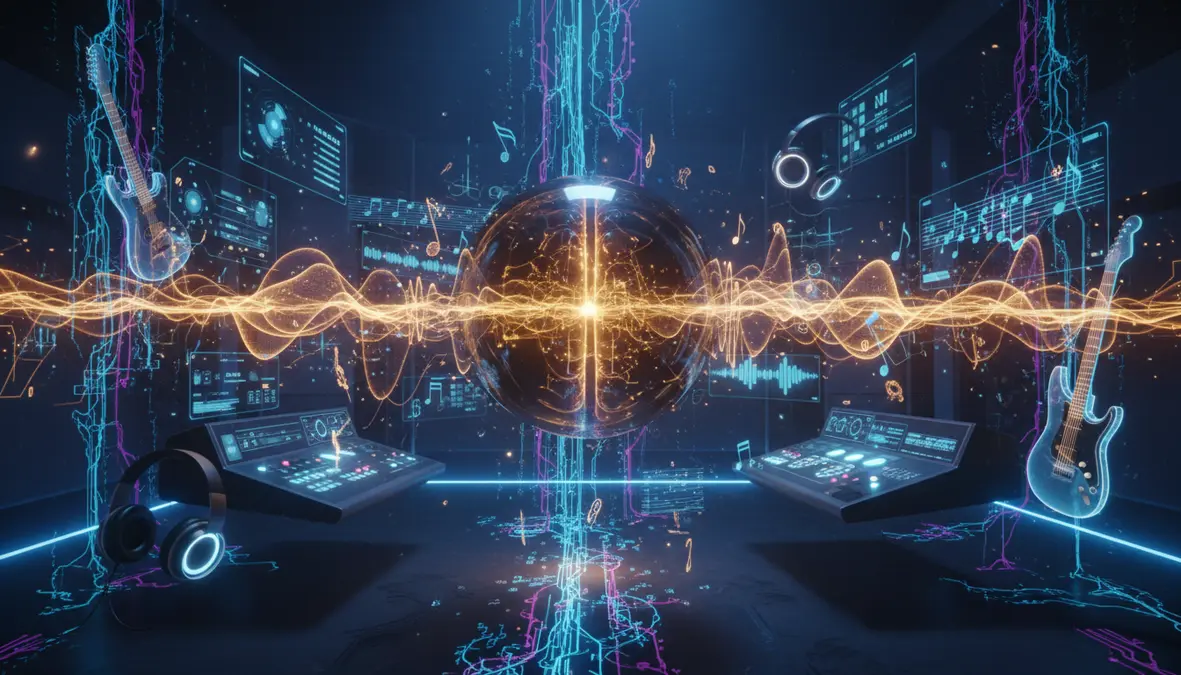
In May 2026, you can hum a melody into a phone, type the words "moody synthwave with a soaring bridge and female vocals in Spanish," and have a fully mastered, three-minute song — drums, bass, vocals, harmonies, mixing — appear on your screen ninety seconds later. The technology that delivers this, generative music AI, has crossed from novelty to working creative tool faster than almost any AI category in history. Suno v5, Udio v2, ElevenLabs Music, Stable Audio 2.5, Google Lyria 2, and Meta MusicGen are now embedded in indie producers' workflows, advertising agencies' pitch decks, podcast intros, video-game soundtracks, and the back catalogs of major labels — quietly reshaping a $30 billion industry that, only two years ago, treated AI as an existential threat to be litigated rather than a tool to be adopted.
From Demos to Albums in 24 Months
In early 2024, the best AI music tools could produce 30-second clips of acceptable quality if you accepted off-key vocals and a faint metallic sheen on the high end. By the end of 2025, Suno v4 and Udio v1.5 had pushed full-song generation past the threshold where casual listeners stopped noticing the seams. The 2026 cohort — Suno v5, Udio v2, ElevenLabs Music — broke the remaining ceilings. Vocals are intelligible and emotionally appropriate. Mixes have proper headroom. Songs follow real arrangement conventions: intros, verses, choruses, bridges, outros. The output goes straight into a DAW and survives mastering without obvious tells.
The technical leap came from three converging advances: latent diffusion on long audio sequences (Stable Audio Open and Stable Audio 2.5 pioneered minute-scale coherent generation), flow-matching audio decoders that produce 48 kHz stereo without the artifacts of older neural vocoders, and music-specific transformer language models that learn structure tokens — section markers, key changes, dynamics — alongside raw audio tokens. Combined, they let a single text prompt control everything from the genre fingerprint to the lyrics to the engineering choices.
Full-Song Text-to-Music
Suno v5, Udio v2, and Lyria 2 generate complete 3-4 minute tracks with verses, choruses, and bridges from a single prompt — instruments, vocals, and mixing all included.
Stems and Editability
Modern systems output separate vocal, drum, bass, and instrument stems — letting producers swap parts, retune vocals, or remix sections without regenerating the whole track.
Style Transfer and Refinement
Upload a reference track or hum a riff and the model produces variations, extends sections, or matches an existing arrangement to a new genre — turning generation into an iterative dialogue.
The 2026 Generative Music Landscape
A handful of platforms now dominate the working-producer market, each with a different bet on where the value lies — full-song generation, stems and editability, integration into pro tools, or open weights for self-hosting.
| Platform | Strength | Where It Fits in 2026 |
|---|---|---|
| Suno v5 | Full-song generation, vocals, accessibility | The mass-market favorite — clean lyrics, strong choruses, fast iteration; powers TikTok soundtracks, podcast jingles, and millions of indie demos |
| Udio v2 | Audio fidelity, prompt nuance, extension | Loved by producers for its texture and the "extend" feature that lets you grow a song section by section under tight creative control |
| ElevenLabs Music | Vocal realism, multilingual lyrics | Built on the same speech-synthesis stack as ElevenLabs voice — strongest at convincing solo vocals and code-switching across languages |
| Stable Audio 2.5 | Open weights, instrumental focus, sound design | Stability AI's open model — favored by sound designers, game studios, and self-hosting shops that need control over training data and output rights |
| Google Lyria 2 / DeepMind | Quality + provenance, YouTube integration | Powers YouTube Dream Track and Music AI Sandbox; every output watermarked with SynthID-Audio for traceability |
| Meta MusicGen / AudioCraft | Open research, instrumental and short-form | Open-source baseline that drives most academic and indie research on top of LLaMA-Audio backbones |
| Riffusion | Real-time loop and groove generation | Live-performance-friendly latent diffusion model; integrated into Ableton Live 13 via Max for Live as a real-time idea engine |
| iZotope / LANDR | AI mixing, mastering, vocal repair | Production-side AI: Ozone 12, RX 11, and LANDR Mastering finish AI-generated tracks to broadcast standards in seconds |
How Producers Actually Use Generative Music in 2026
The industry narrative oscillates between "AI replaces musicians" and "AI is just a fad." Neither matches what is happening in working studios. Real workflows look more like the early days of sampling: a creative-control tool that compresses certain steps and frees up time and budget for the parts a human still does best.
- Idea generation. A songwriter feeds a chord progression or a mood prompt into Udio, gets thirty starting points in an afternoon, and picks one to develop the long way — with real instruments, real vocals, real arrangement decisions.
- Demo to client. Ad agencies and indie game studios used to wait three weeks and pay $5,000 for a custom track demo. They now generate ten options in an hour, pick a direction, and license a final track from a human composer or commission a stems-replaced AI track under proper rights.
- Library and sync. Production-music libraries like Epidemic Sound, Artlist, and Soundstripe now serve millions of AI-generated cues with cleared training data — turning "background music for YouTube" into a near-zero-marginal-cost commodity.
- Vocal augmentation. Singers clone their own voice (with consent and watermarking) to extend takes, harmonize across octaves they cannot reach, or sing in languages they do not speak — opening global markets without losing artistic identity.
- Sound design and game audio. Stable Audio 2.5 and MusicGen power adaptive in-game music systems that respond to player state in real time — something pre-baked stems could only approximate.
"AI music generation is not the end of musicians — it is the end of the line between composer, producer, and listener. In 2026, anyone with a feeling and a phone can ship a song. The musicians who win are the ones who treat the model as their newest, weirdest, most prolific collaborator."
The Copyright Reckoning
The law has not been quiet. The RIAA's 2024 lawsuit against Suno and Udio over alleged unauthorized training on copyrighted recordings reached partial settlement in late 2025: both companies now disclose training-data policies, license major-label catalogs through new collective frameworks similar to ASCAP/BMI, and route a share of revenue back to rights holders. Stability AI signed a separate licensing deal with the Society of Composers and Lyricists. Meta and Google built their music models almost entirely on licensed and synthetic data after the 2024 European Copyright Directive transparency rules took effect.
For users, the practical impact is that commercial-grade AI music in 2026 generally comes with cleared training data and explicit license terms for output use. The "is this song safe to ship" question, which paralyzed brands and platforms in 2024, now has straightforward answers — provided you stay on the licensed side of the line and avoid prompts that explicitly imitate living artists' protected styles.
Watermarking, Attribution, and the Authenticity Problem
Even with clean training data, the question "did a human or a model make this?" has not gone away. The 2026 answer combines two layers: imperceptible watermarks (Google SynthID-Audio, Meta AudioSeal, OpenAI audio provenance) embedded into every generated waveform, and C2PA Content Credentials for audio attached as cryptographically signed manifests in standard audio container formats. Streaming platforms — Spotify, Apple Music, YouTube Music, Tidal — now read these manifests and surface a small AI-generated badge to listeners, similar to the "verified" check on social platforms.
The watermarking is not bulletproof. Re-encoding, time-stretching, and aggressive mastering can attenuate the signals, and adversarial removers exist. But for the dominant case — tracks moving from generation tools into mainstream distribution — the chain of custody is finally legible enough to underpin policy decisions about royalties, eligibility for songwriting awards, and platform monetization tiers.
The Money: Where Generative Music Actually Earns
Generative music in 2026 monetizes across four main channels:
- Subscription tools. Suno, Udio, and ElevenLabs Music collectively count more than 25 million monthly active users on consumer plans, plus enterprise tiers with cleared catalogs and indemnification.
- Sync and stock libraries. Epidemic Sound, Artlist, and Soundstripe license millions of AI-assisted tracks per year for video, podcasts, and ads.
- Game and adaptive audio. AAA studios and live-service mobile games license real-time generative engines (Riffusion, Stable Audio) for dynamic soundtracks.
- Streaming royalties for AI-assisted human releases. Most actual hits using AI tools are credited to human artists with AI as a production aid — they collect normal royalty splits via PRO membership.
The Limits of the Model Today
For all the progress, current systems still struggle with a few things. Long-form structural coherence — a song that genuinely develops a motif across five minutes — remains hard; most outputs feel great in chunks but generic across the arc. Specific lyrical content with real narrative complexity often produces hollow lines that pass at first listen but rarely survive a second. Studio-quality acoustic performances — a solo piano with the touch of a great pianist, a string quartet with breathable phrasing — sit just outside the current frontier. And, perhaps most importantly, AI music has no taste. It will happily produce a thousand competent songs, but the curation step — what to make, what to keep, when to stop — is still a human job.
A Practical Generative-Music Decision Guide
- Indie songwriter / hobbyist? Start with Suno v5 ($10/month) for full songs or Udio for finer control. Both deliver shareable results in minutes; export stems for further work in any DAW.
- Producer or composer? Use Udio v2 or ElevenLabs Music for ideation, then bring stems into Logic Pro, Ableton Live, or FL Studio. Master with iZotope Ozone 12 or LANDR.
- Brand, agency, or content studio? Choose a platform with clear training-data licensing and indemnification — Suno Pro, Udio Studio, Lyria via YouTube, or licensed library partners like Epidemic Sound and Artlist.
- Game or app developer? Stable Audio 2.5 (open weights) or Riffusion for adaptive in-engine generation; reserve Suno/Udio for marketing and trailer work.
- Publishing or rights holder? Engage on the new collective licensing frameworks and require Content Credentials and SynthID-Audio on every commercial release.
The New Shape of the Music Industry
Music has lived through this story before. Multitrack tape did not kill orchestras; sampling did not kill drummers; auto-tune did not kill vocalists; bedroom DAWs did not kill professional studios. Each wave compressed certain costs, decentralized certain skills, expanded the universe of people who could participate, and ultimately created more music — and more good music — than the era before. Generative music AI is the same kind of shift, accelerated by an order of magnitude.
In 2026, the most interesting work is happening at the seams: human songwriters using AI to chase ideas faster, AI-native artists building catalogs no human team could finish, hybrid releases where the line between performer and prompter dissolves entirely. The platforms with the cleanest training data, the best stems, the best DAW integrations, and the most credible artist partnerships are pulling ahead. The labels that fought hardest two years ago are now signing the producers using these tools the most. The question is no longer whether AI belongs in music; it is what kind of music it helps us make.