AI Protein Design in 2026: How AlphaFold 3, RFdiffusion, ESM3, Boltz-1, and Chai-1 Are Creating New Proteins From Scratch
- Internet Pros Team
- May 18, 2026
- AI & Technology
For half a century, the central problem of molecular biology was reading proteins: given the amino acid sequence, what shape does the molecule fold into? In 2020, AlphaFold 2 effectively closed that problem. In 2026, the field has moved on to a much harder and far more useful question — writing proteins. Given a function you want, design a molecule that performs it. AlphaFold 3 from Google DeepMind and Isomorphic Labs now predicts protein complexes with DNA, RNA, ions, and small-molecule drugs. RFdiffusion from the Baker lab at the University of Washington generates new proteins around any binding pocket you sketch. ESM3 from EvolutionaryScale treats proteins as a language and can write new ones at scale. Boltz-1 from MIT and Chai-1 from Chai Discovery have made an open-source AlphaFold 3-class model available to anyone with a GPU. Together, they are turning protein engineering from a multi-decade craft into a software workflow that runs overnight — and quietly rewriting the economics of drug discovery, vaccines, enzymes, and materials.
From Predicting Nature to Designing It
Until 2020, predicting a protein's 3D structure from its sequence was a grand challenge that consumed entire PhDs. AlphaFold 2 reduced that problem to a 10-minute API call. But predicting nature is only half the story. The dream — and the commercial prize — is the reverse direction: starting from a function and asking the model to design a protein that performs it. De novo design means inventing molecules that have never existed in biology, optimized for binding affinity, stability, solubility, or catalytic activity in ways evolution has not bothered to discover.
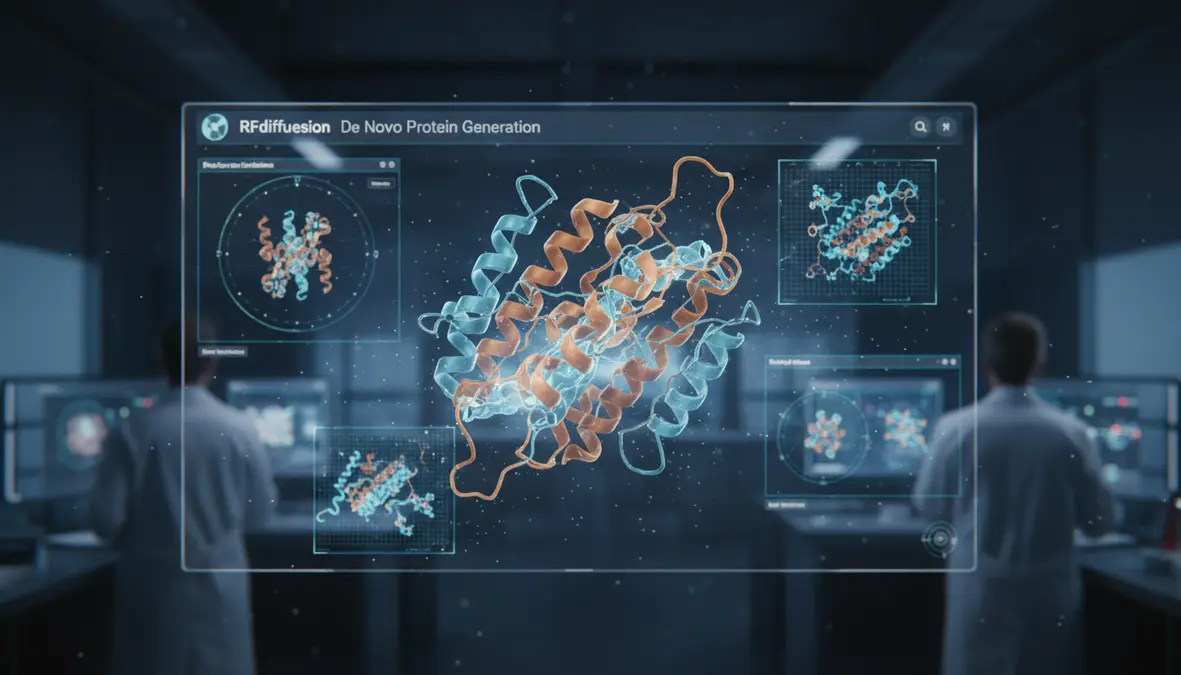
In 2026 that has finally arrived at production quality. Diffusion-based generators like RFdiffusion can be conditioned on a target shape (the surface of a virus, the active site of an enzyme, a small-molecule pocket) and asked to hallucinate a protein scaffold that binds it. ProteinMPNN, the sister model from the same lab, then writes the amino acid sequence that will physically fold into that shape. The two together compose a true generator: shape in, sequence out, ready for the wet lab.
"What took us five years of directed evolution in 2015, we now get on the first round of RFdiffusion plus ProteinMPNN. The molecule comes out of the printer expressing, folded, and binding the target. The bottleneck has fully moved from design to validation."
The Models That Define 2026
| Model / Lab | What It Does | Where It Wins |
|---|---|---|
| AlphaFold 3 (Google DeepMind / Isomorphic Labs) | Predicts complexes of proteins with DNA, RNA, small molecules, ions, and post-translational modifications. The AlphaFold Server runs it free for academic use. | Highest-accuracy structure prediction for full biomolecular assemblies. The default tool for drug-target complex modeling. Isomorphic's commercial pipeline runs on AlphaFold 3 internally with Novartis and Eli Lilly partnerships. |
| RFdiffusion + ProteinMPNN (UW IPD / Baker Lab) | SE(3)-equivariant diffusion model that generates new protein backbones around a target, paired with ProteinMPNN to assign sequences. Open source under a permissive license. | De novo binder design. The 2024 Nobel Prize work that produced novel COVID binders, snake venom antitoxins, and influenza neutralizers on demand. The default open-source design engine. |
| ESM3 (EvolutionaryScale) | Multimodal protein language model trained on sequence, structure, and function simultaneously. Generates new functional proteins by prompting in any of the three modalities. | Scale and zero-shot reasoning over the protein universe. ESMFold runs structure prediction with a single sequence — no MSA required — at 60x AlphaFold's speed for metagenomic-scale screens. |
| Boltz-1 (MIT) | An open-weights, AlphaFold 3-class structure prediction model released under the MIT license in late 2024 and refined through 2026. | Open science access to AlphaFold 3-quality predictions without the AlphaFold Server's commercial restrictions. The model academic labs and biotech startups actually deploy. |
| Chai-1 (Chai Discovery) | Multimodal structure prediction with strong protein-ligand and antibody-antigen accuracy, open for non-commercial use with a commercial tier for enterprise. | Antibody design and small-molecule docking. The fast-moving startup challenger reaching AlphaFold 3 parity on docked complexes — heavily used by the antibody discovery industry. |
| Chroma (Generate Biomedicines) | Diffusion-based programmable generator that emits proteins matching arbitrary natural-language and symmetry constraints. Backs an industrial-scale therapeutic pipeline. | Pharmaceutical-grade de novo therapeutics. Generate's Amgen, Novartis, and BMS partnerships fund clinical candidates emerging directly from Chroma generations. |
What This Actually Changes in the Pipeline
The classical biotech timeline ran roughly six years from target identification to a clinical candidate molecule. AI protein design compresses two pieces of that timeline so hard they nearly disappear: hit discovery and lead optimization. Where directed evolution used to require thousands of screening rounds in a yeast or phage display library, a 2026 in-silico campaign generates ten thousand candidate binders overnight, ranks them with an AlphaFold 3 / Boltz-1 structural filter, and ships the top fifty to a cloud lab for synthesis. Two weeks later the wet results come back, and the best three feed back into the next design loop.
Antibody and Vaccine Design
Computationally designed mini-protein binders are now in clinical trials for influenza, RSV, and SARS-CoV-2. AI-designed nanoparticle vaccines presenting RFdiffusion-engineered immunogens are emerging as a faster, more thermostable alternative to mRNA for cold-chain-limited geographies.
Enzyme Engineering
From FAST-PETase variants that depolymerize plastic at scale, to engineered carbonic anhydrases for carbon capture, to redesigned nitrogenases for ammonia synthesis without the Haber-Bosch process — AI is producing industrial enzymes that took decades of directed evolution in months of compute.
Gene Therapy Delivery
Designer AAV capsid variants engineered with ESM3 and ProteinMPNN are reaching brain, muscle, and eye tissues that natural serotypes cannot. The 2026 gene therapy startups racing into rare disease all rely on AI-redesigned capsids as their delivery platform.
Materials and Biomanufacturing
Self-assembling protein nanocages, spider-silk variants, and biosensor scaffolds designed end-to-end in silico are entering pilot manufacturing. Lab-grown meat scaffolds, designer caseins for animal-free dairy, and computationally evolved fermentation enzymes are all 2026 commercial products.
The Hard Problems Still Open
Function is harder than shape. Predicting a static 3D structure is solved. Predicting whether a designed protein will actually do its catalytic, allosteric, or signaling job once it lives in a cell is not. Dynamics, conformational ensembles, and the chaos of intracellular biology remain hard. ESM3 and Chroma are starting to attack function directly, but the field is one or two generations away from sequence-to-function being as reliable as sequence-to-structure.
The wet lab is still the rate limit. Computational throughput is now effectively unlimited; you can generate a million candidate binders before lunch. The bottleneck is making and testing them. Cloud-lab platforms like Emerald Cloud Lab, Strateos, and Ginkgo Bioworks are sprinting to industrialize the synthesis-screen-feedback loop, and self-driving laboratories — robots that close the loop between AI design and physical assay without human hands — are where the next ten years of pharma productivity gains will come from.
Biosecurity is the elephant. The same models that design therapeutic binders against a viral spike can, in principle, design enhanced pathogens or selective toxins. The 2025 White House and EU AI Act bioweapon-screening requirements, the International Gene Synthesis Consortium's synthesis screening protocols, and Anthropic and OpenAI's biology-specific safety evaluations are an early, imperfect attempt at a regulatory perimeter. Open-weights protein models are a dual-use technology, and the field has not yet converged on what responsible release looks like.
What AI Protein Design Means for Businesses in 2026
- Drug discovery is becoming a software discipline. Biotech startups with no wet lab can now ship a hit-to-lead campaign on cloud-lab APIs and open-source models. Capital efficiency in early-stage therapeutics has fundamentally changed.
- The data moat is the new defensible asset. The models are open source. What is not open is your high-quality, target-specific experimental data — DMS scans, binding affinities, expression data. Companies that have generated proprietary biology data are suddenly the most valuable AI players in the sector.
- Industrial enzymes are the under-hyped story. Beyond pharma, AI-designed enzymes are quietly disrupting plastics recycling, food production, carbon capture, and specialty chemicals. The ROI clock is shorter and the regulatory bar lower than for therapeutics.
- Compute matters less than you think. Most production protein design jobs run on a handful of H100s. The CapEx story here is not a 100,000-GPU cluster — it is the wet-lab automation, robotics, and assay throughput downstream of the model.
- Plan for the biosecurity conversation now. If your company uses generative biology, expect screening obligations, audit trails, and dual-use disclosures to land as binding requirements within 18 months. Build the compliance scaffolding before regulators arrive.
Where the Field Goes Next
The 2027 horizon is dominated by three convergences. First, function prediction finally catches up with structure prediction — ESM3-style multimodal models that reason simultaneously about sequence, structure, dynamics, and biological role will collapse another step of the discovery pipeline. Second, self-driving laboratories close the loop: AI proposes the molecule, robots synthesize it, automated assays test it, and the result flows back into the model overnight, without a graduate student in the loop. Third, the "foundation model for biology" race extends from proteins to nucleic acids, cells, and tissues. Companies like Tahoe Therapeutics, Inceptive, and Recursion are training models on RNA, cell-state, and whole-organism data with the same scaling-law playbook that produced AlphaFold 3.
Half a century after Christian Anfinsen first asked how a protein knows how to fold, the answer has stopped being interesting on its own. The interesting question now is how fast we can write new ones, what we choose to make them do, and how we govern a technology that turns the molecular machinery of life into an addressable design space. In 2026, biology has become — for better and worse — a programmable medium. The decade ahead belongs to whoever learns to program it best.