Space-Based Solar Power in 2026: How Caltech SSPD, JAXA OHISAMA, ESA SOLARIS, and China's Bishan Project Are Beaming Gigawatts of Clean Energy From Orbit
- Internet Pros Team
- May 20, 2026
- AI & Technology
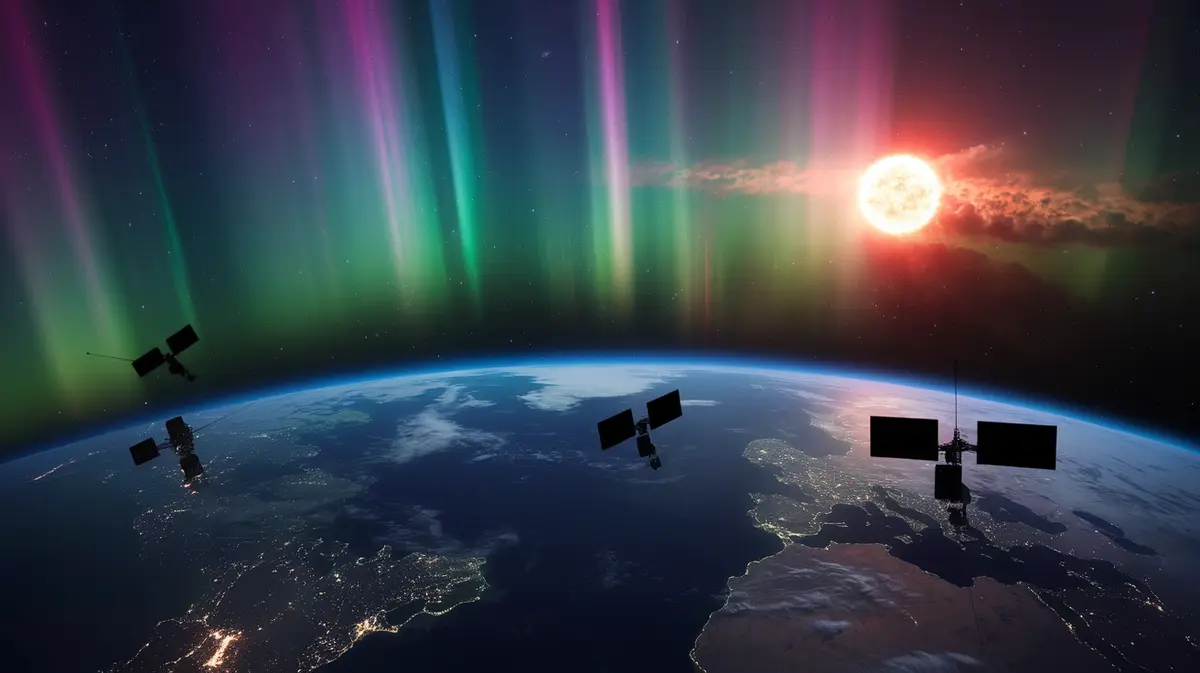
For sixty years, space-based solar power (SBSP) was a thought experiment. In 2026, it is a public roadmap. Caltech's Space Solar Power Demonstrator (SSPD-1) has already beamed measurable wireless power from low Earth orbit to a rooftop in Pasadena. JAXA's OHISAMA mission has demonstrated a 1-kilowatt orbital-to-ground microwave transmission to a Yokohama receiving site. The European Space Agency's SOLARIS programme has moved into a multi-hundred-million-euro preparatory phase. China's Bishan project is building a two-kilometer ground-based test array, and a new generation of startups — Aetherflux, Virtus Solis, Star Catcher Industries, Space Solar UK — is racing to commercialize the architecture. The trigger is no longer physics; it is launch cost. With SpaceX Starship driving cost-to-orbit toward $200 per kilogram, the financial barrier that killed SBSP in the 1970s has finally collapsed.
Why Solar Power Belongs in Space
A photovoltaic panel on the ground spends most of its life producing nothing. It is dark for half the day, dimmed by weather, attenuated by atmosphere, and angled wrong for two-thirds of the hours it does see the sun. The same panel parked in geostationary orbit sees the sun for 99% of the year, with no clouds, no night, and roughly 40% more solar flux reaching the cell. The capacity factor jumps from 20–25% on the best terrestrial sites to better than 95%, and the output becomes baseload — the holy grail of decarbonized grids.
The remaining engineering problem is no longer "how do we collect the power" but "how do we get it down." That is what every active SBSP program in 2026 is actually demonstrating: efficient, safe, kilometer-scale wireless power transmission from orbit to a fixed ground station.
"For the first time in the history of this field, every line in the cost model points the right direction at the same time. Launch is collapsing, photovoltaic mass-per-watt is collapsing, GaN amplifier efficiency is climbing, and grid prices for clean firm power are climbing. The window has opened."
The Active SBSP Programs in 2026
| Program / Lead | Architecture | What It Has Demonstrated |
|---|---|---|
| Caltech SSPD-1 (MAPLE + DOLCE) | Lightweight tile-based modular satellite, retrodirective phased-array microwave beaming, ultralight deployable structure | The first in-space-to-ground microwave power transfer (MAPLE, 2023) and continued on-orbit validation through 2025 of beam steering, tile-level efficiency, and ultralight DOLCE structure deployment. The academic reference architecture. |
| JAXA OHISAMA | 1 kW class LEO microwave beaming testbed at 5.8 GHz, ground rectenna near Tokyo | Japan's decade-long SSPS roadmap reached its in-orbit demonstration milestone. OHISAMA has closed the loop on satellite-to-ground transmission with measurable, calibrated DC output at the rectenna. |
| ESA SOLARIS | Preparatory programme funding industrial studies (Thales Alenia Space, Airbus, Frazer-Nash, Arthur D Little), CASSIOPeiA helix design from Space Solar UK | Moved through Council approval into the implementation track. SOLARIS is Europe's policy commitment that SBSP becomes a candidate for the 2030s energy mix, with a planned in-orbit demonstrator in the late 2020s. |
| China Bishan / CAST | Two-kilometer ground-based microwave transmission test, with a planned megawatt-class orbital demonstrator on Long March 9 | The most aggressive national timeline. The Chongqing Bishan test site has validated long-range ground beaming and is treated by the government as a strategic energy program, not a science experiment. |
| Northrop Grumman SSPIDR / AFRL Arachne | "Sandwich tile" modules combining PV, RF generation, and a transmit antenna in a single panel for the US Air Force | The US Department of Defense's SBSP track, focused on beaming power to forward operating bases and expeditionary forces. Arachne is the planned flight experiment, building on NRL's PRAM hardware aboard X-37B. |
| Aetherflux (Baiju Bhatt) and Virtus Solis | Laser power beaming (Aetherflux) and small-satellite GEO microwave constellation (Virtus Solis), targeting near-term commercial demonstrations | The Silicon Valley track. Backed by founders' capital and seed-stage VC, these startups are skipping the GW super-station architecture and aiming at first-revenue demos in the 1-10 kW range within three years. |
How Power Gets From Orbit to the Grid
An SBSP satellite is, at heart, three things stacked on top of each other: a photovoltaic surface that turns sunlight into DC, a solid-state RF or laser conversion stage that turns DC into a coherent beam, and a retrodirective phased array that points the beam precisely at a ground receiver locked onto a pilot tone broadcast from the rectenna. On the ground, a rectenna — a sparse grid of small rectifying antennas spread across roughly five kilometers — converts the incoming microwaves back into DC at roughly 85% efficiency, which then feeds an inverter and HVDC link into the grid.
Microwave Beaming (2.45 / 5.8 / 10 GHz)
The dominant approach. Microwave bands pass through clouds and rain with minimal loss, and GaN solid-state amplifiers have hit 70–80% DC-to-RF efficiency. Beam intensity at the ground is kept below the levels safe for people, aircraft, and migrating birds. Caltech, JAXA, and SSPIDR are all microwave-first.
Laser Power Beaming
Aetherflux's wager. Infrared lasers paired with high-efficiency PV receivers shrink the ground footprint dramatically — a backyard-sized receiver instead of a five-kilometer rectenna — but add a hard weather constraint and a regulatory question about high-intensity orbital lasers crossing controlled airspace.
Sandwich-Tile Modular Design
The architecture pioneered by John Mankins' SPS-ALPHA and refined in Northrop's SSPIDR. Each tile is a self-contained PV+RF+antenna unit. Multiply by hundreds of thousands and a gigawatt-class satellite assembles itself on-orbit from identical mass-produced modules — the only economically viable path to scale.
In-Space Assembly
A 2 GW satellite cannot be launched on a single rocket. It is assembled in orbit by robotic servicers — the same in-space assembly and manufacturing (ISAM) technologies NASA, Northrop SpaceLogistics, and Redwire are flying for satellite servicing. SBSP and on-orbit construction are the same supply chain.
The Hard Problems That Remain
Launch is still the line item. Even at $200/kg to LEO, a gigawatt satellite is millions of kilograms of hardware. Without Starship-class fully-reusable super-heavy launch at scale, the SBSP cost curve does not close. Every active program in 2026 is implicitly betting that Starship — or its Chinese and European equivalents — will deliver routine $100-200/kg launch by 2030.
The rectenna footprint is real. A five-kilometer-diameter ground array is land-intensive. The good news: it is sparse, low-rise, and compatible with agriculture or grazing underneath — the early agrivoltaics-under-rectenna studies look encouraging. The bad news: siting one near a major load center will still face the same NIMBY and environmental-review marathon as any large energy project.
Spectrum and beam safety. A 1-10 GW microwave beam is, by design, well below thermal-injury thresholds at the ground — but it sits in spectrum that air-traffic radars, ham radio, and unlicensed ISM devices already use. The ITU coordination, FCC licensing, and ICAO airspace conversations are non-trivial and are happening now.
Competing clean-firm options exist. SBSP is not the only path to 24/7 carbon-free electricity. Small modular nuclear reactors, enhanced geothermal, long-duration storage, and overbuilt solar plus storage are all maturing on similar timelines. SBSP wins if launch costs collapse and a few of those alternatives stall. It loses if the opposite happens.
What Space-Based Solar Power Means for Energy Buyers in 2026
- SBSP is officially a roadmap item, not a fantasy. ESA, JAXA, the UK Department for Energy Security, the US DoD, and the Chinese government are all funding hardware on multi-year programs. Strategic planners need to include it as a 2035-onwards option.
- Launch cost is the single dial that matters. If you want to know whether SBSP closes economically, watch Starship's cadence and price-per-kg curve, not the satellite designs themselves.
- Hyperscalers are paying attention. Google, Microsoft, and Amazon have all signed long-duration "24/7 clean energy" commitments their grids cannot yet meet. SBSP and small modular reactors are the two technologies actively pitched into those procurements.
- Dual-use beaming opens near-term revenue. Beaming kilowatts to forward operating bases, disaster relief sites, and remote mines is a viable first market a decade before any gigawatt civilian station. AFRL, Aetherflux, and Virtus Solis are all targeting it.
- Build the regulatory rails now. Spectrum coordination, airspace integration, environmental review, and beam-safety standards are the gating items for the 2030s. Utilities and operators should join the ITU, IEC, and IEEE working groups already drafting them.
The Road to a Gigawatt
The credible 2026-to-2035 trajectory looks like this. Through 2027, demonstration missions stack up — Caltech, JAXA, and the SSPIDR Arachne flight all close the loop on watt-to-kilowatt-scale orbital beaming. By 2028-2029, the first commercial demonstration satellites from Aetherflux, Virtus Solis, or Space Solar UK reach orbit, selling the first kilowatts of beamed power to early adopters — typically a defense customer or a remote industrial site. By 2030-2032, Starship-enabled launch makes the economics of a megawatt-class pilot satellite plausible, and the first ESA, Chinese, or US national pilot enters construction. The gigawatt-class commercial station is a late-2030s event, not a 2026 one — but every step of the curve from here to there is now identifiable hardware on a funded roadmap.
Sixty years after Peter Glaser sketched the first solar power satellite, the field has finally crossed the line from physically possible to economically conceivable. The decade ahead will decide whether orbital energy becomes a quiet workhorse of the decarbonized grid — or a cautionary tale about a beautiful idea that arrived just a little too late. For the first time, the answer looks like the former.