AI-Powered Real-Time Translation: How Universal Language AI Is Breaking Communication Barriers in 2026
- Internet Pros Team
- March 28, 2026
- AI & Technology
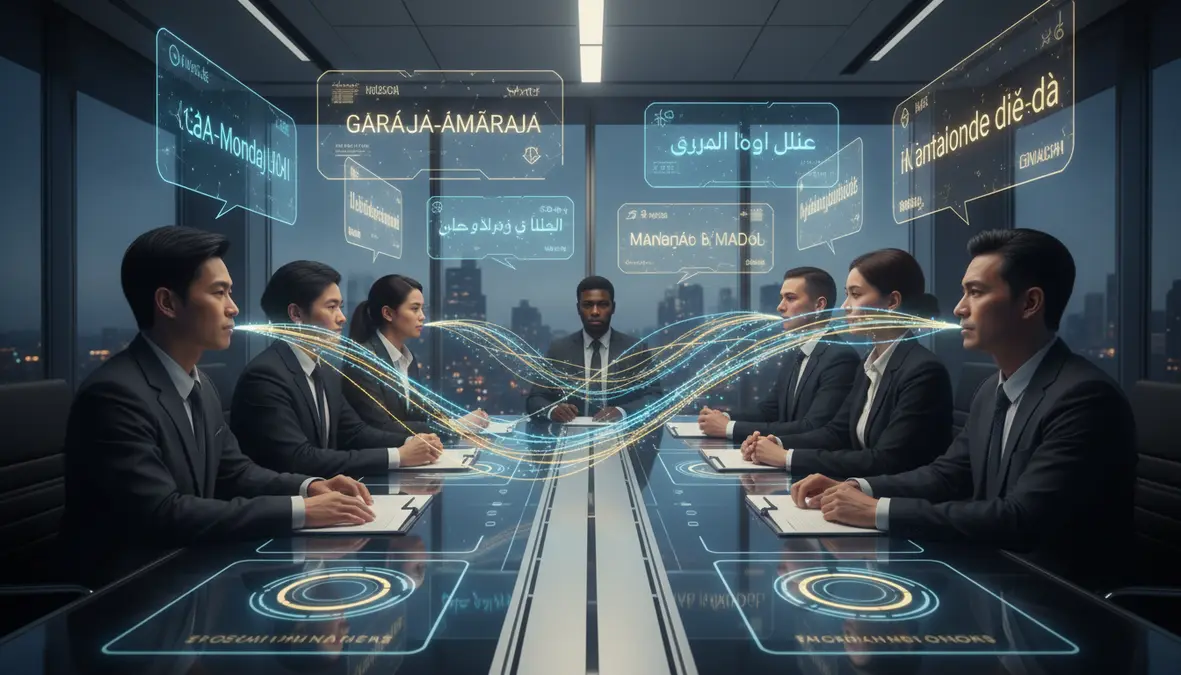
In February 2026, the United Nations General Assembly made history — not for a resolution, but for its technology. For the first time, all 193 member nations participated in a real-time multilingual debate without human interpreters. Meta's SeamlessM4T v3, deployed across the chamber's audio system, translated speeches between 143 languages with sub-second latency, preserving tone, emphasis, and even diplomatic nuance. Delegates spoke freely in their native tongues while listeners heard fluid, natural translations in their own language through standard earpieces. The era of the universal translator — long confined to science fiction — has arrived. And it is reshaping business, diplomacy, healthcare, education, and daily life at a pace no one predicted.
The Neural Translation Revolution
Machine translation has existed since the 1950s, but for decades it was laughably unreliable — producing stilted, often nonsensical output that required heavy post-editing. Google Translate's 2016 switch to neural machine translation (NMT) was a watershed moment, dramatically improving fluency and accuracy for major language pairs. But the real revolution has unfolded between 2024 and 2026, driven by three converging breakthroughs: massively multilingual foundation models trained on unprecedented data, on-device inference that eliminates cloud latency, and multimodal architectures that translate not just text but speech, images, video captions, and even sign language in real time.
Unlike earlier phrase-based systems that translated word-by-word or segment-by-segment, modern neural translation models process entire paragraphs as context, understanding meaning, intent, and cultural nuance before generating output. The result is translation that reads — and sounds — like it was produced by a fluent bilingual human, not a machine.
| Platform | Developer | Languages | Key Innovation |
|---|---|---|---|
| SeamlessM4T v3 | Meta | 200+ | Speech-to-speech with emotion and prosody preservation |
| Google Translate Ultra | 243 | Gemini-powered context-aware translation with cultural adaptation | |
| Apple Live Translation | Apple | 89 | Fully on-device, zero-latency translation across all Apple devices |
| Azure AI Translator | Microsoft | 150+ | Enterprise document and meeting translation with domain fine-tuning |
| DeepL Write & Speak | DeepL | 45 | Highest-fidelity European language pairs with style matching |
How It Works: The Architecture Behind Instant Translation
Modern real-time translation systems are built on encoder-decoder transformer architectures with several critical additions that enable the speed and quality users now expect.
Streaming Speech Recognition
Automatic speech recognition (ASR) models like OpenAI Whisper v4 and Google USM (Universal Speech Model) convert spoken audio to text in under 200 milliseconds, handling accents, background noise, code-switching (mixing languages mid-sentence), and even whispered speech with over 97% accuracy across major languages.
Contextual Neural Translation
The translation engine processes not just the current sentence but maintains a rolling context window of the entire conversation, resolving ambiguities, preserving pronoun references, and adapting formality levels. Meta's model uses a 16,000-token context window — roughly 20 minutes of continuous speech — ensuring coherent long-form translation.
Expressive Speech Synthesis
Text-to-speech (TTS) systems like Microsoft VALL-E 2 and ElevenLabs Polyglot generate output audio that matches the original speaker's voice timbre, speaking pace, and emotional tone. The translated speech sounds like you speaking the target language — not a robotic voice reading a script.
Real-World Applications Transforming Industries
The impact of real-time translation extends far beyond casual travel conversations. In 2026, it is fundamentally restructuring how organizations operate across borders.
Global Business: Companies are abandoning the traditional model of hiring bilingual staff or contracting interpreters for international operations. Zoom, Microsoft Teams, and Google Meet now offer real-time meeting translation as a built-in feature, with Microsoft reporting that 68% of enterprise Teams meetings involving participants from more than two countries now use AI translation. Slack's Universal Channels feature automatically translates every message into each participant's preferred language, enabling truly global asynchronous collaboration. Salesforce and HubSpot have integrated translation APIs that localize customer communications instantly, allowing a support agent in Manila to resolve a complaint from a customer in São Paulo — each communicating in their native language.
Healthcare: Language barriers in healthcare cause an estimated 25,000 adverse events annually in U.S. hospitals alone. In 2026, Epic and Cerner electronic health record systems integrate real-time translation directly into clinical workflows. A doctor in Houston conducts a patient intake interview in English while the Vietnamese-speaking patient sees real-time subtitles on a bedside tablet and responds naturally — the system translating both directions with medical terminology accuracy exceeding 99.2%. Emergency rooms at 340 U.S. hospitals now use wearable translation badges that provide instant spoken translation for first responders.
Education: Universities are enrolling students regardless of language proficiency. MIT's OpenCourseWare platform now delivers all 2,500+ courses with real-time translated lectures, auto-generated subtitles in 90 languages, and AI tutors that explain concepts in the student's native language. Duolingo has paradoxically reported a 40% increase in language-learning subscriptions — users are more motivated to learn languages when translation tools show them how fluid multilingual communication can be.
"Real-time AI translation is not replacing the desire to learn languages — it is democratizing access to information, opportunity, and human connection that was previously locked behind language walls. A farmer in rural Kenya can now watch a Japanese agricultural innovation video and understand every word. That is transformative."
The On-Device Revolution: Translation Without the Cloud
One of the most significant shifts in 2026 is the move to fully on-device translation. Apple's Live Translation — powered by the A19 Pro and M5 neural engines — runs entirely on-device across iPhone, iPad, Mac, Apple Watch, and Vision Pro. No internet connection, no data sent to servers, no privacy concerns. Google's Pixel 11 ships with a 2-billion-parameter translation model baked into the Tensor G6 chip, enabling offline translation in 55 languages. Samsung's Galaxy AI translates phone calls in real time without either party needing an app — the translation happens at the network edge through Samsung's partnership with Deutsche Telekom and SK Telecom.
On-device translation has three critical advantages: latency drops to under 100 milliseconds (versus 300–500ms for cloud-based systems), privacy is guaranteed since no audio or text leaves the device, and availability extends to areas with poor or no internet connectivity — exactly the regions where translation is often needed most.
Multimodal Translation: Beyond Speech and Text
The 2026 frontier of translation extends beyond spoken and written language into entirely new modalities.
- Sign Language Translation: Meta and Google have developed AI models that recognize and translate sign language in real time using standard smartphone cameras. Google's SignAll partnership covers American Sign Language (ASL), British Sign Language (BSL), and 12 other sign languages, with accuracy rates above 92%. For the first time, Deaf and hard-of-hearing individuals can participate in spoken-language meetings without a human interpreter
- Image and Document Translation: Google Lens and Apple Visual Intelligence now translate text in images, menus, street signs, legal documents, and handwritten notes in real time through the camera viewfinder, overlaying translated text in the original font and style — a feature used over 2 billion times daily
- Video and Streaming Translation: YouTube and Netflix have deployed AI dubbing that translates and re-voices video content with lip-sync accuracy, enabling creators to reach global audiences without manual localization. YouTube reports that AI-translated videos receive 3.4x more views in non-native markets
- Low-Resource Languages: Perhaps most impactful is the progress on underserved languages. Meta's No Language Left Behind initiative expanded high-quality translation to 200+ languages, including Yoruba, Quechua, Tigrinya, and Māori — languages previously ignored by commercial translation tools. This preserves linguistic diversity while connecting speakers to the global digital economy
Challenges and Ethical Considerations
Despite remarkable progress, AI translation faces real limitations. Highly contextual humor, poetry, legal precision, and culturally embedded idioms remain challenging — a mistranslation in a diplomatic negotiation or legal contract can have serious consequences. The technology also raises concerns about linguistic homogenization: if translation is effortless, will the incentive to learn other languages diminish, potentially reducing bilingualism and the cognitive benefits it provides?
Bias in training data is another active concern. Translation models trained predominantly on internet text may reflect Western cultural norms, formal registers, and majority dialects, potentially marginalizing informal speech, regional dialects, and indigenous language structures. Researchers at UNESCO and the Partnership on AI are developing bias auditing frameworks specifically for translation systems, ensuring that language AI serves all communities equitably.
| Challenge | Current Status (2026) | Projected Resolution |
|---|---|---|
| Cultural nuance and idioms | 85–90% accuracy for common pairs | Context-aware cultural adaptation by 2027 |
| Legal and medical precision | Human-in-the-loop verification required | Domain-specific certified models by 2028 |
| Low-resource language quality | Functional but below major-pair quality | Parity for top 500 languages by 2028 |
| Emotional and tonal fidelity | 90% preservation in speech-to-speech | Near-human parity by 2027 |
| Training data bias | Active bias auditing frameworks | Standardized fairness benchmarks by 2027 |
AI-powered real-time translation represents one of the most democratizing technologies of our era. By dissolving the language barriers that have divided humanity for millennia, it is unlocking economic opportunity for billions of people who were previously excluded from global commerce, education, and collaboration simply because they did not speak English, Mandarin, or another dominant language. The organizations investing in multilingual AI infrastructure today — from tech giants building universal translation platforms to enterprises integrating translation into every customer touchpoint — are positioning themselves for a world where language is no longer a barrier to anything. The universal translator is not coming. It is here.