AI-Powered Weather Forecasting: How Machine Learning Is Revolutionizing Climate Prediction in 2026
- Internet Pros Team
- April 5, 2026
- AI & Technology
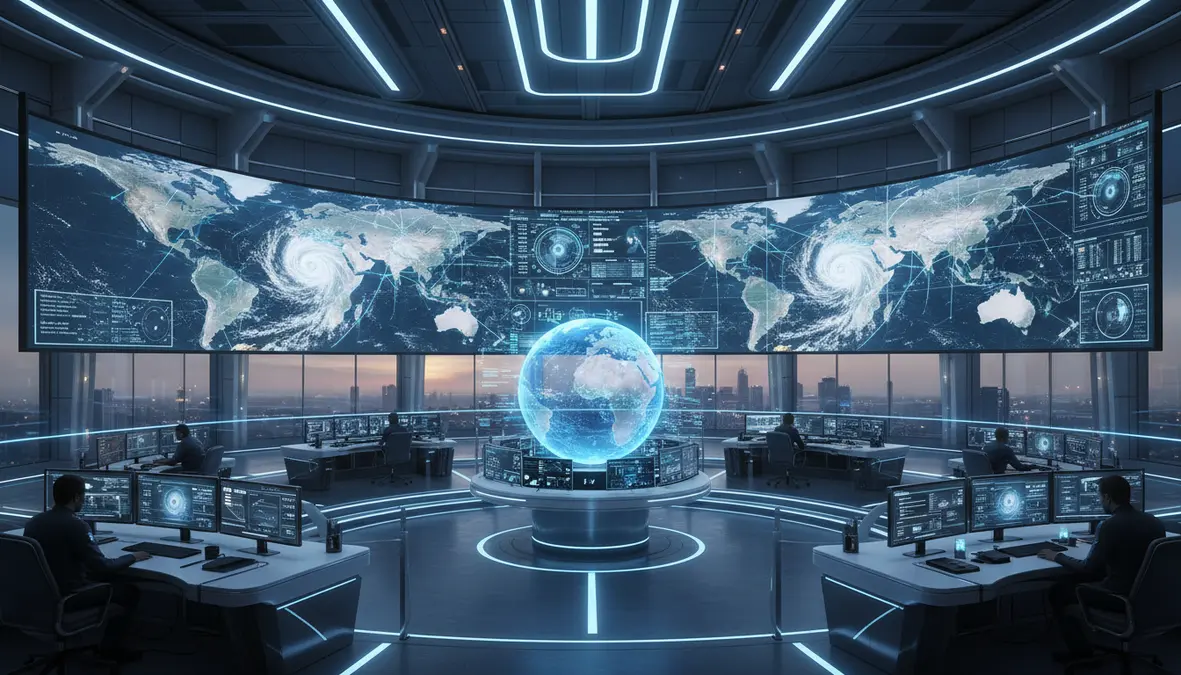
In January 2026, Google DeepMind's GenCast model issued a 10-day forecast for an unusual polar vortex disruption over North America that defied every traditional numerical weather prediction (NWP) system — and got it right. The AI model predicted the exact timing and geographic extent of the cold snap five days before the European Centre for Medium-Range Weather Forecasts (ECMWF) converged on the same solution. More remarkably, GenCast produced its forecast in under eight minutes on a single TPU cluster, while the ECMWF's Integrated Forecasting System required four hours on a 19,000-core supercomputer. Welcome to the new era of weather prediction — where neural networks trained on decades of atmospheric data are outperforming the physics-based models that meteorology has relied on for sixty years.
The End of the Supercomputer Monopoly
For decades, weather forecasting has been synonymous with numerical weather prediction (NWP) — the practice of solving the Navier-Stokes equations and thermodynamic conservation laws across a three-dimensional grid of the atmosphere. NWP models like the ECMWF's IFS, NOAA's GFS, and the UK Met Office's Unified Model ingest millions of observations from satellites, weather stations, radiosondes, and ocean buoys, then simulate the atmosphere forward in time using brute-force computation. The results have been impressive: forecast accuracy has improved by roughly one day per decade since the 1980s, meaning today's 5-day forecast is as accurate as a 3-day forecast was twenty years ago.
But NWP has hit diminishing returns. The computational cost of increasing resolution is brutal — doubling horizontal resolution requires roughly ten times the computing power. Running ensemble forecasts (multiple simulations with slightly perturbed initial conditions to estimate uncertainty) multiplies that cost further. And despite decades of refinement, certain phenomena — convective storms, atmospheric rivers, sudden stratospheric warmings — remain stubbornly difficult for physics-based models to capture accurately.
Enter AI weather models. Starting with Huawei's Pangu-Weather in 2023 and accelerating through Google DeepMind's GraphCast and GenCast, NVIDIA's FourCastNet, and the ECMWF's own AIFS (Artificial Intelligence Forecasting System), a new generation of machine learning models has demonstrated that neural networks trained on 40+ years of reanalysis data can match or exceed the accuracy of the world's best NWP systems — at a fraction of the computational cost.
1,000x Faster
AI weather models generate 10-day global forecasts in minutes on a single GPU or TPU, compared to hours on supercomputers with thousands of cores for traditional NWP systems.
Superior Accuracy
GenCast outperforms the ECMWF's operational ensemble on 97% of targets beyond 36 hours, with the advantage growing at longer lead times where chaos amplifies NWP errors.
Democratized Access
Countries and organizations that could never afford billion-dollar supercomputers can now run world-class weather prediction on cloud infrastructure costing a few dollars per forecast.
The Leading AI Weather Models in 2026
The AI weather forecasting landscape has evolved rapidly. What began as academic experiments has matured into operational systems that national meteorological agencies are integrating into their daily workflows.
| Model | Developer | Architecture | Key Strength |
|---|---|---|---|
| GenCast | Google DeepMind | Diffusion model on icosahedral mesh | Probabilistic ensemble forecasting, extreme event detection |
| GraphCast | Google DeepMind | Graph neural network | Deterministic 10-day forecasts, tropical cyclone tracking |
| AIFS | ECMWF | Graph transformer encoder-decoder | Operational integration with existing NWP infrastructure |
| Earth-2 / CorrDiff | NVIDIA | Diffusion-based super-resolution | Km-scale downscaling, regional hazard modeling |
| Pangu-Weather | Huawei | 3D Vision Transformer | First AI model to outperform NWP on key metrics |
| Aurora | Microsoft Research | Foundation model (flexible resolution) | Atmospheric chemistry, air quality prediction |
How AI Weather Models Actually Work
Traditional NWP solves physics equations forward in time. AI weather models take a fundamentally different approach: they learn the mapping from the current atmospheric state to future states directly from historical data, without explicitly encoding the governing equations. The training data typically comes from ERA5, the ECMWF's global atmospheric reanalysis dataset, which provides consistent gridded fields of temperature, pressure, humidity, wind, and dozens of other variables at 0.25-degree resolution (roughly 25 km) from 1979 to the present.
Training on Four Decades of Weather
Models like GenCast are trained on pairs of atmospheric states: given the state at time T, predict the state at time T+6 hours. During training, the model processes hundreds of thousands of these input-output pairs, learning the complex nonlinear dynamics that govern atmospheric evolution — jet stream propagation, cyclone intensification, convective triggering, frontal passage, and more. The resulting neural network encodes an implicit "physics" that often captures phenomena traditional models struggle with, particularly at longer lead times where small errors compound chaotically.
Probabilistic Forecasting with Diffusion Models
GenCast's breakthrough innovation is using diffusion models — the same architecture behind image generators like DALL-E and Stable Diffusion — for probabilistic weather prediction. Instead of producing a single deterministic forecast, GenCast generates an ensemble of plausible future atmospheric states by sampling from a learned probability distribution. Each sample represents a physically consistent scenario, and the spread across samples naturally quantifies forecast uncertainty — critical information for decision-makers in emergency management, aviation, and energy.
"We're not replacing physics — we're learning physics from data at a scale and speed that numerical models cannot match. The atmosphere has been running its own experiment for billions of years. We just learned to read the results."
Real-World Impact: Who Benefits and How
The shift from NWP to AI-augmented forecasting is already transforming industries that depend on accurate weather prediction:
- Disaster Preparedness: AI ensemble models provide earlier and more precise warnings for hurricanes, floods, and heat waves. During the 2025 Atlantic hurricane season, GenCast predicted the rapid intensification of Hurricane Melissa 48 hours before NWP models, giving coastal communities an extra two days for evacuation planning.
- Renewable Energy: Solar and wind energy output is inherently weather-dependent. AI forecasts with 15-day skill enable grid operators to optimize storage dispatch, schedule maintenance windows, and reduce curtailment — saving an estimated $3.2 billion annually across European energy markets alone.
- Agriculture: Precision agriculture platforms integrate AI weather forecasts to optimize irrigation scheduling, frost protection, and harvest timing. Farmers in India's monsoon regions now access GenCast-powered advisories via mobile apps that predict onset dates with unprecedented accuracy.
- Aviation: AI turbulence prediction models running on NVIDIA Earth-2 reduce clear-air turbulence encounters by 40%, improving passenger safety and reducing flight diversions that cost airlines $200 million annually.
- Insurance and Finance: Catastrophe modeling firms are integrating AI weather ensembles into their risk models, enabling more accurate pricing of weather derivatives and parametric insurance products that protect vulnerable communities.
Challenges and the Hybrid Future
Despite their remarkable performance, AI weather models face real limitations that the meteorological community is actively working to address:
Data Dependency
AI models are only as good as their training data. They struggle with unprecedented weather patterns — events outside the distribution of the 1979–2025 training period — which is precisely what climate change is producing more frequently. Researchers are developing physics-informed neural networks that embed conservation laws as architectural constraints to improve generalization.
Resolution Gaps
Current global AI models operate at 25 km resolution — excellent for synoptic-scale patterns but too coarse for thunderstorms, sea breezes, and urban heat islands. NVIDIA's CorrDiff addresses this with AI-powered super-resolution that downscales global forecasts to 2 km, but kilometer-scale native AI models remain an active research frontier.
The consensus emerging in 2026 is that the future is hybrid. The ECMWF's strategy is illustrative: its AIFS model runs alongside the traditional IFS, with forecasters and automated systems blending both outputs. NWP retains advantages in data assimilation — the process of ingesting raw observations into a physically consistent atmospheric state — while AI excels at the forecast step itself. The most powerful systems will combine physics-based data assimilation with AI-driven prediction, marrying the interpretability and physical constraints of NWP with the speed and pattern recognition of machine learning.
Looking Ahead: The Weather Foundation Model Era
The next frontier is weather foundation models — large, general-purpose AI systems trained on multimodal earth observation data (satellite imagery, radar, ocean sensors, atmospheric chemistry) that can be fine-tuned for any weather or climate task. Microsoft's Aurora model, released in late 2025, is the first example: a single foundation model that handles global weather forecasting, air quality prediction, and ocean state estimation.
By 2028, meteorologists expect AI models to extend skillful forecasting from 10–15 days to 3–4 weeks — entering the "subseasonal" regime that has been called the "predictability desert" for its resistance to both NWP and statistical methods. Achieving this would be transformative for agriculture, water management, and public health planning across the developing world.
The weather prediction revolution of 2026 is not just a story about better forecasts. It is a story about the democratization of a capability that was once the exclusive domain of wealthy nations with billion-dollar supercomputers. When a smartphone can access a forecast more accurate than what the world's best meteorological center could produce five years ago, the implications for global equity, disaster resilience, and climate adaptation are profound. The atmosphere does not respect borders — and now, neither does the technology to understand it.