Digital Twins: How Virtual Replicas and Industrial IoT Are Transforming Smart Infrastructure in 2026
- Internet Pros Team
- April 2, 2026
- AI & Technology
In January 2026, engineers at the Port of Rotterdam detected — and prevented — a catastrophic crane failure 72 hours before it would have occurred. No human inspector flagged the issue. Instead, a digital twin — a real-time virtual replica of the port's entire crane fleet, fed by 12,000 IoT sensors streaming vibration, load, temperature, and structural stress data every second — identified a micro-fracture propagation pattern in a critical boom joint that no scheduled inspection would have caught. The repair cost €40,000. The failure would have cost €12 million and shut down Europe's largest port for weeks. This is digital twin technology in 2026: not a visualization gimmick, but an operational nervous system for the physical world.
What Are Digital Twins?
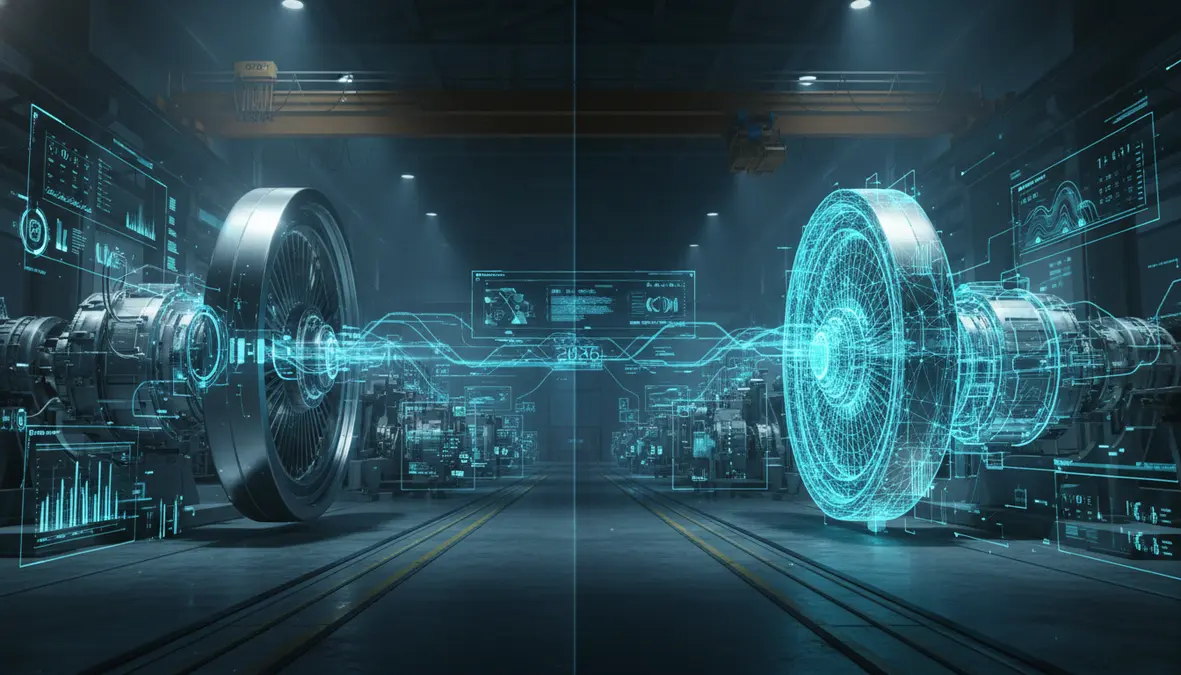
A digital twin is a continuously synchronized virtual representation of a physical asset, process, or system. Unlike a static 3D model or a one-time simulation, a digital twin lives and breathes — constantly updated with real-time data from IoT sensors, SCADA systems, ERP platforms, and edge computing nodes embedded in the physical counterpart. It mirrors the current state of its physical twin with sub-second latency, enabling engineers, operators, and AI agents to monitor performance, simulate what-if scenarios, predict failures, and optimize operations without touching the physical system.
The concept originated at NASA in the early 2000s — mission engineers built virtual replicas of spacecraft to diagnose problems from millions of miles away. But in 2026, digital twins have moved far beyond aerospace. They now underpin smart factories, city-wide infrastructure networks, power grids, hospital operating rooms, and global supply chains, driven by three converging forces: the explosion of low-cost Industrial IoT sensors, the maturity of cloud-native simulation platforms, and the integration of AI and machine learning models that can learn from — and reason about — twin data at scale.
| Platform | Provider | Key Capability (2026) | Primary Use Case |
|---|---|---|---|
| Siemens Xcelerator | Siemens | Full lifecycle digital twin from design through decommission with physics-based simulation | Manufacturing & industrial automation |
| NVIDIA Omniverse | NVIDIA | Photorealistic 3D simulation with GPU-accelerated physics and generative AI agents | Warehouse robotics & autonomous systems |
| Azure Digital Twins | Microsoft | Enterprise-scale graph-based twin modeling with Copilot AI integration | Smart buildings & smart cities |
| AWS IoT TwinMaker | Amazon | Composable digital twins connecting IoT, video, and 3D data with SageMaker ML models | Supply chain & logistics |
| Ansys Twin Builder | Ansys | Reduced-order physics models enabling real-time twin simulation on edge hardware | Aerospace & energy systems |
| Bentley iTwin | Bentley Systems | Infrastructure digital twins integrating BIM, GIS, and reality mesh data | Civil infrastructure & utilities |
The Industrial IoT Foundation
Digital twins are only as good as the data that feeds them, and in 2026, that data foundation is Industrial IoT at unprecedented scale. The number of connected industrial sensors worldwide has surpassed 28 billion, with the average smart factory deploying over 5,000 sensors per production line. These sensors measure everything from vibration frequency and thermal gradients to acoustic emissions, chemical composition, humidity, and electromagnetic interference — streaming data at rates that would have overwhelmed cloud infrastructure five years ago.
What has changed is the edge-cloud architecture that processes this data. Rather than shipping raw sensor streams to centralized cloud servers, modern digital twin platforms deploy edge computing nodes — small, ruggedized servers installed on the factory floor, in the wind turbine nacelle, or on the building rooftop — that pre-process, filter, and compress data locally. Only anomalies, aggregates, and model-relevant features are transmitted to the cloud twin, reducing bandwidth requirements by 90% while maintaining real-time synchronization. Companies like Litmus, Crosser, and Siemens Industrial Edge provide the middleware that bridges the gap between legacy OT (operational technology) protocols like Modbus and OPC UA and modern cloud-native twin platforms.
Predictive Maintenance
Digital twins analyze vibration patterns, thermal cycles, and wear indicators to predict equipment failures days or weeks in advance. BMW's Regensburg plant reduced unplanned downtime by 37% in 2025 using Siemens digital twins that model every robotic welding arm in real time.
Simulation-Driven Design
Engineers test thousands of design variations against real-world operating conditions inside the digital twin before committing to physical prototypes. Rolls-Royce's jet engine twins simulate 10 years of flight cycles in 48 hours, catching fatigue points that would take years of physical testing.
Autonomous Operations
AI agents trained inside digital twins are now directly controlling physical systems. Amazon's warehouse twins in NVIDIA Omniverse train robot fleets in simulation, then deploy optimized behaviors to physical robots — reducing pick-and-place cycle times by 22%.
Smart Cities and Infrastructure Twins
Beyond the factory floor, digital twins are scaling to entire cities. Singapore's Virtual Singapore platform — the world's most comprehensive urban digital twin — now models every building, road, utility line, and green space in the city-state at centimeter-level accuracy, integrating live data from traffic sensors, air quality monitors, energy meters, and public transit systems. Urban planners use it to simulate the impact of new construction on wind corridors, shadow patterns, and pedestrian flow before breaking ground.
In 2026, the cities of Helsinki, Shanghai, Dubai, and Las Vegas are deploying similar platforms. Helsinki's Kalasatama district uses a Bentley iTwin-powered infrastructure twin that connects building management systems across 40 commercial properties, optimizing HVAC, lighting, and elevator operations collectively to reduce district-wide energy consumption by 19%. Dubai's Roads and Transport Authority runs a traffic digital twin processing data from 15,000 cameras and 8,000 road sensors, using reinforcement learning models to dynamically adjust signal timing and reduce peak-hour congestion by 14%.
Healthcare and Energy: The Next Frontiers
Healthcare is emerging as a high-impact domain for digital twins. Philips and Siemens Healthineers are building patient digital twins — virtual physiological models that integrate a patient's imaging data, lab results, genomic profile, and real-time wearable sensor feeds to simulate treatment responses before administering them. Cardiologists at the Cleveland Clinic are using heart digital twins to simulate the hemodynamic impact of valve replacement surgeries, selecting the optimal prosthesis size and placement in silico and reducing surgical revision rates by 28%.
In energy, digital twins are becoming indispensable for managing the complexity of renewable grids. GE Vernova's wind farm digital twins model every turbine's aerodynamic behavior, wake interference patterns, and gearbox health in real time, increasing fleet energy output by 5-8% through AI-optimized yaw and pitch adjustments. National Grid in the UK operates a digital twin of the entire British electricity transmission network, using it to simulate cascading failure scenarios and plan resilience measures against extreme weather events — a capability that proved critical during the January 2026 polar vortex that stressed European power systems.
"The digital twin is becoming the fundamental operating system for physical infrastructure. Every asset that matters — every turbine, every building, every patient, every city block — will have a living virtual counterpart within the decade. The companies and governments that build this capability now will have a permanent information advantage over those that don't."
Challenges and the Road Ahead
Despite the momentum, significant challenges remain. Interoperability is the biggest barrier — most digital twin platforms use proprietary data models, making it difficult to connect twins built on different stacks. The Digital Twin Consortium and ISO/IEC are working on standardized ontologies and APIs, but enterprise adoption of these standards remains fragmented. Data security is another concern: a digital twin that faithfully replicates a power grid or hospital network is also a high-value target for cyberattackers, requiring zero-trust architectures and encrypted twin-to-physical communication channels.
Cost remains a factor for smaller organizations. While cloud platforms have reduced infrastructure costs, building an accurate physics-based digital twin still requires specialized engineering talent, high-fidelity sensor instrumentation, and months of calibration. Companies like Altair and Ansys are addressing this with AI-assisted twin generation tools that can build approximate twins from historical data alone, reducing deployment timelines from months to weeks.
What to Expect: 2026-2030
- 2026-2027: Generative AI integration becomes standard — engineers describe desired twin behaviors in natural language, and AI agents build the simulation logic, sensor mappings, and anomaly detection models automatically.
- 2027-2028: Federated digital twins emerge, connecting city-scale infrastructure twins across jurisdictions to enable regional disaster response simulation and cross-border supply chain optimization.
- 2028-2029: Patient digital twins reach clinical adoption for oncology treatment planning, with virtual tumor models predicting chemotherapy response with over 85% accuracy.
- 2030 and beyond: Planetary-scale digital twins integrating satellite imagery, ocean sensor networks, and atmospheric models enable real-time climate simulation for policy planning.
Digital twins have crossed the threshold from experimental technology to operational necessity. In manufacturing, they are preventing failures and optimizing throughput. In cities, they are reducing energy waste and improving livability. In healthcare, they are personalizing treatment and saving lives. The convergence of cheap IoT sensors, powerful cloud simulation, and AI reasoning means that the gap between the physical world and its digital mirror is closing fast — and the organizations that harness this convergence will define the next era of intelligent infrastructure.