Green Hydrogen Electrolyzers in 2026: How Electric Hydrogen, Plug Power, Nel, ITM Power, Thyssenkrupp Nucera, and Topsoe Are Scaling PEM, Alkaline, and Solid-Oxide Stacks to Gigawatt Production
- Internet Pros Team
- June 6, 2026
- AI & Technology
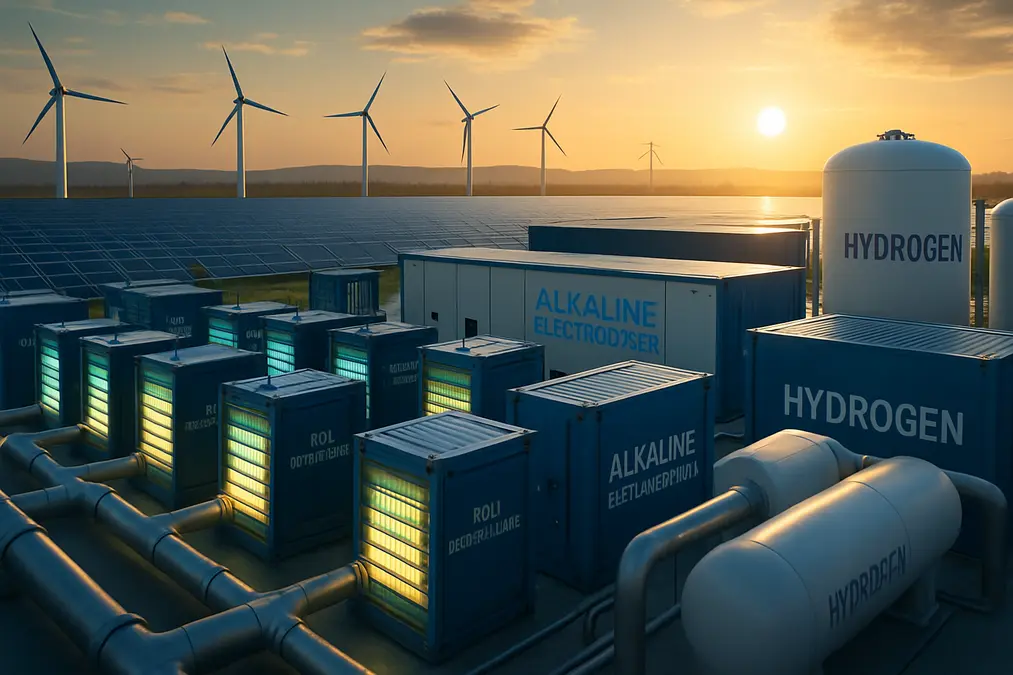
For two decades, "green hydrogen" was a slide in every clean-energy keynote and a product in almost none of them. Splitting water with renewable electricity worked in the lab; it just cost too much to matter. In 2026 that gap is finally closing. Electric Hydrogen is shipping 100-megawatt containerized PEM plants. Plug Power, Nel, ITM Power, and Thyssenkrupp Nucera are running gigawatt-scale factories. And Topsoe and Sunfire are commercializing high-temperature solid-oxide stacks that squeeze more hydrogen out of every kilowatt-hour. The electrolyzer — the box that turns electricity and water into fuel — has become the pivotal piece of industrial decarbonization.
What an Electrolyzer Actually Does
An electrolyzer runs a fuel cell in reverse. Feed it water and direct-current electricity, and it splits H2O into hydrogen and oxygen across a pair of electrodes separated by an ion-conducting membrane or electrolyte. When that electricity comes from solar or wind, the resulting hydrogen carries near-zero lifecycle carbon — hence "green." Burn it, run it through a fuel cell, or react it chemically, and the only byproduct is water.
The reason this matters is that roughly a fifth of global emissions come from sectors electricity cannot reach directly: steelmaking, ammonia and fertilizer, oil refining, cement, and heavy transport. You cannot plug a blast furnace into a battery. But you can feed it green hydrogen. The electrolyzer is the bridge between cheap renewable electrons and the molecules heavy industry actually consumes.
"The question stopped being whether electrolysis works — it has worked since 1800. The question is whether you can manufacture a stack cheaply enough, run it on intermittent renewable power, and still land hydrogen under two dollars a kilogram. That is a factory problem and a power-contract problem, not a chemistry problem."
The Three Electrolyzer Technologies — and Why It Is Not Winner-Take-All
Three architectures dominate the 2026 market, each with a distinct sweet spot rather than a single victor:
Alkaline (AWE)
The mature, cheapest-per-kilowatt option, using a liquid potassium-hydroxide electrolyte and nickel catalysts — no scarce precious metals. Ideal for large, steady-state plants. The workhorse of Thyssenkrupp Nucera, John Cockerill, and China's PERIC and Longi.
PEM
Proton-exchange-membrane stacks are compact, ramp in seconds, and pair beautifully with variable solar and wind. The catch is iridium and platinum catalysts. The bet of Electric Hydrogen, Plug Power, ITM Power, Siemens Energy Silyzer, and Ohmium.
Solid Oxide (SOEC)
High-temperature ceramic cells running at 700-850 °C reach the highest electrical efficiency — especially when waste industrial heat is available. The frontier of Topsoe, Sunfire, and Bloom Energy, best suited to steady chemical plants, not intermittent power.
Who Is Actually Building the Gigawatt Factory
| Company | Technology & Approach | 2026 Footprint |
|---|---|---|
| Electric Hydrogen (USA) | Vertically integrated PEM built around the HYPRPlant — a fully containerized 100 MW plant shipped as factory-built modules to slash on-site engineering and balance-of-plant cost. | Devens and San Jose manufacturing; one of the best-capitalized hydrogen startups, with module deliveries to industrial and ammonia customers and a focus on the lowest installed dollar-per-kilowatt in PEM. |
| Plug Power (USA) | The most vertically integrated player: PEM electrolyzers, liquefaction, fuel cells, and its own green-hydrogen molecules. Builds and operates production plants, not just hardware. | Rochester gigafactory plus operating liquid-hydrogen plants in Georgia, Tennessee, and Louisiana and a Texas facility — the largest installed electrolyzer base in North America, while managing a hard push to profitability. |
| Nel ASA (Norway) | One of the oldest names in the field, offering both alkaline and PEM so customers can match technology to load profile. | Automated alkaline manufacturing at Heroya, Norway and PEM at Wallingford, Connecticut, positioning for IRA-driven US demand. |
| ITM Power (UK) | PEM specialist with the high-throughput Bessemer factory in Sheffield and a sharpened focus on cost-per-megawatt after an operational reset. | One of Europe's largest PEM manufacturing footprints, supplying refinery, mobility, and grid-balancing projects across the UK and EU. |
| Thyssenkrupp Nucera (Germany) | Industrial-scale alkaline in standardized 20 MW scalum modules, leveraging decades of chlor-alkali engineering from Uhde Chlorine Engineers; investing in SOEC for the next wave. | Multi-gigawatt order book anchored by NEOM in Saudi Arabia — one of the largest green-hydrogen projects on Earth — plus European and Indian contracts. |
| Topsoe, Sunfire & Bloom Energy | The solid-oxide (SOEC) frontier, trading flexibility for the highest efficiency by running hot and exploiting industrial waste heat. | Topsoe's Herning, Denmark SOEC factory, Sunfire's Dresden lines, and Bloom's US stacks are targeting steel, ammonia, and e-fuel plants where steady high-temperature operation is the norm. |
The Economics: Why Two Dollars a Kilogram Is the Magic Number
Green hydrogen's cost breaks into three buckets: the electrolyzer capital cost, the price of electricity, and how many hours a year the plant actually runs (its capacity factor). Electricity typically dominates — which is why developers chase the cheapest renewable power on the planet and why an electrolyzer that can ramp with a solar curve is worth a premium.
A modern system consumes roughly 50 kilowatt-hours per kilogram of hydrogen. At today's costs, green hydrogen still lands well above the grey hydrogen made from natural gas. Closing that gap is the entire game, and three levers are doing it: factory-scale manufacturing dragging stack costs down, falling renewable electricity prices, and policy support — the US 45V production tax credit (up to $3/kg), the European Hydrogen Bank, India's National Green Hydrogen Mission, and the DOE's Hydrogen Shot target of $1 per kilogram.
The 2026 Reality Check
The sector is going through a hard, healthy correction. Order books are real, but many announced projects have slipped or been cancelled waiting on firm offtake contracts and final 45V rules. The lesson of 2026 is brutally practical:
- No offtake, no project. Electrolyzer capacity is not the bottleneck anymore — a creditworthy buyer willing to sign a long-term hydrogen contract is.
- Cheap, abundant renewable power is the real moat. The winning projects are co-located with the cheapest solar and wind on Earth, not with the best electrolyzer brochure.
- Policy certainty moves billions. Every ambiguity in 45V additionality rules or EU RFNBO definitions freezes final investment decisions.
Where the Hydrogen Actually Goes
The credible near-term demand is industrial, not the hydrogen cars of old hype cycles:
- Steel. Stegra (formerly H2 Green Steel) in Boden, Sweden is building hydrogen-based direct-reduced-iron production — replacing coking coal with green hydrogen to make near-zero-carbon steel.
- Ammonia and fertilizer. Green ammonia, made from green hydrogen, decarbonizes fertilizer and doubles as a shippable hydrogen carrier. NEOM in Saudi Arabia is the flagship.
- Refining and e-fuels. Refineries already consume enormous grey hydrogen; swapping in green hydrogen is one of the fastest decarbonization wins. The same molecules feed e-methanol and sustainable aviation fuel.
- Long-duration energy storage. Surplus summer solar can be stored as hydrogen in salt caverns and burned back in winter — the kind of seasonal balancing batteries cannot economically reach.
The Honest Limits
Iridium scarcity. PEM stacks depend on iridium, one of the rarest metals on Earth. Scaling PEM to hundreds of gigawatts demands dramatic reductions in iridium loading — an active and unsolved R&D race.
Efficiency losses stack up. Every conversion — electricity to hydrogen, hydrogen to ammonia or back to electricity — loses energy. Green hydrogen is precious; it belongs in sectors that have no better option, not in cars or home heating where batteries and heat pumps win outright.
Infrastructure barely exists. Pipelines, storage, and shipping for hydrogen are nascent. Most 2026 projects are forced to co-locate production and consumption because moving hydrogen any distance is still expensive and leaky.
What This Means for Energy, Industrial, and IT Leaders
- Match the technology to the load, not the hype. Steady industrial baseload favors alkaline or SOEC; intermittent renewable coupling favors PEM. Specifying the wrong architecture wastes both capital and capacity factor.
- Lock the power contract before the electrolyzer. Electricity is the dominant cost. A cheap, firm, genuinely additional renewable PPA matters more than any stack spec sheet.
- Treat the plant as a data problem. Modern electrolyzer plants live or die on SCADA, digital twins, and AI-driven predictive maintenance that maximize uptime and chase electricity-price signals hour by hour — a serious industrial-IT and OT-security workload.
- Underwrite the policy, not just the technology. 45V, the European Hydrogen Bank, and India's SIGHT incentives are the difference between a financeable project and a stranded one. Model the downside where the credit shrinks.
The Bottom Line
Green hydrogen in 2026 is past the demo phase and into the unglamorous, decisive work of manufacturing scale-up and project finance. Electric Hydrogen, Plug Power, Nel, ITM Power, Thyssenkrupp Nucera, Topsoe, and Sunfire are not betting on the same chemistry — PEM, alkaline, and solid-oxide each own a slice of the market — and that diversity is a sign of a maturing industry, not a confused one.
The technology works. The factories are built. What separates the projects that get financed from the ones that get cancelled is no longer the electrolyzer — it is cheap renewable power, a creditworthy offtaker, and policy that holds still long enough to sign a twenty-year contract. For any company in steel, chemicals, refining, shipping, or heavy industry, the strategic question for the rest of this decade is simple: which of your hard-to-electrify processes will run on green hydrogen, and have you secured the molecules before your competitors do?